


Some journeys are meant to be more than just a getaway; they are transformative experiences that alter perspectives and leave lasting impressions. For travel columnist Lee Tulloch, a recent trip to Greenland was one such journey. Known for her extensive travels, Tulloch rarely expects a trip to change her profoundly. However, her visit to the icy landscapes and close-knit communities of Greenland did just that.
Greenland, the world’s largest island, is witnessing a surge in tourism. The opening of a new airport in Nuuk, the capital, has increased the number of direct international flights, while cruise companies are adding Greenland to their itineraries. Despite these developments, Greenland remains a place of stark contrasts and profound lessons.
Greenland’s Geopolitical Significance
The island has been in the news not just for its tourism boom but also for its geopolitical significance. As a self-governing territory under Denmark, Greenland’s relationship with its governing nation is complex. The United States has shown interest in Greenland due to its strategic airspace and the potential for petroleum and rare minerals, which are becoming more accessible as ice melts due to climate change.
According to NASA scientists, Greenland’s outlet glaciers are melting six or seven times faster today than they were 25 years ago.
This rapid melting of glaciers is both a draw for tourists and a threat to the traditional way of life for Greenlanders. The sight of majestic icebergs breaking off glaciers is awe-inspiring for visitors, but for the locals, it signifies a loss of their natural environment and a challenge to their existence.
A Journey to the Far North
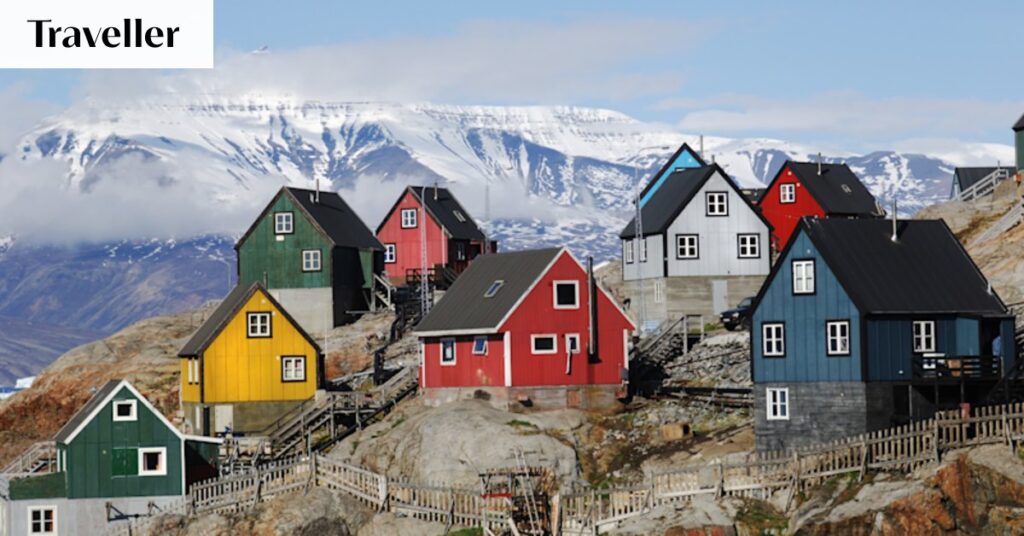
Tulloch’s journey took her to Greenland’s far north with HX Expeditions aboard the Roald Amundsen. She traveled as far as Siorapaluk, the northernmost inhabited settlement in Greenland and the world’s most northerly Inuit community. With a population of just 34, Siorapaluk offers a glimpse into a way of life that has remained largely unchanged for centuries.
Onboard were Greenlanders from various settlements, including Aleqatsiaq Peary, a hunter and cultural ambassador for HX Expeditions. Peary facilitated visits to local communities, where travelers could participate in home visits and witness traditional practices such as seal skinning.
Lessons in Sufficiency
What Tulloch discovered was a deeply poetic people who choose to live as their ancestors did. This means enduring long winters hunting seal, walrus, and polar bear, using every part of the animal for food, tools, and clothing. Despite the availability of modern conveniences like snowmobiles, traditional hand-hewn weapons made from animal bones remain the most reliable.
Greenlanders exemplify a life of sufficiency, taking only what they need from their harsh environment. This stands in stark contrast to a global movement toward “abundance,” which advocates for more of everything—housing, energy, infrastructure. The Greenlanders’ approach offers a powerful lesson in contentment and sustainability.
“They’re happy in a world that seems impossibly harsh to someone from the West. They use everything nature makes available and little more.”
Reflections on Materialism
Tulloch’s experience in Greenland prompted her to reflect on the materialism prevalent in Western societies. The simplicity and sufficiency she observed made her question the emphasis on acquiring goods and status back home. The realization that happiness does not necessarily come from material wealth was a transformative insight.
As Tulloch returned home, she felt a renewed appreciation for the things she had and a desire to focus less on material possessions. The trip to Greenland served as a poignant reminder of the value of sufficiency and the potential for travel to change perspectives.
Wishing everyone some similar travel transformations in 2026.
The writer was the guest of HX Expeditions. See www.travelhx.com/en-au for more information.