




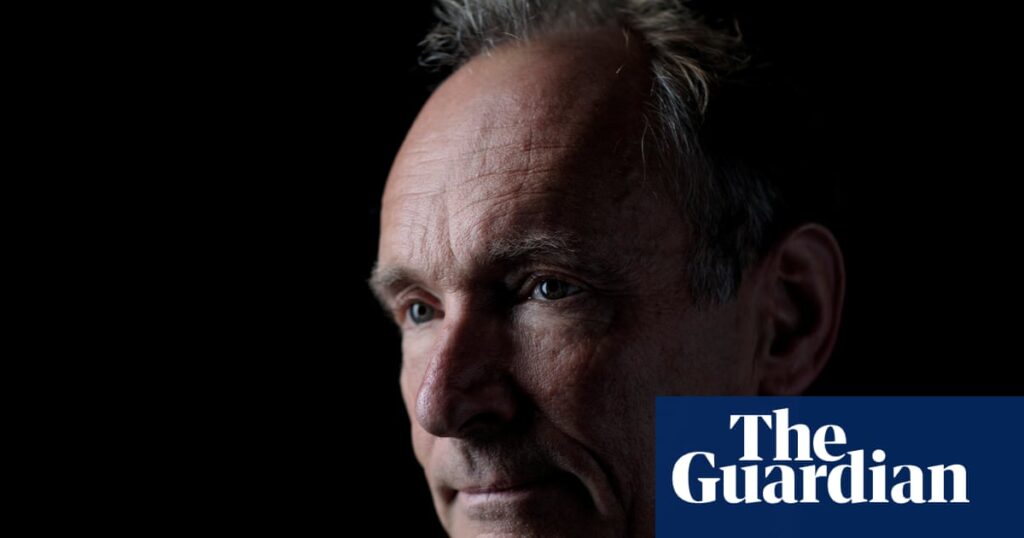
When Sir Tim Berners-Lee invented the World Wide Web in 1989, he envisioned a platform accessible to everyone, rich with diverse content, and crucially, free for all. Today, this groundbreaking creation is utilized by 5.5 billion people worldwide, yet it has diverged significantly from the democratic tool for humanity that Berners-Lee initially imagined.
Currently in Australia to promote his book, This is for Everyone, Berners-Lee is reflecting on the current state of his invention and how he, along with a community of collaborators, aims to restore the power of the web to its users. He describes his early excitement about the web as “uncontainable,” but nearly 40 years later, he finds himself in a “battle for the soul of the web.”
Technology’s Unintended Path
Berners-Lee traces the first signs of the web’s corruption to the commercialization of the domain name system. He argues that the system would have better served users had it been managed by a nonprofit organization focused on public interest. Instead, the .com domain was quickly seized by what he describes as “charlatans” in the 1990s.
“The Americans were very keen about commercializing the internet,” Berners-Lee told Guardian Australia from Brisbane. The pursuit of profit soon became a dominant force in the web’s design. However, it wasn’t until the 2016 U.S. elections that Berners-Lee realized the extent of the web’s potential for harm, a realization that left him “devastated” by the abuses he witnessed.
“We can fix the internet … It’s not too late,” Berners-Lee writes, underscoring his mission.
The Web’s Dark Corners
For 35 years, Berners-Lee has maintained what he considers the world’s first blog. A post from June 2024 features a detailed map of “everything on the internet,” highlighting both its benefits and its darker sides. While the web offers tools for communication, creativity, and digital sovereignty, a section of the map marked in red includes platforms like X, Snapchat, and YouTube, which Berners-Lee criticizes for fostering addiction, polarization, and disinformation.
“It’s only a small part of the whole internet,” he notes, “but the problem is that people spend a lot of time on [social media websites] because they’re addictive.”
Berners-Lee challenges the notion that technology is neutral, arguing that the design of websites can significantly influence user behavior. “The way you design a website, like Reddit or Pinterest or Snapchat, can be explicitly good,” he explains. Conversely, prioritizing engagement can lead to harmful algorithms.
Reimagining Data Ownership
Compounding the issue is the monopolization of the web by giants like Facebook and Google, which Berners-Lee believes stifles innovation and hinders the development of truly pro-human systems. In response, he has dedicated himself to the Solid (social linked data) protocol, a project aimed at fundamentally changing how data is stored on the web, empowering users with personal sovereignty.
Solid “pods” are described as secure data backpacks, allowing individuals to control what information they share and with whom. This approach is already being adopted by the Flanders government in Belgium, treating data as a national utility.
“The existing systems will fade to a certain extent, because people will get more excited in new systems,” Berners-Lee predicts.
The AI Conundrum
While Berners-Lee is optimistic about reclaiming the web, his outlook on artificial intelligence is more cautious. He acknowledges AI’s potential to transform society but stresses the need for guardrails to ensure it remains a force for good. “The horse is bolting,” he warns, referring to AI’s unchecked development.
Berners-Lee envisions a collaborative approach to AI development, akin to Cern’s scientific model. However, he laments the current state of AI research, which is dominated by large companies working in silos without external oversight.
“I don’t see a way that we can get to a point where the scientific community gets to look at the AI and to decide whether it is safe or not,” he says.
Sir Tim Berners-Lee will be speaking at the Brisbane Powerhouse on Thursday, January 29, and the Sydney Opera House on Friday, January 30. The headline of this story was amended on January 29, 2026, to clarify that Berners-Lee invented the World Wide Web, the service that runs on the internet infrastructure, not the internet itself.