


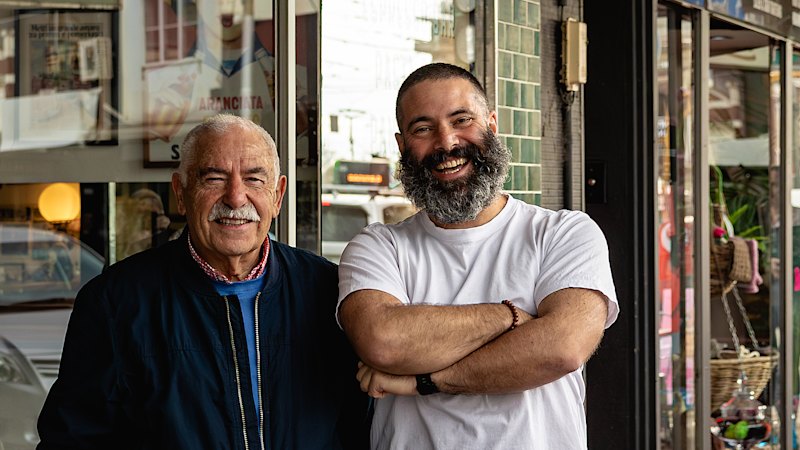
It’s no surprise to Marco Finanzio that some visitors to his Thornbury pasta and coffee bar, Umberto, say it has a Pellegrini’s vibe. “My parents took us there regularly to eat with Sisto, Rocco and his wife, Maria, in the back room,” says Finanzio, referring to Melbourne-Italian hospitality royalty, the late Sisto Malaspina and his co-proprietor of four-plus decades, Rocco Elice.
Finanzio grew up breathing the aroma of espresso and cigarette smoke at the buzzing Italian social clubs of Thornbury, where his Calabrian-immigrant dad, Umberto, took him and his brother as kids. While Umberto played cards with his mates, the boys played pinball and drank cappuccinos. “Secondary smoke and too many Fantas before a quick trip to the TAB was a normal Saturday,” he says.
Like the formerly working-class suburb of Thornbury, his childhood was infused with the energy, food culture, and cafe conviviality of the vast wave of Southern European migrants who settled there after World War II. The young Finanzios went on their dad’s rounds as a sales rep for coffee and espresso machines, visiting the inner sanctums of classic Melbourne venues, “delivering coffee all over Melbourne, from the Jewish cake shops in Acland Street to the cafes of Lygon and Brunswick street.”
The Historical Roots of Thornbury
Ironically, Thornbury’s first housing boom was also triggered by its good transport connections to the CBD, seven kilometres away. Having been originally surveyed on the lands of traditional owners the Wurundjeri Woi-wurrung people as part of Robert Hoddle’s 1837 Melbourne grid, it only really took off in Melbourne’s land boom of the 1880s. This was triggered when it became apparent the railway from Collingwood to Whittlesea would pass through, via Preston.
The Darebin Libraries’ history of Thornbury dates the opening of the railway to 1889 and states that a cable tramway opened in 1890, running the length of High Street, from Northcote to the Preston border. Settlement was sparse until 1904, when a direct train line from the city to Thornbury was linked by railway to Clifton Hill, establishing a faster route to Melbourne. Its proximity to town is high on the list of features fueling the Thornbury development debate now.
A Cultural Melting Pot
One thing on which there appears to be consensus is that as younger people – possibly priced out of “more influencery” Northcote – had joined its older-generation residents, fueling its day and night-life, the lifestyle on offer in Thornbury seems firmly in what Patto calls its “great” era. Locals and visitors rave about its music, drinking, and dining options in venues that sit alongside the remaining, old-school southern European clubs.
A key feature and pole-star in the suburb’s socio-cultural map is their much-loved boutique cinema, the Thornbury Picture House. It is the result of the visionary transformation of a 1920s garage into a seven-nights-a-week movie screening venue by Melbourne filmmaker Gus Berger, with his wife, Lou, a movie-music supervisor.
“People are fiercely loyal in the area, and it definitely helps from a programming perspective that we can really push the envelope with our films, and show films that challenge people to think differently,” says Berger, who offers special rates for community screenings to support local groups.
Music documentaries, in particular, are popular here. A look at Melbourne’s gig guides confirms that as traditional music hot-spots, such as St Kilda, struggle to reboot a live scene that once drew people from all over town, Thornbury residents have reason to be proud of their vital culture scene. (Time Out also named High Street the “coolest street in the world” in 2024.)
Thornbury’s Economic and Cultural Revival
The rejuvenated Thornbury Theatre is a thriving performance hub, as is the pumping Croxton Park Hotel (The Croc) – the fabled home to legendary performances from a roll-call of Australia’s rock music giants, as well as visiting big names and bleeding-edge indie acts. Both venues regularly attract southsiders who deign to travel the whole length of Punt Road to get there, as does one of the city’s original – and most popular – craft beer outlets, Ben Carwyn’s eponymous Carwyn Cellars.
Carwyn Cellars’ success is another testament to the power of loyal residents to make new ventures they feel are worthy of embrace into institutions. “This is an area that is very community-minded anyway, and we became a bit of a hub for it,” says Carwyn, who opened his original, beer-niche bottle shop with wife Nicole in High Street in 2007.
“Northcote lost a little bit of its soul for a while there, but I don’t think we have,” he says. “And I don’t think we will.”
Perhaps what appears to be a living connection between Thornbury past and present helps underpin what feels to the visitor like actual Thornbury pride. The hip new pizza-by-the-slice joint Porco Ciccio embodies this unbroken line. Co-proprietor Julian Mancuso cut his hospo teeth working for Marco Finanzio and Umberto – his own dad, a stainless-steel fabricator, built many of the original commercial kitchens of Thornbury.
Porco is housed in the original High Street shopfront used by Umberto’s, after its popularity recently propelled it across the road to a bigger venue formerly occupied by the 100-year-old Arthur’s Shoes. Mancuso and his business partner built up their following by turning their refurbishment into Instagram stories, and since it opened late last year, every day their pizza sells out. For him, the Italian heritage of the area is very much alive.
“There’s still a good mixture of old Italians and new young Italian families making their way into the area; I see nonnas walking past in the street every day,” he says. Right on cue, an impeccably black-clad elder ambles by. Just across the road, Umberto and Marco Finanzio are both also to be found most days, offering heartfelt hospitality in the old, Italian style.
“We are genuine. Not snobs … Not hipster but welcoming to everyone with warm and friendly service,” says Umberto. “We are a part of their lives, and they are a part of ours. Hospitality is all about the people and human connection. The food and wine is a disguise.”
The ongoing debate over Thornbury’s development reflects a broader struggle between maintaining cultural heritage and embracing modern growth. As high-rise developments loom, the community’s commitment to preserving its unique identity remains steadfast, ensuring that Thornbury’s soul continues to thrive.