

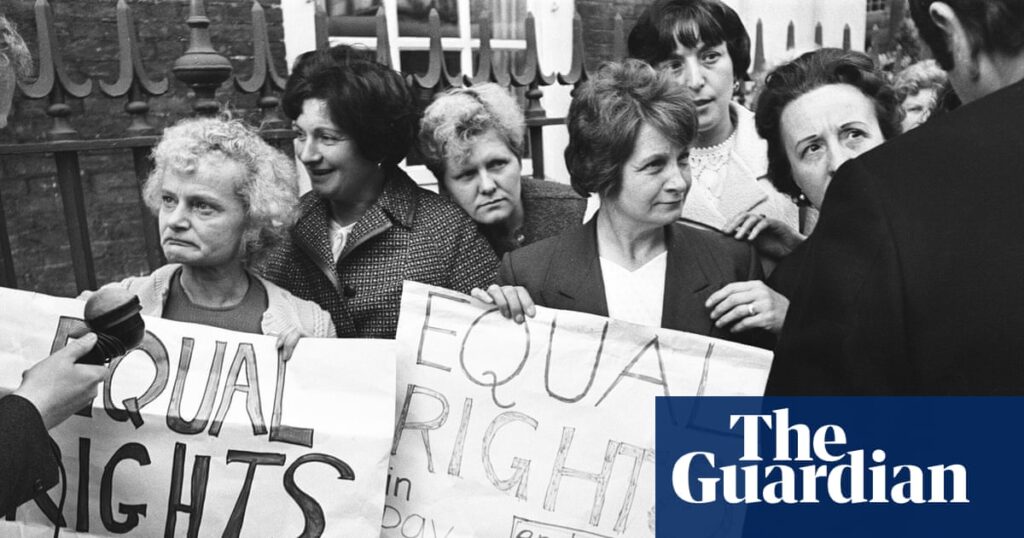
Celia Brayfield was working at her desk in the Femail section of the Daily Mail’s Fleet Street office when an editor called her over. It was July, and Wimbledon had just begun. “He said: ‘We want you to go down and get into the women’s changing rooms and report on lesbian behaviour.’ One didn’t normally swear at that time, but I declined. That was the attitude then,” she recalled. This was the reality for female journalists like Brayfield in the late 1960s and early 70s, an era marked by rampant sexism.
Brayfield was part of a small group of female journalists navigating the male-dominated world of newspaper journalism. “We were dealing with everyday sexism on an unbelievable scale,” she said. “You learned to wear trousers or take the lift because if you took the stairs someone would try to look up your skirt. But then you couldn’t go to a lot of press conference venues in trousers. In the Savoy, for example, women in trousers weren’t allowed.”
The Fight Against Sexism in the Media
Today, Brayfield is an author and lecturer living in Dorset, but her journey began at 19 as an assistant to Shirley Conran, then women’s editor of the Observer. When Conran moved to the Daily Mail, Brayfield followed. “The Daily Mail was a very sexist organisation,” she said. “I can’t tell you how awful women’s pages were, except for Mary Stott’s at the Guardian. All the news of the women’s movement in America was flooding across the Atlantic, but editors were profoundly uninterested.”
Brayfield found her own way of reporting on the women’s liberation movement (WLM), as the resurgent feminism of those years was known. She would set up interviews with the movement’s big hitters and, when editors rejected them, offer them to the underground press. A piece on the radical feminist author Kate Millett was published by Frendz magazine, which Rosie Boycott co-edited before launching the women’s movement journal Spare Rib.
Women in Media: A Pressure Group for Change
Alongside Conran, Brayfield joined Women in Media, a pressure group established in 1970 to challenge sexism in the industry and beyond. Its activities, though largely forgotten, played a key role in the campaign to outlaw sex discrimination and enforce equal pay. One policy that especially riled them was the broadcasters’ refusal to let women read the news. The public would find this “unnatural,” the BBC executive Robin Scott told the Daily Mirror in 1972. “There’s always bad news about and it’s much easier for a man to deal with that.”
Fifty years on, such brazen sexism appears comically old-fashioned. Yet, the women who confronted it have often been the butt of jokes. While achievements such as equal pay and the establishment of women’s refuges are recognized, the movement that fought for them holds an uncertain status. Second-wave feminists, as this generation is known, have been derided as man-hating harridans or entitled princesses with unrealistic demands.
Historical Struggles for Equality
There had been a women’s movement pressing for employment rights since the 19th century when pioneering female trade unionists campaigned for safer conditions and higher wages. However, even after World War II, sexism was deeply ingrained in workplaces. Women were routinely paid less and denied promotions. When the House of Commons supported an amendment calling for equal pay for female teachers in 1944, Winston Churchill was so determined to block it that he made the next vote a vote of confidence in the wartime government.
In 1968, 187 sewing machinists at Ford’s Dagenham plant forced the issue. Their strike for equal pay became legendary, culminating in the Equal Pay Act of 1970. However, the act was a compromise, with a five-year gap before implementation and equal pay only for employees doing work deemed to be “the same or broadly the same” or of “equal value.” Women inside and outside parliament wanted to go further, faster.
Legislative Battles and Activism
On 7 March 1968, Labour backbencher Joyce Butler challenged Prime Minister Harold Wilson in the House of Commons, asking if he planned to mark the 50th anniversary of the 1918 women’s suffrage bill with a law against sex discrimination. Between 1968 and 1971, Butler tried four times to introduce an anti-discrimination bill. Meanwhile, activists mobilized, gathering signatures for a petition demanding a sex discrimination bill.
Women in Media, determined to push a bill through, formed the anti-discrimination bill action group (Adbag). Despite differences in opinion and strategy, the group’s efforts were relentless. When Labour won a majority, it quickly announced that sex discrimination would be outlawed. The NCCL produced a draft bill, and the details were argued over in and outside parliament.
The Legacy of the Sex Discrimination Act
The Sex Discrimination and Equal Pay Acts both came into force on 29 December 1975, along with the establishment of the Equal Opportunities Commission (EOC). With sex discrimination outlawed, it was now up to the commission and judges to oversee enforcement. Patricia Hewitt and Harriet Harman were immediately on the lookout for women with complaints strong enough to take to tribunals, setting precedents for future cases.
In 1977, Women in Media published a book about sexism in media, intended for use in women’s studies courses. Adbag evolved into the Feminist Legislation Action Group (Flag), continuing to lobby for change. Over time, the Equal Pay Act was amended to apply to “work of equal value,” and Women in Media was absorbed by the Fawcett Society.
In 2006, New Labour legislated to dissolve the EOC, replacing it with the Equality and Human Rights Commission. Earlier anti-discrimination laws were combined in the Equality Act of 2010. While feminists of the 1970s were later criticized for a narrow focus, many were active in broader campaigns, including those against deportation and for nationality law updates.
“These things are always a compromise,” says Patricia Hewitt. “By 1980 we were saying ‘there’s not enough in this act,’ but I think in 1975 we felt we’d done pretty well.”
Reflecting on the movement’s achievements, Brayfield states, “We were dealing with an enormous social injustice and an extremely resistant patriarchy or power structure that didn’t want to change. We really did set out to change our society and to make life better for our daughters, but it’s a fight you have to keep winning. There’s never any sitting back and saying ‘we’ve won’ because you never have.”