




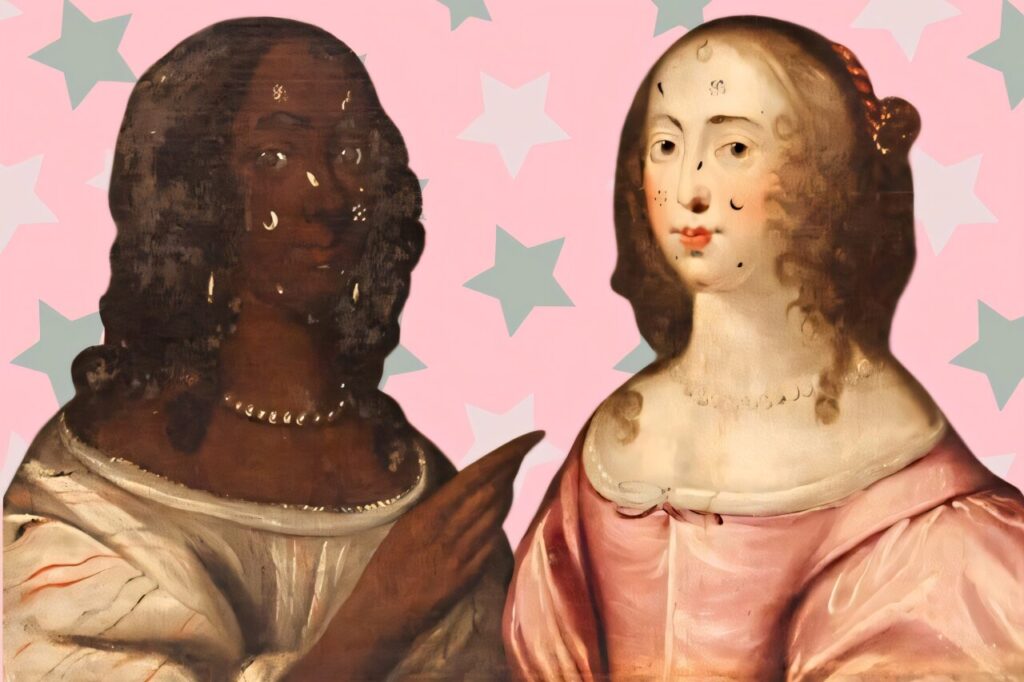
You may have noticed people out and about with little stickers on their faces. Perhaps you’ve seen moons, stars, clouds, or even smiley faces adorning people’s cheeks and chins. Maybe you wear them yourself. While some people do wear them as accessories, these colorful stickers are medicated “pimple patches,” designed to treat spots or acne.
Some of the patches simply contain a gel formula, which keeps the emerging blemish moist to aid healing. Others opt for near-transparent film patches to get the benefit in a more inconspicuous way. However, far from being a new fad, beauty patches have a long and storied history.
The Historical Roots of Beauty Patches
The trend of using beauty patches first took off in 17th-century Europe, with patches made from paper, silk, velvet, or even fine leather, cut into lozenge shapes, stars, or crescent moons. They could be made in many colors, but black was generally preferred as it made a stark contrast to the idealized pale face of western upper-class men and women. This complexion was seen as a status symbol, indicating that they did not work outdoors.
The play Blurt, Master-Constable from 1602 explains another appeal of the patches—when well applied, they could “draw men’s eyes to shoot glances at you.” Mentions of patches occur regularly in print from the late 16th and early 17th century, highlighting their dual function. In his 1601 play Jack Drum’s Entertainment, John Marston explains that:
“Black patches are worn, some for pride, some to stay the rheum, and some to hide the scab.”
Moral Critiques and Social Implications
While some wore patches to enhance their attractiveness, others—sometimes medicated—used them to dry up sores or conceal blemishes from diseases such as smallpox or syphilis. This latter use was the reason moralists took issue with patches. An anonymous book from 1665 claimed a chaplain of King Charles I had given a sermon comparing beauty patches to the biblical mark of Cain, suggesting they invited plague epidemics:
“black-patches and beauty-spots … were Forerunners of other Spots, and Marks of the Plague.”
Other moralists focused on how, like makeup, their job was to conceal and present a false front, which could trick admirers. This criticism gained traction into the 18th century, when people linked the use of patches to sexual promiscuity. William Hogarth’s series A Harlot’s Progress (1731) depicted the fall of a country girl, Moll Hackabout, tricked by the real-life brothel keeper Elizabeth Needham, whose face was covered with black patches.
Fashion and Function in the Restoration Era
Civil servant Samuel Pepys makes over a dozen mentions of these patches in his diary between 1660 and 1669. He first encountered “two very pretty ladies, very fashionable and with black patches, who very merrily sang all the way” on a business trip to the Hague in spring 1660. By August that same year, Pepys noted in a diary entry that his wife Elisabeth was sporting black patches to a christening.
The fashion for wearing patches rose higher in the Restoration era (1660–1700), when returning royalist exiles from the Commonwealth brought home French fashions they considered the height of sophistication. English writer Mary Evelyn explained that mouches was the fashionable French name for “Flies, or, Black Patches,” since patches were called “flies” in French and sometimes in English too. Evelyn’s poem The Ladies Dressing-Room Unlock’d, published posthumously in 1690, was a biting satire on the Francophile fashions of Restoration London.
The Modern-Day Pimple Patch Phenomenon
While it is hard to see how people wearing spot patches nowadays might be subject to the same sorts of moralizing backlash seen in the past, there are corners of the internet that mock people for going out in public with visible spot patches. Whether they work or not, pimple patches are a harmless accessory. From the late 17th century, books began to refer to patch boxes, ornate little containers specifically designed to hold patches.
Fashionable types came to like being seen carrying a little silver box especially designed to hold their velvet or silk patches. Perhaps this will be the next development in the modern pimple patch craze. As history shows, the appeal of these small but significant accessories is anything but fleeting.