


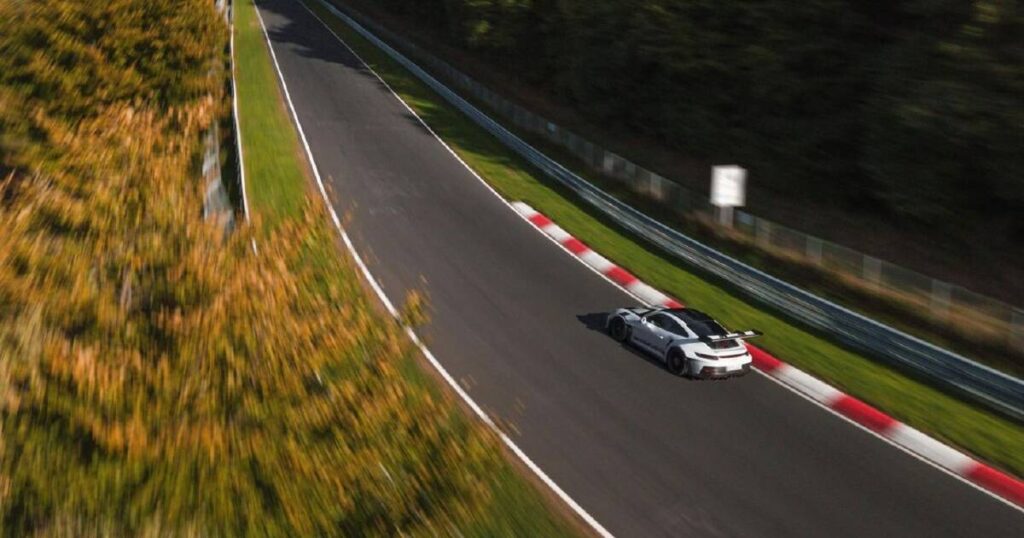
If you have even a passing interest in cars, the name Nurburgring will likely resonate with you. This legendary 20.8-kilometer circuit, nestled in the forests of Germany, is often considered the ultimate proving ground for automotive excellence. Known officially as the Nurburgring Nordschleife, this track is infamous for its challenging array of surfaces and corners, earning it the moniker ‘Green Hell’.
The significance of lap times recorded at the Nordschleife extends beyond mere numbers. Car manufacturers frequently tout impressive lap times as a testament to their vehicles’ performance capabilities. Recent examples include BYD’s premium brand Yangwang, which highlighted its U9 electric supercar’s achievements. However, one brand with a storied history at the ‘Ring is Porsche, which recently unveiled its new 911 Turbo S, boasting a remarkable 7:03.92 lap time under the skilled hands of racing driver and Porsche brand ambassador Jörg Bergmeister. This time is 14 seconds faster than its predecessor, marking a significant leap in performance.
The Role of Nurburgring in Automotive Marketing
Why do car manufacturers place such importance on Nurburgring lap times? The answer lies in the track’s ability to serve as a benchmark for technological advancements. At a media event during the Icons of Porsche Festival in Dubai, Frank Moser, Porsche Vice President for Product Lines 911 and 718, explained the rationale behind this focus.
“I think it’s not the one topic where the customer decides, ‘I need the new Turbo S’,” Moser told Australian media. “The Nurburgring Nordschleife is very important for us, because the customer can see how the technological step is going ahead, and then they are recognizing, ‘well, they did a lot on that car’, it’s more dynamic’.”
Porsche’s commitment to improving lap times is not just about marketing; it demonstrates tangible progress in vehicle performance. For a car like the 911, which maintains a consistent aesthetic across generations, these advancements reassure customers that significant improvements have been made.
Technological Innovations Behind Faster Lap Times
The new 911 Turbo S exemplifies Porsche’s dedication to innovation. Despite being 85 kilograms heavier than its predecessor, the car’s performance enhancements are evident. Moser highlighted several key changes contributing to this improvement.
“First of all is due to the hybridisation. We have 711 horses (523kW), 800 Newton metres of torque. But power is not everything you need on a race track, so we fine-tuned the suspension as well,” Moser explained. “We integrated the Porsche Dynamic Chassis Control into the 400-volt system… and that is even faster and more precise.”
These advancements extend beyond high-tech solutions. The 911 Turbo S features mechanical upgrades, such as larger rear brake discs and wider tires, enhancing grip and braking performance. Aerodynamic improvements, including a variable front spoiler lip and adjustable cooling flaps, further contribute to the car’s capabilities on the track.
Expert Insights: Jörg Bergmeister’s Perspective
Jörg Bergmeister, a seasoned driver with extensive experience at the Nurburgring, played a crucial role in testing the new 911 Turbo S. He shared his insights on the car’s performance and the challenges of shaving 14 seconds off the previous lap time.
“Fast!” Bergmeister laughed when asked about the experience. “Definitely a car I need to get used to the power, because usually what I race there, and on the GT car model lines, was all around 500 horsepower (370kW), so having basically 200 horsepower more changes the track quite a bit!”
Bergmeister emphasized the car’s versatility, noting that it performs exceptionally well both as a daily driver and on the track. His feedback has been instrumental in refining the vehicle’s handling and responsiveness, ensuring that it remains a joy to drive.
The Broader Implications for Consumers
While Nurburgring lap times may not be the primary factor influencing consumer decisions, they serve as a powerful indicator of a car’s performance capabilities. For enthusiasts, the ability to boast about a vehicle’s prowess on such a challenging track adds to its allure. However, as Moser pointed out, other factors, such as aesthetics and power, often play a more significant role in purchasing decisions.
Ultimately, the pursuit of faster lap times at the Nurburgring reflects a broader commitment to innovation and excellence within the automotive industry. As manufacturers continue to push the boundaries of what’s possible, consumers can expect to benefit from these advancements, whether they plan to take their cars to the track or simply enjoy them on the open road.
The Nurburgring remains a symbol of automotive achievement, and as long as manufacturers like Porsche continue to strive for excellence, it will continue to hold a special place in the hearts of car enthusiasts worldwide.