

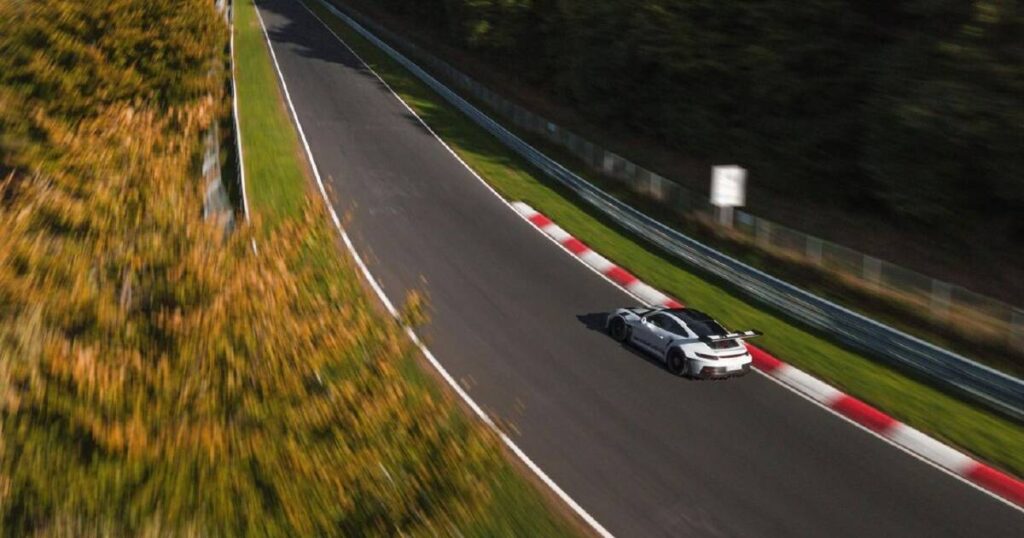
If you have even a passing interest in cars, the name Nurburgring will likely ring a bell. This 20.8-kilometer circuit, nestled within a forest in Germany, is often regarded as the ultimate pilgrimage site for motoring enthusiasts. Known as the Nurburgring Nordschleife, this track is distinct from the shorter Nurburgring Grand Prix Circuit and is infamous for its challenging array of surfaces and corners.
The Nordschleife is not just a test of speed but of dedication and skill. A mistake here can result in lost seconds or, worse, a severe crash. It’s no wonder that this demanding track has earned the moniker ‘Green Hell’. But why do lap times at the Nurburgring matter so much, particularly for road cars?
The Marketing and Engineering Impact
For sports car brands and engineers, an impressive lap time at the Nordschleife is often used as a marketing tool. Recently, BYD’s premium brand Yangwang highlighted its U9 electric supercar’s performance there. However, a brand with a more storied history at the ‘Ring is Porsche.
Porsche’s latest 911 Turbo S was unveiled with a remarkable 7:03.92 lap time, achieved by racing driver and Porsche brand ambassador Jörg Bergmeister. This time is 14 seconds faster than its predecessor, marking a significant improvement. But why do brands focus on these lap times, and do customers actually care about performance on a track they may never visit?
Customer Perception and Technological Advancements
During a media event at the Icons of Porsche Festival in Dubai, CarsGuide posed this question to Frank Moser, Porsche’s Vice President for Product Lines 911 and 718. Moser explained, “I think it’s not the one topic where the customer decides, ‘I need the new Turbo S’. The Nurburgring Nordschleife is very important for us, because the customer can see how the technological step is going ahead.”
For a car like the 911, which maintains a consistent look and feel across generations, proving advancements through improved lap times is crucial. “I think if you’re sitting with your colleagues or your guys, and you’re talking about, ‘hey, my car is 14 seconds quicker than the previous one’, that’s nice, but I think it’s not the number one topic,” Moser noted.
Technological Innovations Behind the Performance
When asked to quantify the changes that allowed the heavier new 911 Turbo S to outperform its predecessor, Moser had detailed insights. “First of all is due to the hybridisation. We have 711 horses (523kW), 800 Newton metres of torque. But power is not everything you need on a race track, so we fine-tuned the suspension as well.”
Porsche has integrated the Porsche Dynamic Chassis Control into the 400-volt system, enhancing speed and precision. In addition to high-tech enhancements, there are mechanical changes that contribute to the car’s improved performance. “We increased the size of the rear discs from 390mm to 410 millimeters. So it is the biggest brake ever on a 911,” Moser explained.
“We optimized the aerodynamics. So we have, from the Turbo S, the variable front spoiler lip, the rear wing, and the new cooling flaps integrated into the aerodynamic concept.”
The Driver’s Perspective
Jörg Bergmeister, who drove the 911 Turbo S to its record time, shared his experience. “Fast!” he laughed, describing the sensation of shaving 14 seconds off the previous lap time. “Definitely a car I need to get used to the power, because usually what I race there, and on the GT car model lines, was all around 500 horsepower (370kW), so having basically 200 horsepower more changes the track quite a bit!”
Bergmeister emphasized the car’s dual nature as both a daily driver and a track performer. “For a Turbo or Turbo S as a daily driver, it works really well. And still, when you go to a track, any track I’ve taken the car to, [you’re] just smiling, because you can just play with the car.”
The Broader Implications
The feedback from the track is invaluable for Porsche engineers, aiding in the development of the car. “Obviously, the tyre wears a bit more, but definitely we way overcompensated the weight with power and how the car handles,” Bergmeister noted.
With the turbo-hybrid throttle response, the car drives like a normally aspirated engine, allowing for better throttle steering. “Therefore, for me, it just adds fun,” he added. If someone with Bergmeister’s experience finds joy in the car, customers are likely to as well.
In conclusion, while Nurburgring lap times may not be the sole factor in a customer’s purchasing decision, they serve as a testament to the technological advancements and capabilities of a vehicle. For brands like Porsche, these times are a demonstration of engineering prowess and a point of pride, reinforcing their status in the competitive sports car market.