



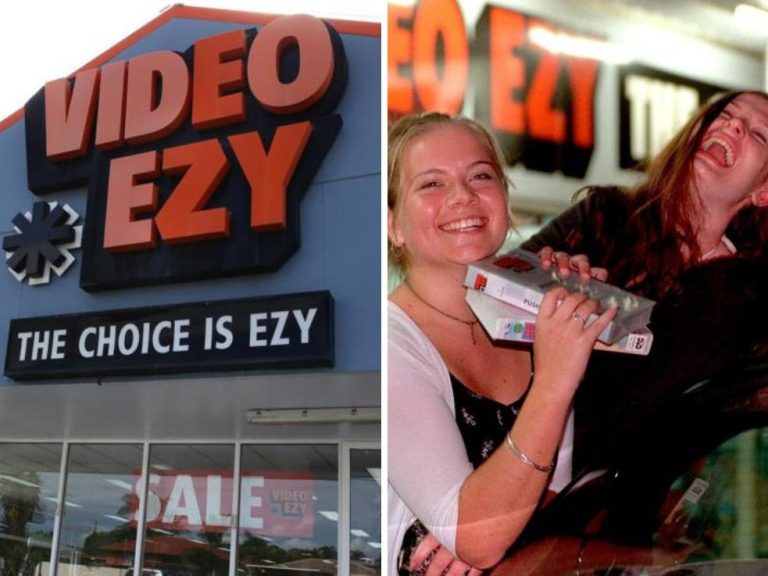
Once a beloved fixture in local shopping centers across Australia, Video Ezy was a source of countless family debates over movie choices and fond memories for many. At its peak in the mid-2000s, the franchise boasted over 500 video rental stores, easily recognizable by their vibrant orange and black logo. However, much like the VHS tapes and DVDs it once rented, Video Ezy has faded into obscurity.
The decline of Video Ezy can be largely attributed to the rise of streaming services, yet it was a specific historical moment that ultimately sealed its fate. This is the story of Video Ezy’s journey from humble beginnings to its eventual downfall.
Humble Beginnings in Hurstville
Video Ezy began its operations in 1983 when Kevin Slater opened the first store in Hurstville, offering a modest selection of VHS and Betamax movies. Just a year later, Video Ezy became a franchise, expanding to a second location in Miranda to serve Sydney’s Sutherland Shire. These stores disrupted the traditional broadcast TV schedule, allowing Australians to watch movies on their own terms.
By the end of the 1980s, Video Ezy had expanded beyond New South Wales, opening its first international location in Auckland, New Zealand, and setting its sights on further growth.
Asian Expansion
The late 1990s saw Video Ezy venture into Asia, partnering with the Malaysian conglomerate Berjaya Group. By 1997, the franchise had established a presence in Malaysia, followed by Thailand in 1999 and Singapore in 2001. At its height, Video Ezy operated 571 stores across four countries, generating an annual turnover of approximately $250 million.
However, despite its international success, a domestic controversy threatened to tarnish its reputation.
The GST Controversy
In May 2000, the Australian Competition and Consumer Commission (ACCC) accused Video Ezy of price exploitation. The ACCC alleged that in anticipation of the Goods and Services Tax (GST), Video Ezy unlawfully increased movie rental prices at 21 of its 33 corporately owned stores. The price hike aimed to reach a convenient new price point of $7.00, which would cover the GST once implemented.
In April 2001, Video Ezy acknowledged its wrongdoing and agreed to Federal Court orders to reduce prices, offer free rentals to affected customers, and contribute to the ACCC’s legal costs. The scandal was a significant blow to the franchise’s credibility.
Innovations and Acquisitions
In 2004, Video Ezy introduced ‘DVD Unlimited,’ a subscription service inspired by the burgeoning US company Netflix. This service allowed customers to rent up to four movies at a time without incurring late fees, marking a shift towards a more modern rental model.
Three years later, Video Ezy acquired the Australian operations of Blockbuster, gaining control over 29 company-operated and 341 franchisee stores. Despite the growing threat of digital downloads and piracy, Video Ezy’s then-managing director, Paul Uniacke, remained optimistic about the future of physical rentals.
“If [owners don’t diversify] they will die,” Uniacke stated in a 2012 interview, emphasizing the need for adaptation in the face of digital disruption.
The Streaming Revolution
By 2015, Netflix had transformed from a fledgling startup into a dominant force in the media landscape. Within three months of its Australian launch in March 2015, Netflix amassed over one million users, a figure that nearly tripled within a year. By 2024, 67% of Australian adults were Netflix subscribers, making Australia the most highly penetrated Netflix market globally.
As streaming services like Disney+, Apple TV+, and Amazon Prime Video emerged, Video Ezy struggled to maintain relevance. Critics argued that the franchise had become more of a nostalgic novelty than a necessity.
The Final Blow
While streaming dealt a significant blow to Video Ezy, the onset of the COVID-19 pandemic in 2020 delivered the final nail in the coffin. The pandemic’s impact on Hollywood production schedules, coupled with health protocols, forced the closure of all Video Ezy kiosks.
“Netflix never worried Blockbuster and later Video Ezy because we got all the new releases two weeks before everyone else,” said Mic Noble, the last Video Ezy manager in Logan, in a 2021 interview. “When Covid started, there were not that many blockbusters coming out of Hollywood.”
In March 2021, Video Ezy’s remaining kiosks ceased operations as Evolve Entertainment, the company managing them, went into liquidation. The Video Ezy name was officially deregistered on January 30, 2024, marking the end of a 41-year journey for an Australian cultural icon.
The story of Video Ezy serves as a poignant reminder of the rapid technological advancements that have reshaped the entertainment industry, and the challenges faced by businesses in adapting to these changes.