



Last summer, a significant breakthrough occurred when a museum successfully recovered Rubens’s oil sketch, Saint Gregory of Nazianzus, after it surfaced at Christie’s auction house. Now, the institution is on the trail of a 15th-century print of the Annunciation by the enigmatic German engraver known only as “Master ES” and a pair of exceptionally rare “table automata”—proto-robots crafted by a goldsmith at the dawn of the 17th century.
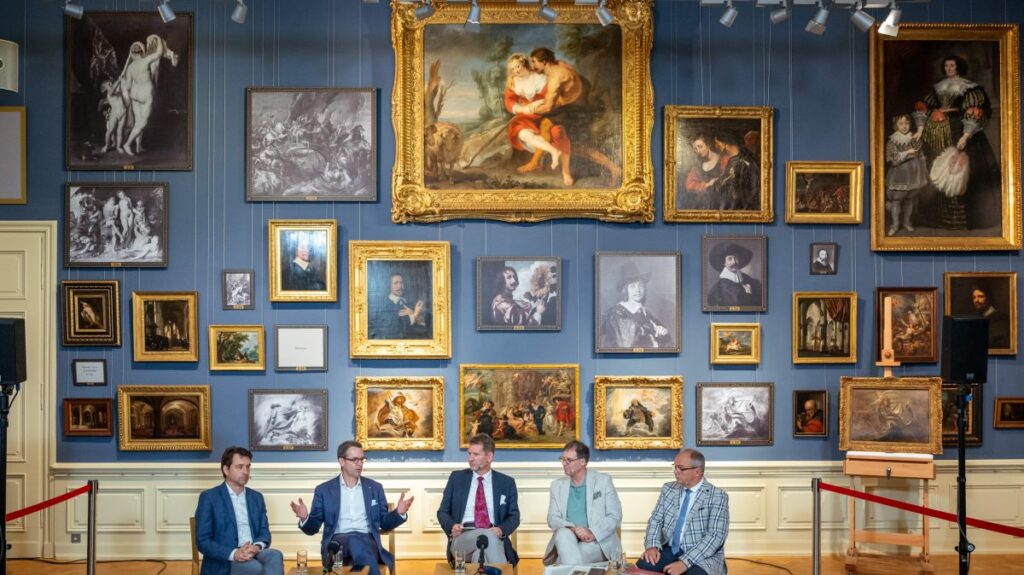
For Timo Trümper, the research director and curator of paintings at the museum, this mission is about more than just recovering lost art; it is an effort to restore the soul of a central German city that thrives on the memories of its illustrious past. “This gallery of shadows is a reminder of our mission to fight for these objects and bring them back into this historical collection,” Trümper stated.
Gotha’s Lost Heritage
Germany’s complex 20th-century history has left many of its museums in pursuit of their missing artifacts. However, few places experienced as severe a loss of heritage after 1945 as Gotha. This small city, with a population of 46,000, was once the seat of the Protestant Ernestine dynasty, renowned for its advanced administrative state and robust education system within the Holy Roman Empire.
“There used to be a saying that the farmers in Saxe-Gotha were cleverer than the nobles in the other principalities,” Trümper remarked. The dukes compensated for their lack of territorial power by investing in culture and science, amassing a collection of 1.2 million objects, including works by Cranach the Elder and Hans Holbein, ancient Egyptian mummies, exotic beetles, and meticulously accurate cork sculptures of Roman ruins.
The Royal Connection and Its Aftermath
In 1840, the duchy of Saxe-Coburg and Gotha secured a royal connection by marrying Albert, the duke’s second son, to Queen Victoria. This link to the British royal family added prestige and influence, with the family name enduring until it was changed to Windsor during World War I due to anti-German sentiment.
Alfred, Victoria and Albert’s son, expanded the Gotha castle museum with curiosities from his global travels, including lacquerwork from imperial Japan. Despite Gotha’s transformation into a manufacturing hub for German bombers during World War I, the collection remained intact until the Weimar Republic era when the duchy was abolished, and the museum became public property.
The Impact of War and Division
The museum’s troubles escalated during World War II. Although the building was undamaged, the aftermath of the war saw the region handed over to Soviet control. In the chaos, Viktoria Adelheid, the last duchess of Saxe-Coburg and Gotha, transported significant treasures to her estate in American-controlled Bavaria, despite their no longer belonging to her family.
Treasures included a self-portrait by Rembrandt, now at Munich’s Alte Pinakothek, a hoard of gold coins, and the Echternach Gospels. Tobias Pfeifer-Helke, director of the Friedenstein Foundation, which now oversees Gotha’s castle and museums, described the duchess’s actions as a “cloak-and-dagger operation” to sell the rarest works internationally.
“They systematically sold them off through the international art trade in the Forties and Fifties to earn money,” Pfeifer-Helke said.
The Soviet Era and Beyond
Stalin’s “trophy brigades” further depleted Gotha’s cultural heritage, with about 80% of these objects returned in the 1950s, leaving many unaccounted for. Museum staff also contributed to the loss, selling items on the black market during the postwar period until the GDR reestablished the museum foundation in 1949.
The final blow came in 1979 with East Germany’s largest art heist, when a disgruntled train driver stole five Old Masters, including Van Dyck’s Self-Portrait with a Sunflower and Brueghel the Elder’s Country Road with Wagons and Cows. To this day, the exact number of stolen objects remains uncertain, though over 2,000 paintings and prints are believed to be missing.
The Ongoing Quest for Recovery
After German reunification in 1990, the Friedenstein Foundation launched a campaign to recover Gotha’s lost art, facing challenges due to a 30-year statute of limitations on art theft. Without legal recourse, the foundation relies on negotiation and moral persuasion, retrieving about a dozen pieces annually from as far as Uruguay and the United States.
Some recoveries are straightforward, driven by owners’ remorse. Recently, a Parisian orthopaedic surgeon returned an antique jade teapot upon realizing it was listed in the museum’s catalogue of missing items. In 2019, a lawyer in Munich facilitated the return of five stolen Old Masters, which a family had kept uncertainly in their flat.
“The Gothans, above all the older people, were standing there with tears in their eyes when the paintings came back,” Pfeifer-Helke said.
Challenges and Triumphs
Other cases are more complex. In the 1990s, Gotha investigators traced a painting by Dutch mannerist Joachim Wtewael from Moscow and Berlin to Sotheby’s in London, where it was bought by a collector using an offshore vehicle. With German government support, Gotha pursued the case to the British High Court, which ruled the artwork belonged to Germany.
The quest to reclaim Gotha’s treasures continues, driven by a determination to restore the city’s cultural legacy. Each recovered piece is celebrated as a “homecomer,” a testament to the enduring connection between the people of Gotha and their storied past.