
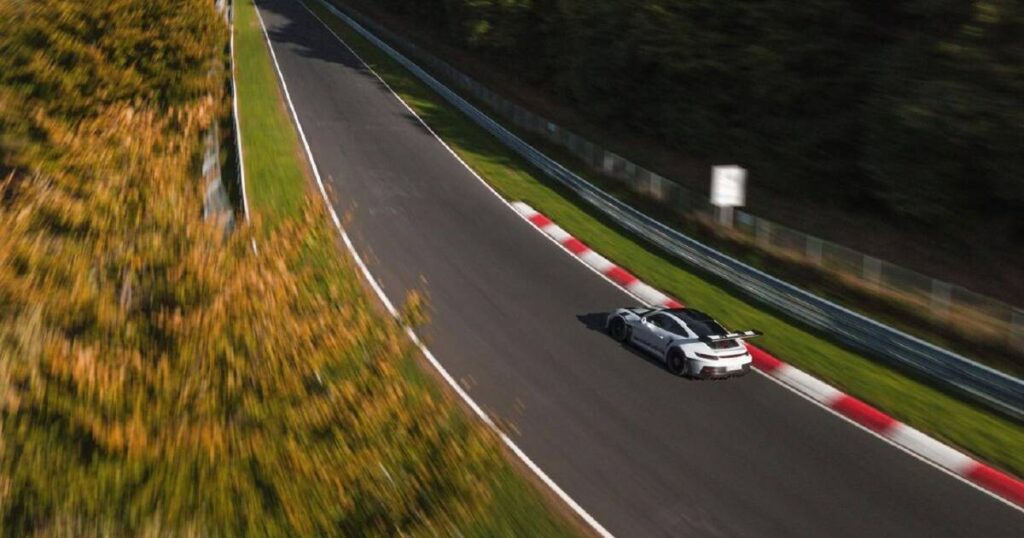
If you have even a passing interest in cars, the name Nurburgring likely rings a bell. This 20.8-kilometer circuit, nestled within a forest in Germany, is often revered as a motoring Mecca. Known officially as the Nurburgring Nordschleife, it is distinct from the shorter Nurburgring Grand Prix Circuit and is infamous for its challenging array of surfaces and corners.
For car manufacturers, a fast lap time at the Nordschleife is not just a badge of honor but a crucial marketing tool. Recently, BYD’s premium brand Yangwang highlighted its U9 electric supercar’s performance there. However, the brand with perhaps the most storied history at the ‘Ring is Porsche. The latest 911 Turbo S, piloted by racing driver and Porsche ambassador Jörg Bergmeister, clocked an impressive 7:03.92 lap time—14 seconds faster than its predecessor.
The Significance of the Nurburgring
The Nordschleife’s reputation as the ‘Green Hell’ is well-earned, given its technical demands and potential for catastrophic crashes. But why do these lap times matter so much? According to Porsche’s Frank Moser, Vice President for Product Lines 911 and 718, the Nurburgring serves as a benchmark for technological advancement.
“The Nurburgring Nordschleife is very important for us, because the customer can see how the technological step is going ahead,” Moser explained. “It’s more dynamic, but I think customers decide first of all, how the car looks, what is the power of the car.”
For a model like the 911, which maintains a consistent aesthetic and driving feel across generations, demonstrating tangible improvements is crucial. A faster lap time not only showcases enhanced capabilities but also reassures customers of genuine advancements.
Engineering Innovations Behind Faster Lap Times
Despite being 85 kilograms heavier than its predecessor, the new 911 Turbo S achieves its remarkable lap time through a combination of power and precision engineering. Moser detailed the enhancements that contributed to this performance leap.
“First of all is due to the hybridisation. We have 711 horses (523kW), 800 Newton metres of torque,” he noted. “But power is not everything you need on a race track, so we fine-tuned the suspension as well.”
The integration of Porsche Dynamic Chassis Control into the 400-volt system enhances responsiveness, while mechanical upgrades like larger rear brakes and wider tires improve stopping power and grip. Aerodynamic tweaks, such as a variable front spoiler lip and adjustable cooling flaps, further optimize performance.
Driver Insights and Consumer Implications
Jörg Bergmeister, who executed the record lap, emphasized the car’s balance of power and agility. “For a Turbo or Turbo S as a daily driver, it works really well,” he remarked. “And still, when you go to a track… you’re just smiling, because you can just play with the car.”
“Obviously, the tyre wears a bit more, but definitely we way over compensated the weight with power and how the car handles,” Bergmeister added. “And with the turbo-hybrid throttle response, you have no more turbo lag, so you’re driving it like a normally aspirated engine.”
For consumers, these enhancements mean a vehicle that is not only faster but also more enjoyable to drive, whether on a racetrack or a daily commute. The feedback from professional drivers like Bergmeister is invaluable in refining these vehicles, ensuring they meet the high standards expected by enthusiasts and casual drivers alike.
The Broader Impact of Nurburgring Performance
While not every car buyer will take their vehicle to the Nurburgring, the performance metrics achieved there resonate in the broader automotive world. They serve as a testament to a brand’s engineering prowess and commitment to pushing boundaries. As such, they can influence purchasing decisions by highlighting a car’s potential and the technological innovations behind it.
As automotive technology continues to evolve, the Nurburgring will likely remain a pivotal proving ground. For manufacturers like Porsche, it is not merely about setting records but demonstrating the continuous evolution of their vehicles. As Moser succinctly put it, “We did a lot in every detail in order to make the car faster on the Nurburgring Nordschleife.”
In conclusion, while a fast lap at the Nurburgring may not be the sole factor driving consumer interest, it undeniably enhances a car’s allure by showcasing its capabilities and the cutting-edge technology that powers it. As the automotive industry advances, the ‘Green Hell’ will continue to be a critical stage where the limits of performance and innovation are tested.