



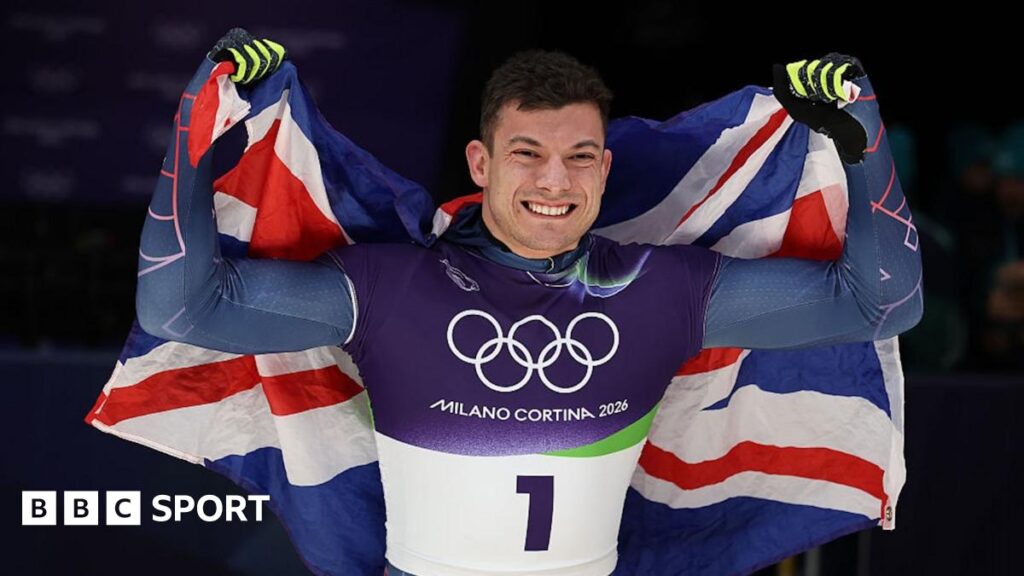
Despite lacking an ice track, Team GB has emerged as the most successful nation in Olympic skeleton history. This remarkable feat was underscored when Matt Weston clinched a historic gold medal on Friday at the Milan-Cortina Winter Olympics, joining a distinguished line of British skeleton athletes who have graced the Olympic podium. Weston’s victory follows in the footsteps of Amy Williams and Lizzy Yarnold, with Yarnold having claimed gold twice. Weston is the first British man to stand atop the podium, bringing the sport’s total medal haul to 10, with potential for more during these Games.
The announcement comes as a testament to Britain’s unique approach to skeleton, a sport where they have consistently excelled despite the absence of a domestic ice track. Weston, a two-time world champion, acknowledges the irony, suggesting that Britain’s success is likely “quite infuriating” for other nations. For Yarnold, this absence is Team GB’s “superpower.” She explains, “What the Brits are really good at is that when we turn up a track, you have six practice runs before the race, so six minutes of practice. You go in there with purpose, with clarity, with commitment in every single run.”
The Secret Behind the Success
A small wooden hut on the University of Bath campus may not appear to be a breeding ground for Olympic champions, yet it serves as the start of the UK’s only push track and the home of the skeleton and bobsleigh teams. Here, athletes hone their skills on a 140-meter stretch during summer, perfecting their starts and building strength for the winter season.
The technology supporting British skeleton athletes is cutting-edge. In the 1990s, Kristan Bromley, later known as ‘Dr. Ice,’ was tasked with creating a sled for the British military. His work laid the foundation for many of Britain’s early successes in the sport. Over the years, partnerships with McLaren and British Aerospace have advanced sled engineering, while innovative ‘drag-resistant’ skin suits sparked controversy at the 2018 Games. Ahead of the 2026 Games, the team utilized a wind tunnel to enhance performance.
“Research and innovation are really important in a sport like skeleton where it’s the human and the machine,” said Yarnold. “It’s a combination of everything coming together.”
Challenges and Adaptations
Despite technological advancements, challenges persist. At these Games, Team GB faced a ban on new helmets by the Court of Arbitration for Sport, which deemed them designed to enhance aerodynamic performance. This setback, however, did not deter the team, contrasting with the disappointment at the Beijing Games four years prior, where equipment issues led to a medal drought.
Historically, skeleton has been one of Great Britain’s highest-funded winter sports. However, after the Beijing Games, UK Sport funding for the skeleton program dropped from £6.5 million to an initial £4.8 million for the 2026 cycle, later rising to £5.8 million. This funding supports talent identification schemes like Discover Your Gold, which introduced Weston to skeleton after a career in taekwondo and rugby union. Similar schemes have brought other notable athletes, including Yarnold and 2018 bronze medallist Laura Deas, into the sport.
International Expertise and Team Dynamics
The recruitment of top-tier coaches has further bolstered Team GB’s skeleton program. In 2022, Latvian Martins Dukurs, regarded as the greatest slider in history, joined as a coach. His expertise, alongside that of his coach and sled designer Matthias Guggenberger, represents a significant asset to the team.
“This is just a massive bonus to a good package that we already had, this is the icing on the cake,” Weston told BBC Sport in 2025. “Martins is the best ever at what he’s done. His experience is invaluable.”
Dukurs’ transition from having constant access to ice in Sigulda to joining a setup without an ice track posed a challenge. Yet, the camaraderie and collaborative spirit among British athletes compensate for this lack of facilities. Marcus Wyatt, who finished ninth in Cortina, emphasizes the importance of sharing knowledge and experiences with teammates to maximize their limited time on the ice.
“We only get to slide down an ice track about 120-150 times a year. Each run is less than a minute, so you’re looking at less than two hours actually doing the sport every year,” Wyatt explained. “But if you talk to other athletes, learn from their experiences and share what you’re doing, suddenly you’ve doubled, tripled, quadrupled your knowledge.”
Weston concurs, highlighting the competitive yet supportive environment that sets Team GB apart. “On the track, he’s the first person I want to beat, I’m the first person he wants to beat. But when we’re training, when we’re working stuff out, we work together so well, and I think that’s what separates us apart [from the rest].”
As Team GB continues to defy expectations and achieve success in skeleton, their story serves as a testament to the power of innovation, collaboration, and resilience in the face of challenges. With the Milan-Cortina Games underway, the British team is poised to add to their impressive medal tally, driven by a unique blend of talent, technology, and teamwork.