


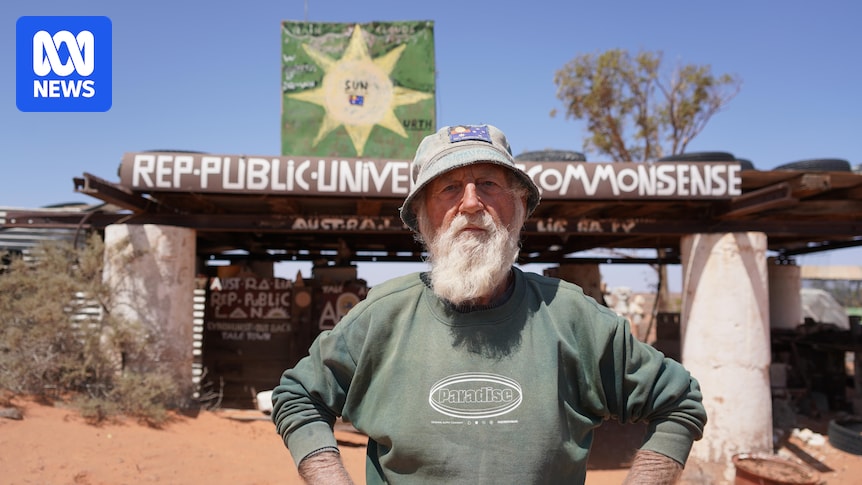
Amid the light brown sand and sparse scrub of outback South Australia, Talc Alf’s workshop emerges as a beacon of creativity. Constructed from salvaged materials and boldly marked with the words “Reppublic [sic] University of Common Sense,” this unique gallery has become a must-see for travelers navigating the Strzelecki Track near Lyndhurst, approximately 570 kilometers north of Adelaide.
Alf, known for his distinctive carvings, sits at his workbench, deftly shaping a chunk of white talc. This soft, powdery stone, which he sources from various locations across Australia, has earned him his nickname. As he works, clouds of white powder fill the air, settling on everything in sight. Just steps away, the unforgiving outback sun illuminates his outdoor gallery, where his creations sit exposed to the elements.
The Journey to Lyndhurst
Alf’s path to becoming a renowned artist in South Australia’s outback was anything but straightforward. Born in Holland, he immigrated to Australia at the age of eight with his family, who settled on a farm in Margaret River. As an adult, Alf worked various jobs across Western Australia, Queensland, and the Northern Territory before finally putting down roots near Lyndhurst in 1974.
It was during these travels that Alf discovered a geology book highlighting talc deposits across the country. Inspired by an article about First Nations communities in Canada carving soapstone, he decided to try his hand at carving talc. “I thought, maybe I’ll do the same thing myself,” he said. “I was not too keen to stay on the farm for the rest of my life, so I just thought I’d make a living at this carving business.”
Crafting Stories in Stone
Alf’s process begins with smoothing the talc using sandpaper and a rasp, followed by selecting a design. “You draw the picture on. It’s like doing a painting and then you get the hammer and chisel out and chip it out,” he explained. His creations often depict scenes from Australian history, fiction, and anecdotes gathered during his travels.
Tourists are drawn to his gallery, intrigued by the unique art and the stories behind each piece. “They’re fascinated … and some of them would come back after a few years,” Alf noted. “They said, ‘We still got your carving sitting on the mantelpiece, been there for the last 20 years’ or something and some bring their kids with them.”
An Alphabet of His Own
Beyond his sculptures, Alf has developed his own interpretation of the Latin alphabet. This project began when he was teaching his daughter to read. Using a stick, he drew letters in the sand, starting with the letter P. “You started with the letter P, you draw a stroke for the body and you put your head on top of it and put a little smile on and arms and legs — you got P for people,” he said. “That should be taught at schools. It’s easy to do.”
Alf’s alphabet is more than just a teaching tool; it’s a philosophical exploration of language. “Every letter’s a story and it didn’t come from England, it came from all over the world, people bought in their ideas,” he said, reflecting on the global influences that shaped his work.
A Lasting Legacy in the Outback
Despite being in his 80s, Alf shows no signs of slowing down. His gallery remains a memorable stop for those venturing through South Australia’s outback, offering a glimpse into the mind of an artist who has dedicated his life to carving stories into stone.
The allure of Talc Alf’s work lies not only in the art itself but in the journey it represents—a journey of discovery, creativity, and a deep connection to the land and its stories. As tourists continue to flock to his gallery, they leave with more than just souvenirs; they take with them a piece of Alf’s enduring legacy.