


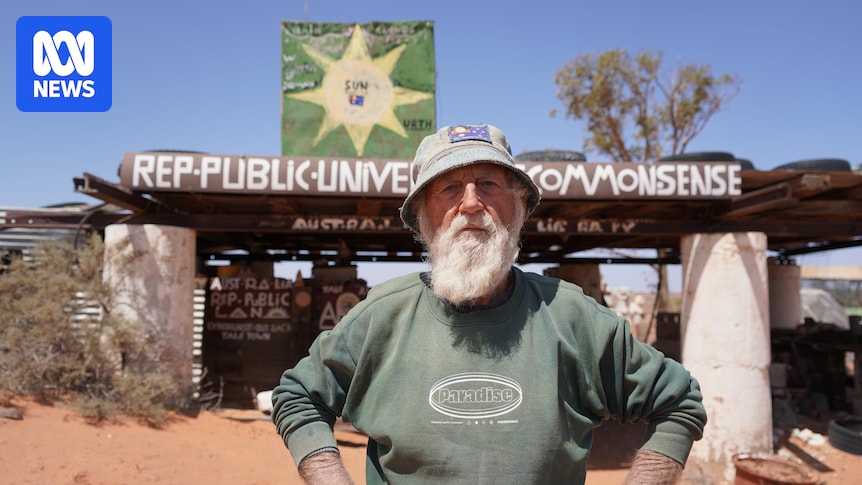
Amid the light brown sands and sparse scrub of outback South Australia, Talc Alf’s workshop emerges as a beacon of creativity and eccentricity. Nestled just off the Strzelecki Track near Lyndhurst, about 570 kilometers north of Adelaide, this unusual gallery attracts tourists traversing the rugged landscape. The workshop, crafted from salvaged materials, proudly bears the sign “Reppublic [sic] University of Common Sense,” setting the tone for the unique experience within.
Inside, Alf, whose real name is Albert, sits at his workbench carving his chosen medium—soft, powdery talc. This material, which he has sourced from various locations around Australia, has earned him the nickname “Talc Alf.” As he works, clouds of white dust swirl around him, settling on everything in a pale coat. Just a few steps away, his outdoor gallery is illuminated by the harsh outback sun, showcasing his carved talc pieces on wooden and rusty metal shelves against the backdrop of the Gammon Ranges.
The Journey to Lyndhurst
Alf’s journey to this remote corner of South Australia was a long and winding one. His family immigrated to Australia from Holland when he was just eight years old, settling on a farm in Margaret River after arriving in Fremantle. As an adult, Alf worked various jobs across Western Australia, Queensland, and the Northern Territory before finally settling near Lyndhurst in 1974. It was during his travels that he discovered a geology book marking talc deposits across the country.
Inspired by an article about First Nations communities in Canada carving soapstone, Alf decided to try his hand at carving talc. “I thought, maybe I’ll do the same thing myself,” he said. “I was not too keen to stay on the farm for the rest of my life, so I just thought I’d make a living at this carving business.”
The Art of Carving Talc
Alf’s process begins with smoothing the talc using sandpaper and a rasp, followed by sketching a design. “You draw the picture on. It’s like doing a painting and then you get the hammer and chisel out and chip it out,” he explained. His creations often depict Australiana scenes from fiction, history, and anecdotes from his travels across Australia.
Each day, Alf finds inspiration in books and stories, translating them into his distinctive carvings. His gallery has become a popular stop for tourists, with buses frequently pulling off the Strzelecki Track to explore his work. “They’re fascinated … and some of them would come back after a few years,” he said. “They said, ‘We still got your carving sitting on the mantelpiece, been there for the last 20 years’ or something and some bring their kids with them.”
A New Take on the Alphabet
In addition to his carvings, Talc Alf has developed his own interpretation of the Latin alphabet. This venture began as he taught his daughter to read, using the sandy ground of their Lyndhurst property as a canvas. With a stick, he drew a vertical line and added a circle at the top, creating what he called the letter P. “You started with the letter P, you draw a stroke for the body and you put your head on top of it and put a little smile on and arms and legs — you got P for people,” he said.
Alf believes this method should be taught in schools, describing it as an easy and intuitive way to learn the alphabet. “Every letter’s a story and it didn’t come from England, it came from all over the world, people bought in their ideas,” he said, likening his approach to that of a philosopher.
Looking Ahead
Despite being in his 80s, Alf has no plans to retire or close his gallery. His unique creations and interpretations continue to captivate visitors, ensuring his place as a memorable stop in South Australia’s outback. With each carving, Talc Alf not only crafts a piece of art but also shares a piece of his journey and philosophy with the world.