

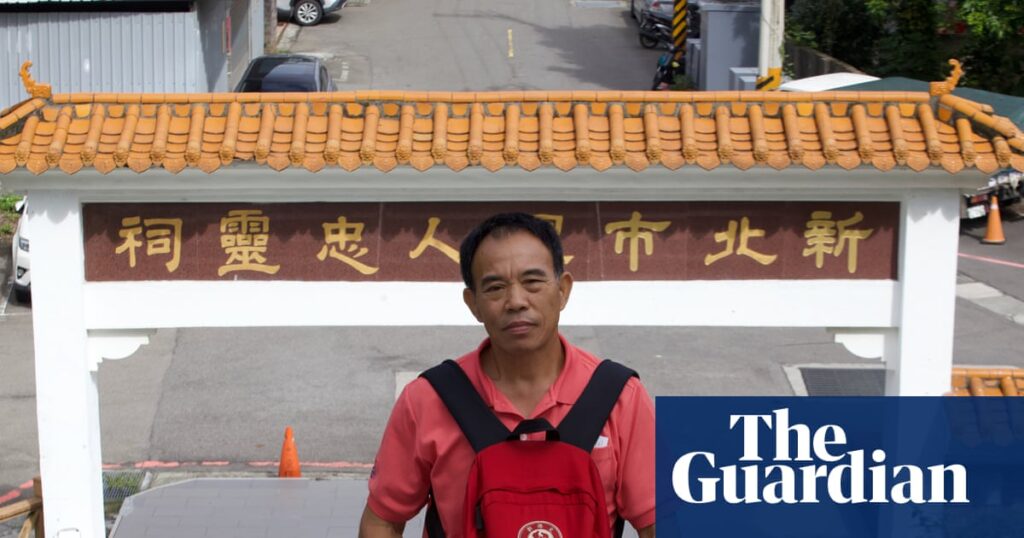
In the serene confines of a military cemetery in northern Taiwan, Liu De-wen, a 58-year-old Taiwanese man, undertakes a solemn ritual. Surrounded by rows of shelves, he carefully retrieves an urn, cradling it with reverence. “Grandpa Lin, follow me closely,” Liu whispers, promising to fulfill Lin Ru Min’s final wish of returning to his homeland in Fujian, China. Lin, a former soldier who lived to 103, is one of hundreds Liu has helped to reunite with their ancestral roots over the past 23 years.
Liu’s mission operates within a complex historical and emotional landscape, navigating the delicate ties between Taiwan and China, family separations, and the potential for political exploitation. His work is rooted in the aftermath of China’s civil war, when the nationalist Kuomintang (KMT) retreated to Taiwan, taking with them soldiers and civilians, including Lin, who was forcibly conscripted from his coastal village in Fujian.
The Historical Context of Liu’s Mission
The end of the Chinese civil war in the late 1940s saw the KMT, led by Chiang Kai-shek, flee to Taiwan with an estimated one to two million people, known as waishengren. Among them were soldiers, government workers, and forced conscripts like Lin. According to Dominic Meng-Hsuan Yang, a historian at the University of Missouri, “Tens of thousands were literally kidnapped to Taiwan this way.”
Chiang’s plan to regroup and reclaim the mainland never materialized. Instead, Taiwan endured decades of martial law, isolating it from the Communist-ruled People’s Republic of China. By the time travel bans were lifted in the late 1980s, the world had changed irreversibly for the veterans left behind. “The homes that the old KMT soldiers left behind in the late 1940s changed dramatically,” notes Prof. James Lin of the University of Washington. Most veterans had settled in Taiwan, their dreams of returning home fading with time.
Liu’s Personal Journey and Commitment
Liu’s dedication to his cause began in his 30s when he moved to a village built for KMT veterans. As the borough chief, he witnessed the deep longing these men had for their homeland. “There were over 2,000 single veterans just in my community,” Liu recalls. “Every Chinese New Year, they would face the direction of their hometown and sit there for hours, quietly missing home.”
His work extends across Taiwan, often leading him to neglected graves in remote areas. Liu assists families in repatriating the ashes of both soldiers and civilians, ensuring they are honored in their ancestral homes. His social media accounts document these journeys, showing urns treated with utmost respect, occupying seats in vehicles and beds in hotel rooms.
Political Implications and Personal Motivations
While Liu’s work garners praise in both Taiwanese and Chinese media, it also serves as a tool for Beijing’s reunification narrative. Prof. Lin explains, “It theoretically benefits Beijing to highlight the close familial ties that link together society across Taiwan and China.” Despite the political undertones, Liu remains focused on his humanitarian mission, stating, “What I care deeply about is building this kind of bridge for veterans to go home.”
Liu’s efforts resonate with many in China, where the plight of the old soldiers is met with sympathy. Yet, the narrative also underscores the deep-seated tensions between Taiwan’s identity and China’s reunification ambitions. More than 60% of Taiwanese identify solely as Taiwanese, with only a minority supporting unification.
The Emotional Impact and Future Prospects
As Liu prepares to transport Lin’s urn to Fujian, the emotional weight of his work is palpable. Chen Rong, Lin’s niece’s daughter, expresses her gratitude and sorrow. “We are going home,” she says tearfully. “I am asking Mr. Liu to bring you home. Please bless us with health and safety.”
Liu’s endeavors highlight the enduring human connections that transcend political boundaries, offering a poignant reminder of the personal stories intertwined with historical events. As Taiwan and China continue to navigate their complex relationship, Liu’s work stands as a testament to compassion and the universal desire for closure and belonging.