



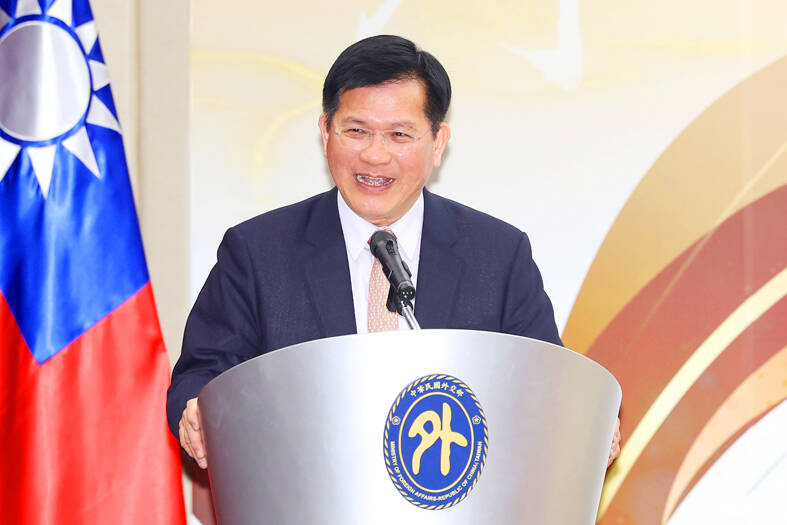
MISSION OF PEACE: The foreign minister urged Beijing to respect Taiwan’s existence as an independent nation and work together to ensure peace and stability in the region.
Minister of Foreign Affairs Lin Chia-lung yesterday firmly rejected Chinese Minister of Foreign Affairs Wang Yi’s comments regarding Taiwan, denouncing China as a “troublemaker” in the international community and a disruptor of cross-strait peace. The exchange highlights escalating tensions as Taiwan continues to assert its sovereignty.
Speaking at a news conference on the sidelines of the Chinese National People’s Congress, Wang Yi reiterated China’s longstanding position that Taiwan is an inseparable part of China, emphasizing that any pursuit of independence by Taiwan is “doomed to fail.” Wang cited historical documents such as the Cairo Declaration, Potsdam Declaration, Japanese Instrument of Surrender, and UN General Assembly Resolution 2758 as evidence of Taiwan’s status.
Historical Context and Legal Disputes
Wang Yi’s remarks are rooted in historical claims that the “return” of Taiwan to China was a natural outcome of the Chinese people’s resistance against Japan in World War II. He stressed that the Taiwan issue is a core interest of China and a red line that must not be crossed.
In response, Lin Chia-lung countered by emphasizing that under the Republic of China (ROC), Taiwan has always been an independent sovereign country, and neither the ROC nor the People’s Republic of China (PRC) are subordinate to each other. Lin cited the Treaty of San Francisco in 1951, a formal agreement signed between Japan and the Allied Powers after WWII, as having replaced wartime declarations.
“Whether based on historical facts, objective reality, or international law, Taiwan’s sovereignty has never belonged to the PRC,” Lin stated, adding that only the Taiwanese people have the right to decide the nation’s future.
Democratic Progress and Regional Stability
Taiwan’s journey towards liberalization and democratization, which began in the 1980s, culminated in the nation’s first democratic presidential election in 1996. Lin pointed out that these events have established the ROC as the only legitimate government representing Taiwanese people, consolidating the “status quo” of cross-strait relations.
Lin criticized recent military exercises conducted by China in the Taiwan Strait, arguing that they have severely affected regional peace and stability. He called on Beijing to respect Taiwan’s existence as an independent nation and work collaboratively to ensure peace and stability in the region.
The Ministry of Foreign Affairs (MOFA) urged the international community to condemn China’s unilateral attempts to alter the “status quo” through coercion, military threats, and intimidation.
International Reactions and Future Implications
Separately, the Mainland Affairs Council responded to Wang’s remarks by reaffirming its commitment to upholding the freedom and democracy of the ROC. “We believe that maintaining the status quo is in the best interests of the people on both sides of the Taiwan Strait,” it stated.
The announcement comes at a time when international scrutiny of cross-strait relations is intensifying. Analysts suggest that the global community’s response will be crucial in shaping the future dynamics between Taiwan and China.
Meanwhile, experts emphasize the importance of diplomatic engagement and dialogue to prevent further escalation. According to sources familiar with the matter, several countries have expressed support for Taiwan’s democratic values and its right to self-determination.
“The international community must stand united in opposing any form of aggression that threatens regional peace,” remarked a senior diplomat from a European nation.
The move represents a significant moment in Taiwan’s ongoing struggle for international recognition and autonomy. As tensions continue to simmer, the world watches closely, aware that the implications of this standoff extend far beyond the Taiwan Strait.