




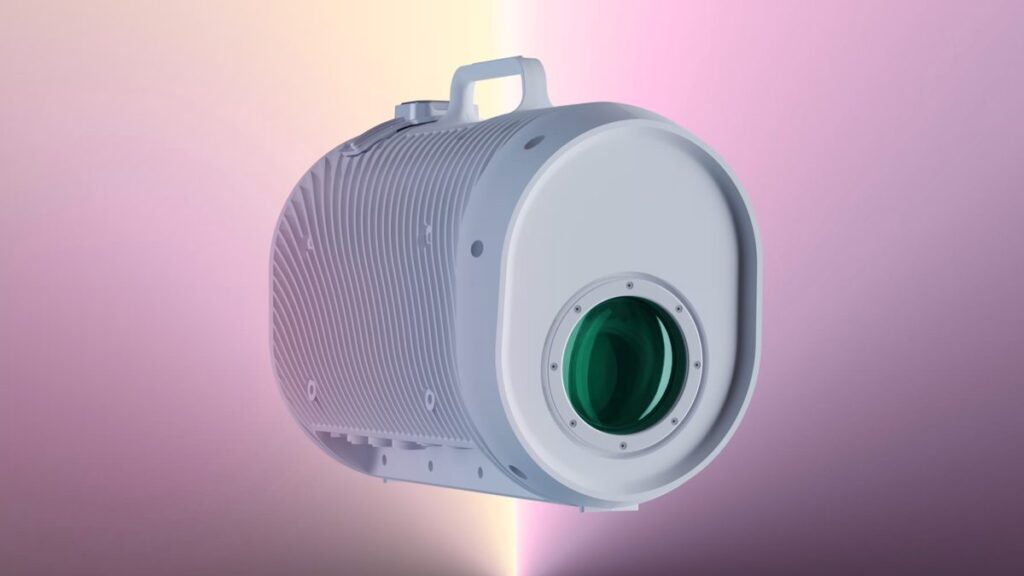
A startup spun off from Google’s parent company, Alphabet, has introduced a groundbreaking device capable of delivering fiber-optic internet speeds through the air, potentially revolutionizing broadband access in remote regions. The device, known as the Taara Beam, weighs 17 pounds and resembles a projector. It is engineered to transmit up to 25Gbps of internet data using near-infrared light across distances of up to 10 kilometers (6.2 miles). This innovative system can be mounted on cell towers or positioned on opposite sides of buildings.
The development comes from Taara, a company that emerged from Alphabet’s “moonshot factory” and became independent last year. Taara’s vision is to offer a more cost-effective alternative to traditional optical fiber by transmitting fiber-like internet speeds through the air. The technology is particularly appealing for Internet Service Providers (ISPs) and carriers, as it aims to provide a cheaper and faster solution for expanding broadband infrastructure.
Competing with Starlink
Taara’s system presents a potential alternative to SpaceX’s Starlink, which utilizes orbiting satellites to deliver high-speed internet primarily to rural and remote users. However, unlike Starlink, Taara is marketing its technology to ISPs and carriers instead of directly to consumers. This strategic choice could position Taara as a critical player in the telecommunications industry, offering a complementary solution to existing satellite-based services.
The new Taara Beam is approximately 50% smaller than its predecessor, the “Lightbridge” device, which had a throughput of up to 20Gbps and weighed nearly 29 pounds. Despite the reduced range of 10 kilometers compared to Lightbridge’s 20 kilometers, the smaller Beam device is expected to facilitate easier deployment and broader adoption.
Deployment and Advantages
According to Taara, the Beam device can be installed on rooftops, poles, or existing infrastructure within hours, eliminating the need for trenching, spectrum licensing, or right-of-way permits. The startup emphasized in a blog post,
“Where traditional infrastructure is slow or impractical to build, Beam provides a faster, more flexible alternative.”
Furthermore, Taara envisions the Beam as a tool for ISPs and mobile carriers to enhance network capacity in urban rooftops, enterprise campuses, data center clusters, and event venues. The Beam can also be integrated with the Lightbridge system to deliver internet connectivity across cities or neighborhoods, offering a versatile solution for various environments.
Challenges and Future Prospects
However, Taara faces significant challenges, particularly regarding weather conditions. Inclement weather, such as fog, can disrupt the over-the-air fiber beam. To address this issue, the startup recently announced the “Lightbridge Pro” system, which promises to deliver a
“99.999% uptime, even during bad weather.”
This advancement could be crucial in ensuring reliable service in diverse climatic conditions.
Looking ahead, Taara plans to showcase its new technologies at the upcoming Mobile World Congress (MWC) in Barcelona. This event presents an opportunity for the company to attract potential enterprise customers and expand its market reach. While the exact cost of the Beam remains undisclosed, Taara has indicated that it offers various pricing models, including hardware and connectivity-as-a-service, with pricing tailored to different geographical regions.
The introduction of the Taara Beam signifies a significant step forward in the quest to provide high-speed internet access to underserved areas. As the company continues to refine its technology and expand its market presence, the potential impact on the global telecommunications landscape could be substantial. With further advancements and strategic partnerships, Taara is poised to play a pivotal role in shaping the future of internet connectivity.