
There are no windows and no running water in the Qilawi family’s house in the southern suburbs of Damascus. Mohammed Qilawi, along with his two wives and five children, returned from Lebanon in recent months, having been forced out of their refugee camp back to what is now termed “liberated” Syria.
“Living in Lebanon, we even found it better than here,” Mr. Qilawi told the ABC. “But the problem is the camp pressured us very, very much [to return]. If they hadn’t pressured us, we wouldn’t have returned here to Syria.”
The family’s apartment building in Darayya was bombed by Syrian government forces during the suburb’s uprising against the regime, which saw it occupied by rebels from 2012 to 2016. Since their return, the family has cleared debris and laid carpets and mattresses on the concrete floor, scavenging wood from the wreckage to burn for warmth. Mohammed is also struggling to find work, a common plight among returnees.
“Life here is very, very hard because work has become scarce and we are getting by day by day,” Mohammed said. “There is work one day [but on another] I don’t work. And even diesel, and diapers, and milk [are unaffordable]. The situation is difficult.”
A Year of Liberation: A Mixed Reality
Today marks one year since Islamist rebels toppled the Assad dictatorship in Syria, ending nearly 14 years of civil war. Throughout the conflict, over six million Syrians fled overseas, many finding refuge in camps across the Middle East. Now, they are returning to a country still reeling from the war’s devastation, which claimed more than half a million lives.
The United Nations estimates that 1.2 million Syrian refugees have returned in the past year. Another returnee, Ahmed Atah Alawi, came back six months ago to find his Darayya apartment uninhabitable. “We want to fix just two rooms now, but they said it would cost 150 million Syrian pounds [$A18,500] and there is no money,” he explained.
Signs of Improvement Amidst Challenges
Syria’s civil war began in 2011 when the regime’s brutal crackdown on street protests ignited widespread discontent and rebellion. The nation fractured into regions controlled by various militias and the Islamic State. The Islamist rebels who ousted Bashar Al-Assad, primarily from Hay’at Tahrir al Sham, have since rebranded as Syria’s transitional government, pledging to prioritize recovery and improve international relations.
Syrians report that services have been slowly improving. At Damascus’s central public hospital, Al Mujtahed, the state of the morgue is a testament to progress. “All the mortuary cabinets were previously broken. After the liberation, all this was repaired,” morgue manager Nayef Hassan explained. “The situation is much better than before.”
Despite these improvements, challenges remain. The hospital’s emergency department is overwhelmed, and while medical supplies are now available, they are still limited. “Previously, the hospital was dilapidated to the extent that any patient visiting was forced to buy even the intravenous catheter,” logistics manager Wassim al Boukai noted.
Economic Struggles and Hopes for Recovery
Syria’s economy, severely contracted by the war, faces hyperinflation and widespread unemployment. The new government is attempting to rebuild the financial sector, receiving technical assistance from the International Monetary Fund. However, improvements have been slow to reach the general population, with cash shortages and restrictions persisting.
Prior to Assad’s fall, it took 22,000 Syrian pounds to buy one US dollar on the black market. Now the exchange rate is closer to 12,000 Syrian pounds to one US dollar ($A8,000).
In the Damascus produce market, fruits and vegetables cost between 5,000 to 10,000 pounds per kilogram, often of poor quality. Yet, some shoppers notice a slight improvement in food availability and prices. “The situation is very good, better,” Damascus resident Mohamad Hoda el Darwish remarked.
Celebrating Liberation Day Amid Uncertainty
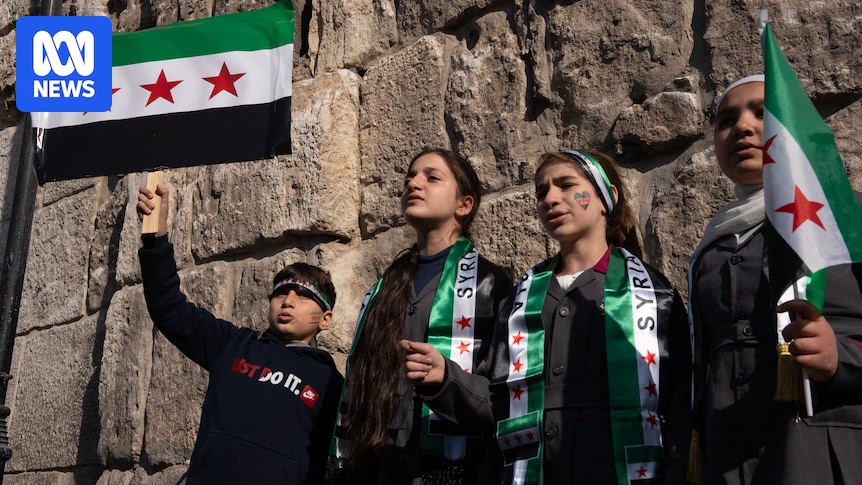
Billboards around Damascus herald December 8 as “Liberation Day,” marking the anniversary of Assad’s departure. The day is celebrated with slogans like “One Nation, one people” and features events such as a Revolutionary Military Expo displaying rebel-used vehicles and weapons.
Grade six teacher Rihane Atiye brought students to the Umayyad mosque to commemorate the day. “Liberation Day is a holiday that has great importance for the Syrian people because they suffered for 14 years from guilt and oppression and tyranny,” she said.
Despite the celebrations, many Syrians remain uncertain about the future, expressing distrust towards former jihadist fighters now in government roles. Security remains a concern, with armed “Internal Security Service” members patrolling the streets.
The government aims to drive recovery through investment rather than aid, but Western companies are hesitant to invest despite eased sanctions. Yet, the absence of conflict and gradual service improvements offer hope.
“You see this joy on everyone’s features, happiness, comfort, [and] freedom is the most precious thing for a human, honestly,” Ms. Atiye said.