



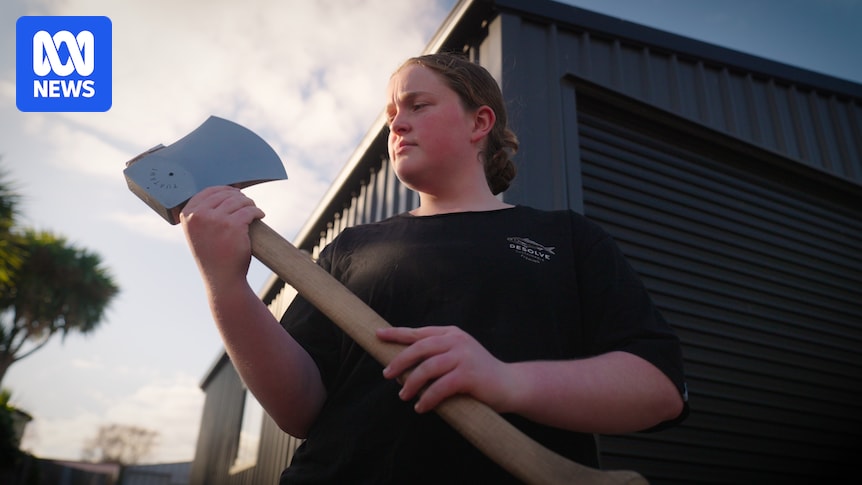
When 16-year-old Kallie steps onto her log and lifts her axe, a crowd has already gathered. Like her father, grandfather, and great-grandfather before her, woodchopping is part of her family’s legacy. However, Kallie is the first female in her family to embrace this tradition, joining a growing wave of women eager to prove their mettle in a sport long dominated by men.
“I’m trying to represent the younger girls because it’s a male-dominated sport, and I think having a role model really helps,” Kallie explained. Growing up in Tasmania, the birthplace of competitive woodchopping, she first picked up an axe at the age of 14. Despite initial concerns about safety, her father was thrilled to see her become the first female in the family to compete.
“My dad was so excited because I’ve always been my dad’s son in a way, and now we get to compete together,” she said. “Competing is what made me fall in love with woodchopping. Just the atmosphere and the crowds. And I love a crowd.”
Breaking Barriers in a Male-Dominated Sport
While some still doubt women’s place in the sport, Kallie finds encouragement in the support she receives. “I’d be walking into a toilet at a show, and people would say, ‘Oh, I saw you out there. Don’t give it up,'” she shared.
Last year, Kallie welcomed two local girls her age into the sport and recently competed against a newcomer in her 40s. “Before them, it was just me and the world champion, Amanda Beams, competing,” Kallie said. “On the log, we’re very competitive, then we come off and give hugs and say, ‘You did so well.'”
Amanda Beams, 54, first started competing as a teenager when her only option was to face male competitors. She sees the current growth as a pivotal moment. “I see it as, we’re a flower, we’re a bud, just starting to open,” Beams remarked.
The Evolution of Competitive Woodchopping
The rise in female participation is driving significant changes, with competitions across the country now introducing events that were once exclusive to men. “Timber sports are about to introduce a new discipline for women — which is the standing block. The springboard is coming too. This whole new world is opening up,” Beams noted.
The prize money is also catching up. “When I first started wood chopping, you were cutting for $250 at a royal show for first prize. Now, the world title at Sydney Show in the women’s underhand is $6,000,” Beams highlighted. This shift reflects the rising visibility of female competitors and the public’s growing interest in the sport.
“And luckily for us, the public love it. They just love watching women wood chopping and sawing,” Beams said.
Looking Ahead: The Future of Women in Woodchopping
Today, Beams holds five world titles in the underhand chop and two Jack and Jill sawing titles with her husband, fellow world champion Dale Beams. She’s also the captain of the Australian women’s woodchopping team. “We’re not at the level of the guys, but the competition now is in a really good place,” she acknowledged.
Kallie plans to compete interstate for the first time this year, a step her great-grandfather could never have imagined. Her journey and the broader movement of women into competitive woodchopping signal a transformative era for the sport, one where female athletes are carving out their own legacy.
As the sport evolves, the introduction of new events and increased prize money are likely to attract even more women, further diversifying the field and challenging traditional gender roles. The future of woodchopping is being reshaped, one swing of the axe at a time.