




The United States Supreme Court has delivered a significant blow to former President Donald Trump’s economic strategy by striking down the tariffs he imposed on foreign imports. The ruling, handed down recently, declared these tariffs illegal, prompting a furious response from Trump, who has vowed to explore alternative measures to reinstate them.
This landmark decision centers on the constitutional authority to impose tariffs, which resides with Congress rather than the President. Trump’s attempt to circumvent this by declaring national emergencies has been deemed unlawful by the judiciary. The Supreme Court’s ruling upholds a prior decision by the US Court of International Trade, which found that Trump’s emergency tariffs violated the law.
Understanding the Legal Battle
Under the US Constitution, the power to levy tariffs is vested in Congress. However, Trump sought to expand his executive authority by declaring two national emergencies last year. The first was a “public health crisis” targeting illegal drugs like fentanyl, while the second addressed “large and persistent” trade deficits. The White House argued that these declarations allowed Trump to implement “emergency tariffs” under the International Emergency Economic Powers Act (IEEPA).
Initially, Trump introduced “fentanyl tariffs” on imports from China, Mexico, and Canada, aiming to pressure these nations to curb drug smuggling. Later, he announced “reciprocal tariffs” on imports from nearly every other country to address trade imbalances. However, a coalition of businesses and a dozen US states challenged these actions in court, asserting that the President lacked the authority to impose tariffs unilaterally through emergency declarations.
The Court’s Ruling and Dissent
The Supreme Court’s decision aligns with the earlier judgment from the US Court of International Trade, affirming that the IEEPA does not grant the President the power to impose tariffs. Despite this, the ruling was not unanimous, with three of the nine justices dissenting. Justice Brett Kavanaugh, in his dissenting opinion, argued,
“The tariffs at issue here may or may not be wise policy, but as a matter of text, history, and precedent, they are clearly lawful.”
Impact on Existing Tariffs
The Supreme Court’s ruling specifically targets the tariffs Trump enacted under emergency orders, such as the 10 percent tariff on Australian imports. These country-specific tariffs have been nullified. However, tariffs on certain products, including aluminum, steel, copper, and vehicles, remain intact, as they were implemented under different legislative provisions.
Economics expert Justin Wolfers from the University of Michigan noted,
“Roughly speaking, what you should expect going forward is there will be tariffs on things rather than tariffs on countries.”
Trump’s Response and Future Strategies
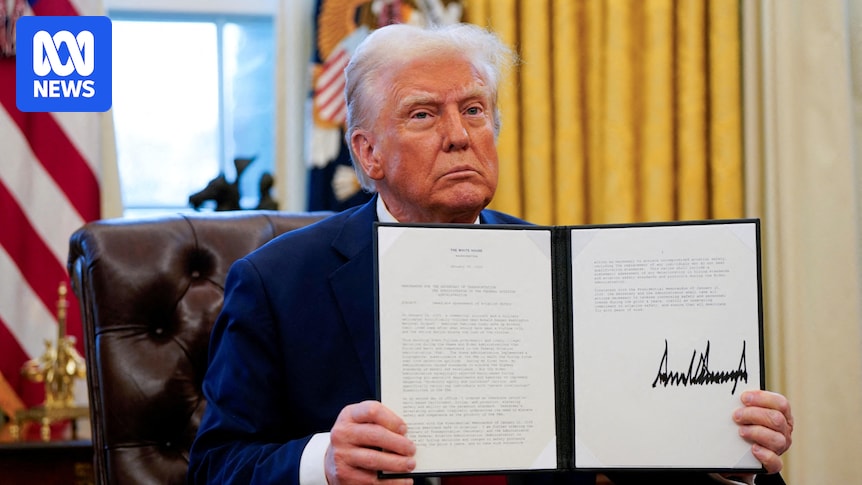
In response to the court’s decision, Trump expressed his outrage, labeling the ruling as “ridiculous” and accusing the justices of being “very unpatriotic and disloyal to our constitution.” Following the verdict, Trump signed an order imposing a new 10 percent tariff on various foreign imports, utilizing a section of trade law that permits such tariffs for a limited duration of 150 days.
US Trade Representative Jamieson Greer outlined potential strategies for reinstating tariffs, including expedited investigations under Section 301 of the Trade Act. This provision allows the President to impose tariffs on countries if investigations reveal unfair treatment of the US. Greer stated,
“We expect these investigations to cover most major trading partners and to address areas of concern such as industrial excess capacity, forced labor, and discrimination against US technology companies.”
Political Dynamics and Congressional Challenges
Despite Republican control of Congress, passing tariff-related legislation remains a challenge due to the party’s slim majority in the House of Representatives. Any bill would require unanimous Republican support, which is unlikely given past defections on similar issues. In February, a symbolic vote saw six House Republicans break ranks to oppose tariffs on Canadian goods, highlighting internal divisions within the party.
Implications for Australia and Potential Refunds
The Supreme Court’s decision has significant implications for international trade partners, including Australia. The 10 percent “baseline” tariff on Australian imports has been replaced by a temporary tariff under Section 122 of the Trade Act, limited to 150 days. Professor Wolfers emphasized that Trump’s ability to leverage tariffs as a diplomatic tool has been diminished.
The question of refunds for tariffs already paid remains unresolved. Importers affected by the tariffs are expected to pursue legal action to recover costs. Justice Kavanaugh acknowledged the complexity of the refund process, stating,
“The United States may be required to refund billions of dollars to importers who paid the IEEPA tariffs, even though some importers may have already passed on costs to consumers or others.”
For Australian companies, the potential for refunds exists, particularly for those with American subsidiaries or agreements with US importers to share tariff costs. Luke Branson, regional global trade leader for Oceania at Ernst & Young, noted that Australian companies could be owed up to $1.4 billion in refunds. He advised businesses to prepare submissions for refund processes through US Customs and Border Protection.
As the legal and political landscape surrounding tariffs continues to evolve, stakeholders worldwide are closely monitoring developments to assess the broader implications for international trade and economic policy.