




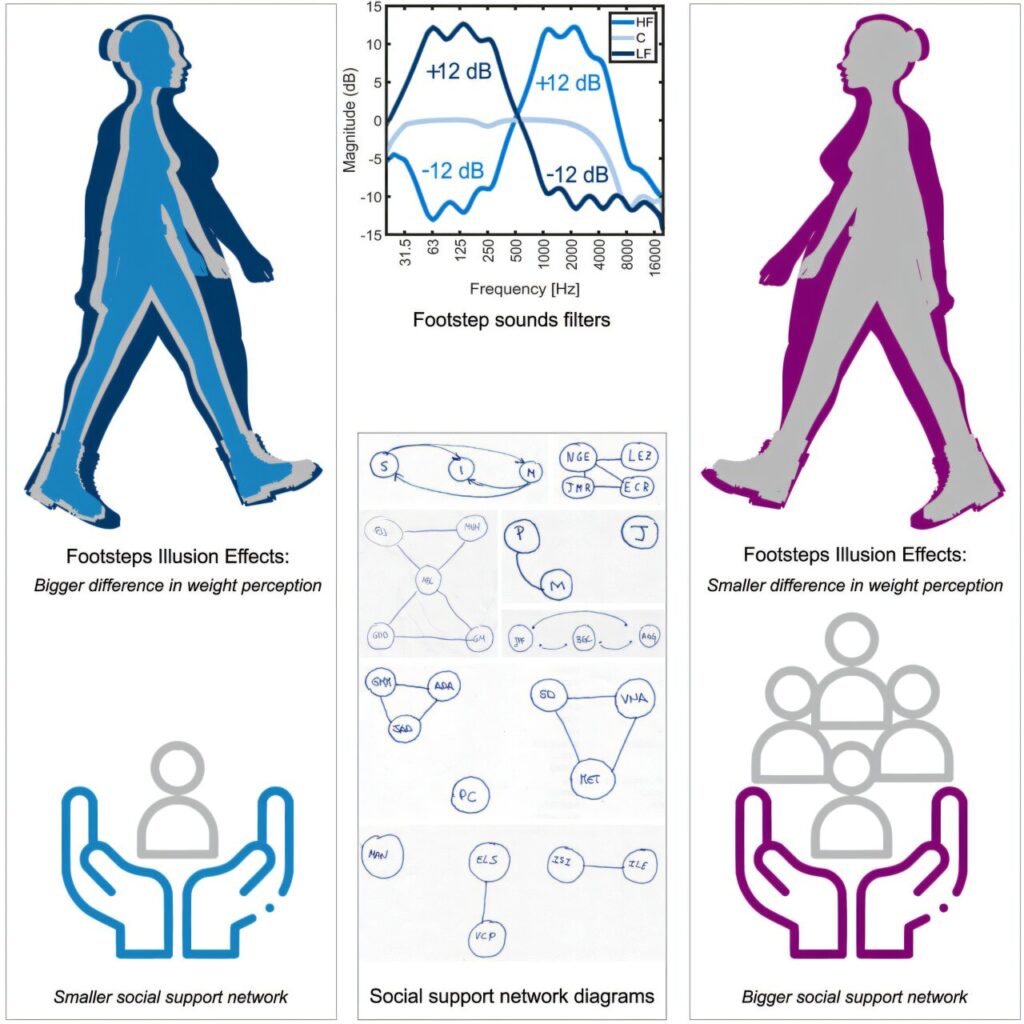
A groundbreaking study led by Universidad Carlos III de Madrid (UC3M) has uncovered the significant role that the size and composition of our social networks play in shaping our perception of body image. Published in the journal iScience, the research suggests potential new avenues for treating conditions such as body dysmorphic disorder, anorexia, and other eating disorders.
The study involved over 100 participants and utilized the “Footsteps illusion,” an innovative experiment where the sounds of a person’s footsteps are altered in real time to simulate those of a lighter or heavier body. This auditory manipulation was found to shift participants’ perception of their own weight, triggering a range of behavioral, emotional, and physiological responses. The experiment highlights the malleability of body image in response to sensory input.
Social Networks and Body Perception
Participants in the study were asked to walk while listening to three different types of footstep sounds: unmodified, sounds suggesting a lighter body, and sounds suggesting a heavier body. They also completed questionnaires assessing their body image, potential symptoms of eating disorders, and the extent of their social support networks.
The results revealed that individuals with larger and more diverse social networks were generally less affected by the sound illusion. They tended to be more satisfied with their body image and exhibited fewer symptoms of eating disorders. In contrast, those with smaller social networks experienced more pronounced effects from the auditory changes, indicating that body perception is influenced not only by sensory stimuli but also by the social environment.
“The implications of our study are that your circle of friends influences how you perceive your own body. If you have a wider circle of friends, you perceive your body in a more positive way,” said Anxo Sánchez, a researcher in the Department of Mathematics at UC3M.
Amar D’Adamo, another study author and researcher in the Department of Computer Science at UC3M, added, “People would think that self-perception depends on oneself, but in reality, it depends on the number of people who support you and surround you.”
Potential Interventions and Future Applications
These findings underscore the importance of broad and diverse social support in reinforcing stable body self-perception and protecting against external influences that could distort it. This discovery paves the way for new social interventions aimed at promoting a positive body image and mitigating the effects of weight-related stigma.
Moreover, the research team suggests the potential use of mobile applications to assist individuals struggling with body image issues. Ana Tajadura, head of the i_mBODY Lab and researcher at the Department of Computer Science at UC3M, explained, “At the i_mBODY Lab, we develop sensory technologies that allow us to change the perception of the body. We are also very focused on applications because we want to understand how we can use these technologies to support people.”
Implications for Mental Health and Society
The study’s findings have significant implications for mental health professionals and policymakers. By understanding the role of social networks in body image perception, interventions can be tailored to enhance social support systems for individuals at risk of developing eating disorders. This approach could lead to more effective prevention strategies and therapeutic outcomes.
Historically, body image has been a topic of concern, particularly in societies with high cultural emphasis on physical appearance. This research adds a new dimension to our understanding by highlighting the social factors that contribute to body image perceptions. As society continues to grapple with issues of body positivity and mental health, these insights could inform public health campaigns and educational programs.
Looking forward, further research could explore how digital social networks and online communities influence body image, especially in an era where social media plays a dominant role in shaping self-perception. The integration of technology with traditional therapeutic approaches could offer innovative solutions for those struggling with body image disorders.
As the study concludes, the relationship between social networks and body image is complex but crucial. By fostering supportive social environments, we can help individuals build a healthier perception of themselves, ultimately contributing to better mental health and well-being.