



Endorsed by the United Nations General Assembly in 2015, the Sendai Framework for Disaster Risk Reduction aims to achieve a substantial reduction in disaster-related losses and risks across all sectors and scales. Central to this intergovernmental agreement is the recognition of science as a critical foundation for understanding, assessing, and mitigating disaster risk. A decade on, the global disaster risk reduction community convened in Geneva, Switzerland, in June 2025 to assess progress, identify challenges, and propose strategies to accelerate implementation.
This gathering raised concerns about a potential weakening of key aspects of the science-policy interface underpinning the Framework’s goals. It also considered the actions necessary to ensure the scientific community plays a full role in informing and shaping work to and beyond 2030. Disasters are complex and interdisciplinary challenges, requiring contributions from diverse actors. While nation-states have a primary responsibility to reduce disaster risk, the Sendai Framework encourages a multi-stakeholder approach, with a clear role for the science and technological community.
The Role of Science in Disaster Risk Reduction
The Sendai Framework articulates a role for the scientific community in delivering its objectives, with several specific references to science throughout. A guiding principle of the Framework emphasizes the need for easily accessible, up-to-date, comprehensible, science-based, non-sensitive risk information, complemented by traditional knowledge. At regional and global levels, there is an agreed action to enhance the scientific and technical work on disaster risk reduction and its mobilization through the coordination of existing networks and scientific research institutions.
At national and local levels, agreed actions include supporting and facilitating science-policy interfaces for effective decision-making in disaster risk management. The mobilisation of the scientific community is suggested to assist in enhancing methods and standards for risk assessments and disaster risk modelling, encourage effective data use, help identify gaps and priorities in research and technology, and support the integration of scientific knowledge into decision-making processes.
Challenges in the Science-Policy Interface
Despite the emphasis on science, evidence suggests there is considerable scope to rejuvenate and improve the structures and systems that facilitate dialogue with scientists at the intergovernmental level. Several mechanisms appear stagnant, lack clear guidance on participation, or are implemented in an ad hoc manner that hinders effective and inclusive participation. For instance, online information about the Global UNDRR Science and Technology Advisory Group (STAG) includes outdated member lists and terms of reference.
Unclear guidance on how advisory groups function and recruit members may result in perspectives from the globally diverse scientific community not being embedded into the advice provided to UNDRR and other UN-level agencies. While scientific insights may be brought into discussions via other stakeholders, direct participation at the global level strengthens the science-policy interface.
Strengthening the Science-Policy Interface
Given the importance of the scientific community to advancing the Sendai Framework, action is needed to reverse the potential weakening of the science-policy interface. Here are some recommendations on how we can leverage the potential of the scientific community to support global disaster risk reduction efforts:
Inclusive Mechanisms for Science Representation
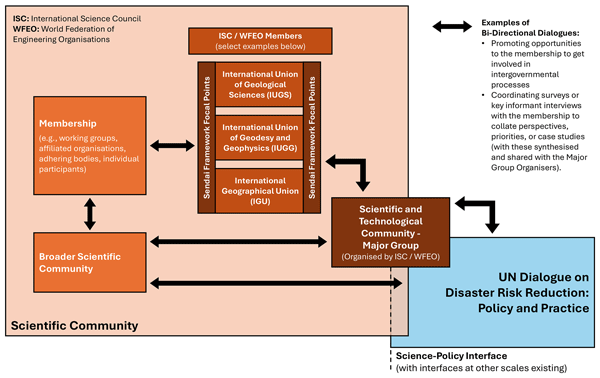
- Readily accessible information about the independent coordinating mechanism for the science and technology community in the Sendai Framework, including ways of engaging and the groups coordinating it.
- Dedicated focal points within international unions and other scientific organizations to support a bidirectional flow of information into and out of that coordinating mechanism.
- A commitment to open and inclusive practice by the Major Group of Stakeholders: Scientific and Technological Community, ensuring meaningful opportunities to contribute to calls for evidence and the shaping of policy positions.
Collation and Sharing of Learning
- Thematic and geographically specific reports capturing emerging priorities and innovations presented at scientific conferences.
- Major scientific journals with a risk reduction focus appointing a dedicated editorial role to promote access to and understanding of the journal’s content by other disaster risk reduction stakeholders.
Future Directions
While mechanisms have been established to support the science-policy interface required to implement the Sendai Framework, work is needed to refresh these in the next five years as we seek to deliver action and as dialogues commence on the post-2030 agenda. The primary goal of the Sendai Framework is the substantial reduction of disaster risk and losses in lives, livelihoods, health, and in the economic, physical, social, cultural, and environmental assets of persons, businesses, communities, and countries.
Reducing disaster risk is key to advancing sustainable development objectives. As we work towards these ambitions, we must recognize that structures and mechanisms can both hinder and catalyze progress. Achievements to date can be lost or their full potential never realized if we don’t capture, share, and build on good practice and ensure improved access to scientific understanding, data, tools, and products. Rejuvenating and strengthening the science-policy interface required to deliver the Sendai Framework should be an urgent priority if we are to secure the progress expected – and needed – by communities around the world.