



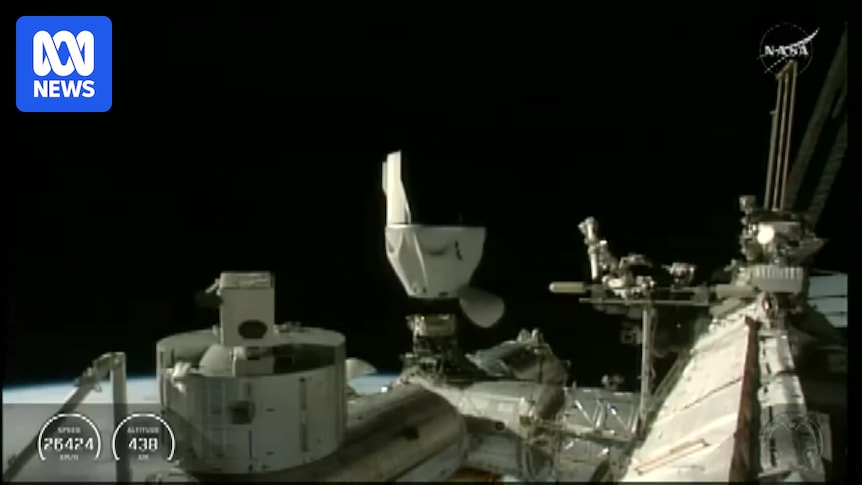
A SpaceX Crew Dragon capsule has undocked from the International Space Station (ISS) and is making its way back to Earth, carrying four astronauts, one of whom requires urgent medical attention due to a “serious medical condition.” The capsule is expected to splash down in the Pacific Ocean off the coast of California early Thursday, local time.
The capsule, which includes two NASA astronauts, a Japanese astronaut, and a Russian cosmonaut, began its descent from orbit at approximately 9:20 am AEDT (2220 GMT). The crew onboard consists of NASA astronauts Mike Fincke and Zena Cardman, Roscosmos cosmonaut Oleg Platonov, and JAXA astronaut Kimiya Yui.
Emergency Return Due to Medical Condition
The emergency return was announced on January 8 by NASA Administrator Jared Isaacman, who stated that one of the astronauts was facing a “serious medical condition” necessitating immediate medical intervention upon return to Earth. However, NASA has withheld the identity of the affected astronaut and the specifics of the medical issue, citing privacy concerns.
The Crew Dragon’s departure was captured via a live NASA webcast, showing the capsule separating from the ISS and drifting away as both vehicles orbited approximately 418 kilometers above Earth, south of Australia. The astronauts were visible inside the cabin, secured in their seats and wearing their distinctive white and black space suits.
Mission Background and Context
The Crew-11 mission, which launched from Florida in August, was originally scheduled to return a few weeks later. The crew had been engaged in various scientific and maintenance activities aboard the ISS. Notably, Mr. Fincke, the station’s commander, and Ms. Cardman, a flight engineer, were slated to perform a spacewalk last week to install new hardware. This spacewalk was canceled on January 7 due to what was then described as a “medical concern” with an astronaut.
NASA Chief Health and Medical Officer James Polk later clarified that the medical emergency did not stem from an injury related to operational activities. The decision to return the crew early underscores the priority placed on astronaut health and safety during space missions.
Implications and Future Considerations
If the splashdown proceeds as planned, it will conclude a 167-day mission for the Crew-11 team. The incident highlights the challenges of maintaining astronaut health in the isolated and confined environment of space. Medical emergencies in orbit present unique challenges, requiring coordination between space agencies and rapid response capabilities to ensure the well-being of crew members.
SpaceX and NASA have demonstrated their ability to adapt to unforeseen circumstances, ensuring the safety of their astronauts through timely decision-making and technical expertise. The successful return of the Crew Dragon will further solidify the capabilities of commercial spaceflight in handling emergencies.
“The safety of our astronauts is our top priority, and we are committed to ensuring they receive the best care possible,” said NASA Administrator Jared Isaacman.
As the space industry continues to evolve, the experiences and lessons learned from missions like Crew-11 will inform future protocols and technologies aimed at enhancing the safety and health of astronauts on long-duration missions.
Meanwhile, the space community awaits further updates on the condition of the affected astronaut and the outcomes of the medical evaluations that will follow the crew’s return to Earth.