



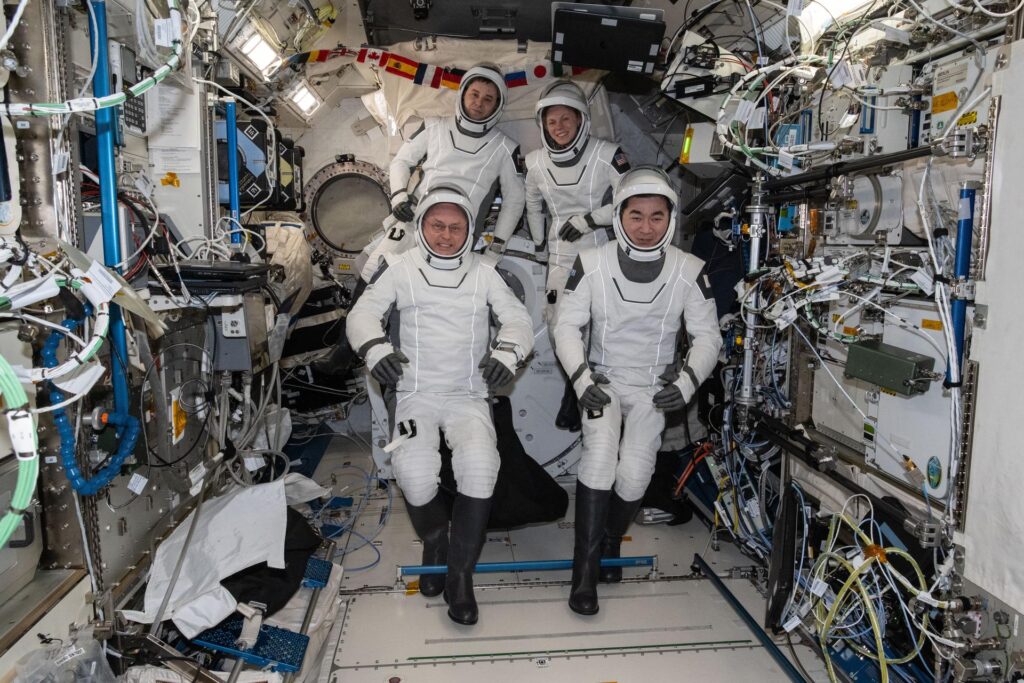
After months of orbiting Earth aboard the International Space Station (ISS), the astronauts of the SpaceX Crew-11 mission have returned to solid ground. Their return marks the conclusion of a long-duration expedition that combined cutting-edge science with a powerful demonstration of international cooperation in space exploration.
The crew, consisting of NASA astronauts Mike Fincke and Zena Cardman, JAXA astronaut Kimiya Yui, and Roscosmos cosmonaut Oleg Platonov, dedicated their mission to advancing research critical to humanity’s return to the Moon and eventual journeys to Mars. Cardman, Fincke, and Yui alone logged more than 850 hours of scientific work during their time aboard the ISS.
Strengthening the Human Body for Deep Space
One of the mission’s most significant investigations focused on bone stem cells in microgravity. Working inside the station’s Life Science Glovebox, Zena Cardman contributed to a study aimed at understanding why astronauts experience bone density loss in space. The findings from this research could lead to improved countermeasures for long-duration space missions and inform new treatments for osteoporosis on Earth.
Dr. Susan Bailey, a researcher specializing in space medicine, highlighted the importance of this study, stating, “Understanding bone loss in microgravity is crucial for ensuring the health of astronauts on future missions to Mars and beyond.”
Technology to Clean Up Orbit
In addition to biological research, Mike Fincke tested an experimental inflatable capture bag designed to open and seal reliably in weightlessness. This technology holds potential for removing dangerous debris from Earth’s orbit, capturing samples during exploration missions, or even assisting with operations involving small asteroids.
The development of such technology is timely, as the issue of space debris becomes increasingly pressing. According to the European Space Agency,
“There are currently over 34,000 pieces of debris larger than 10 cm orbiting Earth.”
The successful implementation of capture technology could mitigate the risks posed by this debris.
Watching Earth and Beyond
From the station’s cupola, Kimiya Yui continued a decades-long tradition of photographing Earth’s changing surface. These images play a vital role in supporting climate science, disaster monitoring, and urban planning. The astronauts also used the station’s windows to observe stars and atmospheric airglow without the distortion caused by Earth’s atmosphere.
Yui remarked on the beauty and fragility of our planet, noting, “Seeing Earth from space reminds us of the importance of protecting our home.”
Food, Cargo, and Human Health
Crew-11 also supported the arrival of JAXA’s new HTV-X1 cargo spacecraft, enhancing the station’s capacity to deliver science and supplies. Meanwhile, Yui worked on producing nutrient-rich yogurt using microorganisms, a step toward making vitamins on demand during deep-space missions.
Additionally, Mike Fincke wore a non-invasive temperature-sensing headband to study how the human body regulates heat in orbit. This technology could one day protect workers on Earth in extreme heat conditions, offering potential applications beyond space exploration.
A Quarter-Century in Orbit
The mission coincided with a historic milestone: 25 years of continuous human presence aboard the International Space Station. Since the arrival of its first crew, more than 290 people from 26 countries have lived and worked on the orbiting laboratory, contributing to a legacy of international collaboration and scientific advancement.
As Crew-11 returns home, their research legacy continues to shape safer spacecraft, healthier astronauts, and a clearer path toward humanity’s next giant leap. The lessons learned and technologies developed during their mission will undoubtedly play a crucial role in future space endeavors.
The return of Crew-11 underscores the ongoing commitment to exploring the final frontier, with an eye towards the Moon, Mars, and beyond. As the world looks to the stars, the achievements of these astronauts remind us of the potential for human ingenuity and cooperation in the vast expanse of space.