




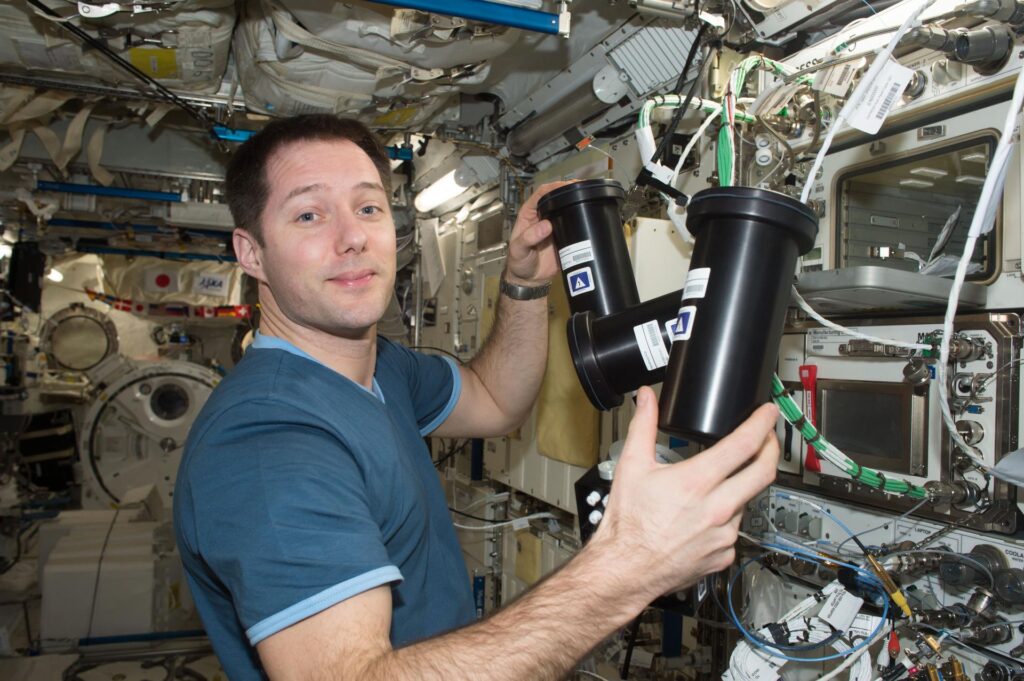
In a groundbreaking development, the International Space Station (ISS) has once again proven its value beyond the realm of space exploration. NASA has opened the ISS to scientists and researchers, allowing them to exploit the unique benefits of microgravity for private industry research, technology demonstrations, and more. This initiative has led to significant advancements in medical research, including a recent U.S. Food and Drug Administration (FDA) approval for a new cancer therapy.
Merck Research Labs, supported by insights gained from ISS experiments, received FDA approval in September for a new injectable version of pembrolizumab, commercially known as KEYTRUDA. This medication, used to treat several types of early-stage cancers, has been enhanced through research conducted aboard the space station. The new injectable formula reduces treatment times while maintaining efficacy, marking a significant milestone in cancer therapy.
Revolutionizing Cancer Treatment
The traditional delivery of pembrolizumab required an in-office infusion therapy, a process that could take up to two hours. Subsequent improvements reduced infusion times to less than 30 minutes every three weeks. The newly approved subcutaneous injectable form, however, can be administered in just one minute every three weeks. This advancement promises not only to reduce costs but also to significantly decrease treatment times for both patients and healthcare providers.
Since 2014, Merck has conducted crystal growth experiments on the ISS to better understand the formation of crystals, including the monoclonal antibody used in this cancer treatment. Monoclonal antibodies are lab-made proteins that assist the body in fighting diseases. The research focused on producing crystalline suspensions that dissolve easily in liquid, facilitating the delivery of the medication by injection.
The Role of Microgravity in Medical Advancements
In microgravity, the absence of gravity’s physical forces allows scientists to grow larger, more uniform, and higher-quality crystals than those produced in ground-based laboratories. This capability has been crucial in advancing medication development and structural modeling. Research conducted aboard the ISS has provided valuable insights into how gravity influences crystallization, which in turn has helped improve drug formulations.
“The work of NASA and its partners aboard the space station not only improves lives on Earth but also grows a commercial economy in low Earth orbit and prepares for human exploration of the Moon and Mars.”
Implications for Future Research and Exploration
The approval of the injectable form of pembrolizumab represents a significant step forward in cancer treatment, underscoring the potential of space-based research in addressing complex health challenges on Earth. The collaboration between NASA and private industry exemplifies how space exploration can yield tangible benefits for terrestrial medicine.
Meanwhile, the success of this research initiative highlights the growing importance of the ISS as a platform for scientific discovery and innovation. As NASA continues to open the space station for various research endeavors, the potential for breakthroughs in other fields, such as pharmaceuticals and materials science, is immense.
Looking Ahead: The Future of Space-Based Research
As the world looks to the future, the role of space-based research in advancing human health and technology becomes increasingly significant. The ISS National Laboratory’s contributions to the development of new therapies demonstrate the potential for space exploration to drive innovation and improve quality of life on Earth.
The successful collaboration between NASA, Merck, and other partners serves as a model for future endeavors. With the continued support of international space agencies and private industry, the possibilities for further advancements are limitless. As humanity prepares for deeper space missions, the knowledge gained from the ISS will undoubtedly play a crucial role in ensuring the success and safety of these endeavors.
In conclusion, the recent FDA approval of the injectable cancer therapy is a testament to the transformative power of space station research. As NASA and its partners continue to push the boundaries of what is possible, the benefits of these efforts will be felt not only in space but also in the lives of people around the world.