



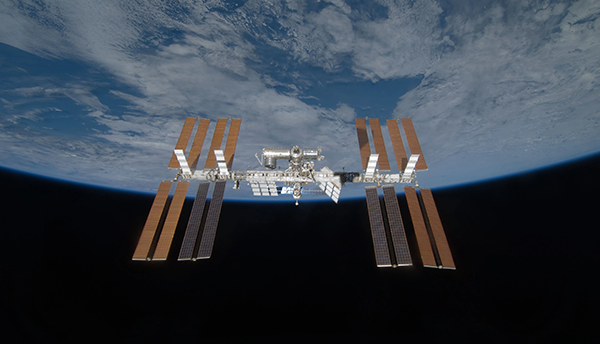
Wrapped snugly in a custom container, seven carefully chosen materials left Earth on August 24, 2025, traveling at 17,500 mph. Nestled atop a Falcon 9 rocket, house dust, freeze-dried human liver, and cholesterol joined four other scientific specimens on their journey to the International Space Station (ISS). These thoroughly studied samples, known as reference materials, play crucial roles on Earth and now aim to do the same in space. As space becomes a domain for habitation, research, and even business, understanding the effects of outer space on everyday objects is essential. For instance, drug development is already occurring in low Earth orbit, and as this research expands, so will the need for reference materials.
This mission was a collaborative effort among the National Institute of Standards and Technology (NIST), the National Oceanic and Atmospheric Administration (NOAA) Office of Space Commerce, and the biotech company Rhodium Scientific. Their goal is to bolster U.S. leadership in the space sector by advancing commercial and scientific capabilities in outer space. This initiative also aligns with the objectives of two recent executive orders on U.S. space activities.
Understanding Reference Materials
From spinach and cement to human fecal matter, over a thousand different reference materials are stored in a Maryland warehouse, ready to be shipped to companies and scientists worldwide. Many research fields and industries rely on the reference materials developed by NIST. Laboratories use these materials to calibrate their measurement devices, ensuring accurate readings. For example, NIST’s cholesterol reference material helps medical labs verify the accuracy of their cholesterol-measuring instruments, a vital quality control measure for monitoring health.
Reference materials also facilitate scientific communication across time and space. If a researcher uses a reference material in a study, others can replicate that experiment using the same reference, even if they are on a different continent decades later.
Six of the seven materials sent on this mission are standard reference materials (SRMs), meeting NIST’s highest measurement standard. These include cholesterol, tripalmitin, house dust, creatinine, urea, and uric acid. The seventh sample, the human liver, is a reference material, NIST’s next-highest standard.
The Rationale for Sending Materials to Space
Space affects people and objects in unexpected ways. The low-gravity environment causes astronauts to lose bone density and can weaken their cardiovascular systems. Above Earth’s protective magnetic field, radiation from the Sun and other stars is more potent.
One stark example of space’s impact is a 2023 elementary school project that showed epinephrine, a drug for treating life-threatening allergic reactions, chemically transforms into poisonous benzoic acid when exposed to cosmic radiation. Such transformations could pose serious risks to astronauts and space tourists.
However, the chemical changes caused by space are not all negative. For instance, protein crystals grow more evenly in microgravity. Scientists on the ISS studied the cancer drug Keytruda, made of protein crystals, leading to a more convenient injectable version of the drug.
“There are opportunities for whole categories of research and manufacturing in space, and standards will play an important role out there, just like on Earth,” said NIST research chemist Dianne Poster, senior adviser to NOAA’s Office of Space Commerce.
Scientists still lack comprehensive knowledge about how space affects molecules crucial to human health. Space may induce subtle but significant changes in organic molecules in liver and other tissues.
“If people are going to be in space for any extended time, they’re going to have to do medical testing, and we’ll need to know how stable their cholesterol and urine molecules are in space and on Earth,” explained NIST scientist Kate Rimmer. “These SRMs are an early step in getting that better understanding.”
The Significance of the Chosen Materials
The seven reference materials were selected for their importance to human health and ease of launch into orbit. These SRMs are in dry powder form, allowing them to be stored at room temperature, unlike blood plasma reference materials, which require storage at minus 80 degrees Celsius.
These materials are some of NIST’s best-measured. Five are “primary chemistry standards,” extremely pure and stable chemicals. “Primary standards are measured as completely as possible with current technology,” said Rimmer, “and because of this, they are the starting point for many other chemical measurements.”
The house dust SRM, though not a primary standard, was chosen for its comprehensive characterization and its content of various chemicals affecting human health. Collected from vacuum cleaner bags across six U.S. states, this dust contains everyday chemicals like outdoor pollutants and pesticides.
“Dust contains chemicals that people are exposed to every day, like outdoor pollutants from vehicle emissions and pesticides – all those things make their way into house dust,” explained Poster. “It’s a very good reservoir of these contaminants.”
Studying house dust offers insights into indoor air quality, chemical movement indoors, and potential health risks. As space becomes more populated and commercial space stations emerge, analyzing dust could help manage air quality in closed environments.
“Standardizing how we measure biological and chemical changes in space is essential for creating a resilient, self-sustaining ecosystem where research and commerce can thrive,” said Gabriel Swiney, director of NOAA’s Office of Space Commerce’s Policy, Advocacy and International Division. “This mission is a critical step toward a more dynamic and scalable space economy.”
Future Steps and Implications
NIST packaged the reference materials in space travel-specific containers designed by Rhodium. During their time in space, the materials will remain in their packaging until their return. After the mission, some samples will be sent to Rhodium’s Space BioBank for future research.
“Sending a sample to space for research can take years and cost millions of dollars,” explained Rhodium CEO Olivia Holzhaus. “The key idea behind the BioBank is to have lots of different samples that have already been to space ready for testing and instantly available, making space research faster and more efficient.”
Other samples will return to NIST, where scientists will employ advanced techniques such as nuclear magnetic resonance spectroscopy to assess any chemical changes during their time on the ISS. Even if no changes occur, this information will be valuable for future space research.
“There aren’t really any physical artifact reference materials for space right now,” said Rimmer. “We’re hoping to help develop the first.”
This pioneering mission marks a significant step in understanding and standardizing the effects of space on various materials, paving the way for future research and commercial endeavors in space.