




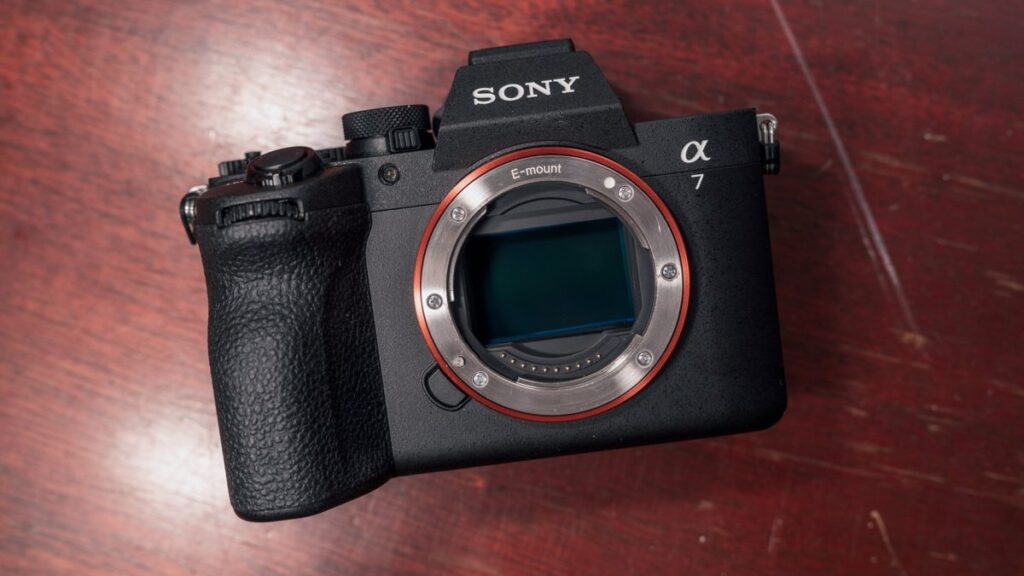
For the first time, Sony finds itself playing catch-up in the competitive world of full-frame cameras. The newly launched a7 V, priced at $2,899.99 for the body only, introduces a 33MP Partially Stacked CMOS sensor capable of shooting 14-bit Raw images at a blistering 30fps. It records full-width 4K60 video with 10-bit color and enhances the already impressive autofocus system of its predecessor, the a7 IV. This new model positions Sony at the forefront of action photography, surpassing the Nikon Z6III and Canon EOS R6 Mark III. Despite the close competition, the a7 V earns the Editors’ Choice award for full-frame generalist cameras.
The announcement comes as the photography industry faces rapid technological advancements, with manufacturers racing to integrate cutting-edge features. Sony’s a7 V, with its advanced capabilities, aims to redefine expectations for full-frame cameras, offering a blend of speed, resolution, and dynamic range.
Design and Build: Familiar Yet Refined
At first glance, the a7 V might be mistaken for its predecessors, the a7 IV or a7 III. Sony’s design language remains consistent, offering a sense of familiarity to those upgrading from older models. The camera measures 3.8 by 5.1 by 3.2 inches and weighs 1.5 pounds, making it comparable in size to competitors like the Nikon Z6III and Canon EOS R6 Mark III. Notably, the a7 V’s rear LCD features a dual-axis hinge, adding a couple of millimeters to its depth.
The a7 V boasts a 33MP Partially Stacked BSI CMOS sensor stabilized across five axes, providing a CIPA-rated 7.5 stops of compensation. Its weather-sealed magnesium alloy body ensures durability, while the large electronic viewfinder, articulating rear display, and dual memory card slots enhance usability.
Available as a body-only option or bundled with the new FE 28-70mm F3.5-5.6 OSS II zoom lens for $3,099.99, the a7 V caters to both existing Sony E-mount lens users and new buyers. The new lens promises faster autofocus, supporting the camera’s 30fps drive and the 120fps capability of the a9 III.
Lens Compatibility: A Broad Ecosystem
Sony’s early entry into the mirrorless market has given it a five-year head start over Canon and Nikon, resulting in a wider variety of first and third-party lenses. While Canon and Nikon are selective about third-party lens compatibility, Sony has embraced it from the start, allowing photographers access to a diverse range of options.
I tested the a7 V with several lenses, including the FE 100mm F2.8 Macro GM OSS and FE 85mm F1.8, as well as third-party options from Sigma and 7artisans. While most lenses worked seamlessly, the Viltrox 35mm F1.2 Lab caused the camera to lock up twice. Viltrox is aware of the issue and is working on a firmware update to resolve compatibility problems.
Control Layout: Intuitive and Unchanged
The a7 V’s control scheme mirrors that of the a7 IV, ensuring a smooth transition for upgraders. The familiar placement of buttons and dials makes it easy for users to adapt, while those switching from other brands may need to adjust their muscle memory. The camera features a front command dial, shutter release, and various customizable buttons, maintaining Sony’s thoughtful layout.
Display and Power: Leading the Class
Sony has addressed past criticisms by equipping the a7 V with an impressive 3.2-inch, 2.1-million-dot touch display, matching the quality of its competitors. The screen’s dual articulation points allow for versatile positioning, catering to both photographers and videographers.
The a7 V’s battery life sets a new standard, offering 630 EVF/750 LCD exposures per charge. This efficiency surpasses rivals like the Nikon Z6III and Canon EOS R6 Mark III. Dual USB-C ports facilitate charging and connectivity, making the a7 V an ideal choice for live streaming and on-the-go shooting.
Autofocus and Image Quality: Cutting-Edge Performance
The a7 V builds on Sony’s renowned Real Time Tracking focus system, introducing new subject recognition modes for insects, cars, and airplanes. Macro photographers will appreciate the insect detection feature, while the camera’s tracking mode excels at maintaining focus on moving subjects.
The 33MP sensor delivers exceptional image quality, with a wide ISO range and impressive dynamic range. Although Raw support in Lightroom is pending, early reports indicate the a7 V offers over 12 stops of dynamic range at base ISO, ensuring ample room for post-processing adjustments.
Video Capabilities: Solid, Yet Not the Leader
While the a7 V excels in still photography, its video capabilities, though strong, do not outshine competitors like the Canon EOS R6 Mark III or Nikon Z6III. The camera supports full-width 4K60 video and cropped 4K120 slow-motion, but lacks the open gate and Raw video options available in some rival models.
Sony’s video engine remains robust, offering excellent 4K picture quality and effective noise reduction. The a7 V’s new microphone system enhances audio capture, though external microphones are recommended for optimal sound quality.
In conclusion, the Sony a7 V sets a new benchmark for full-frame cameras, combining speed, resolution, and versatility. While it may not lead in every category, it offers a compelling package for photographers and videographers alike, solidifying Sony’s position at the forefront of the industry.