




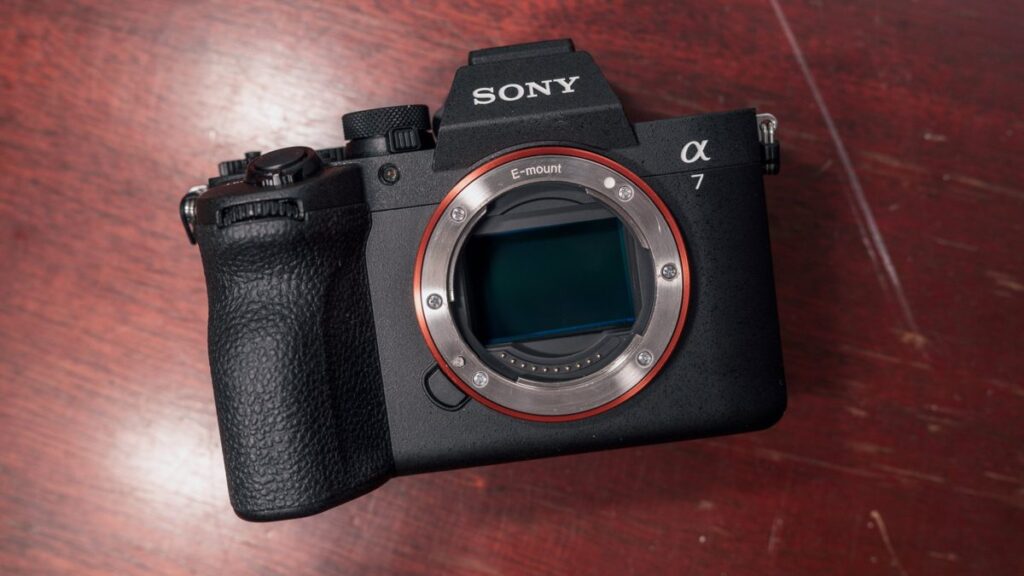
For the first time, Sony finds itself in a position of playing catch-up with its mainstream full-frame camera body, rather than leading the pack. The newly released Sony a7 V, priced at $2,899.99 for the body only, is a testament to the brand’s commitment to innovation. This camera debuts a 33MP Partially Stacked CMOS sensor, capable of capturing 14-bit Raw images at a rapid 30 frames per second. It also records full-width 4K60 video with 10-bit color, enhancing the already impressive tracking autofocus system of its predecessor, the a7 IV. This makes the a7 V a formidable choice for action photography, surpassing the older a7 IV, which remains available for around $2,000. It also outperforms the Nikon Z6III and Canon EOS R6 Mark III in several aspects, earning the a7 V our Editors’ Choice award among full-frame generalist cameras.
The announcement comes as the photography world continues to evolve, with Sony maintaining its lead among the trio of top competitors. However, the performance gap is narrow enough that photographers can’t go wrong with any of these models.
Design: Familiar Yet Improved
At first glance, the a7 V may appear similar to its predecessors, the a7 IV and a7 III. Sony’s design language has remained consistent over the years, and while there are subtle changes with each iteration, the a7 V feels familiar to those upgrading from older models. Its dimensions are typical for the class, measuring 3.8 by 5.1 by 3.2 inches and weighing 1.5 pounds with the battery and memory card installed. This is comparable to the Nikon Z6III and Canon EOS R6 Mark III.
The a7 V boasts all the features expected of a nearly $3,000 full-frame camera. Its 33MP Partially Stacked BSI CMOS image sensor is stabilized across five axes, offering a CIPA-rated 7.5 stops of compensation. The weather-sealed, magnesium alloy body is built to last, and it includes a large, sharp electronic viewfinder, an articulating rear display, and dual memory card slots.
Lens Compatibility and Options
The a7 V can be purchased as a body only or in a kit with the new FE 28-70mm F3.5-5.6 OSS II zoom lens for $3,099.99. Sony claims this lens has faster autofocus than its predecessor, supporting the a7 V’s 30fps drive and the 120fps on the a9 III. Photographers using Sony cameras benefit from a wider variety of first and third-party lenses compared to Canon and Nikon, thanks to Sony’s early entry into the mirrorless market and its openness to third-party lens makers.
However, some compatibility issues have been reported. YouTuber Kai Wong highlighted that the a7 V has trouble with certain lenses. While Sigma lenses and 7artisans models work well, the Viltrox 35mm F1.2 Lab caused the camera to lock up. Viltrox is aware of the issue and is working on a firmware update. Despite this, such issues are often resolved with firmware updates, a common occurrence in the digital age.
Controls and Usability
The a7 V retains Sony’s familiar control layout, making it easy for users to transition from the a7 IV without missing a beat. The buttons and dials are in the same locations, ensuring a seamless upgrade experience. For those switching from other brands, some adjustment may be necessary, but the transition is generally smooth.
The front command dial is integrated into the handgrip, positioned for easy access. The shutter release, collared by the On/Off switch, sits atop the grip, with the Record and C2 buttons just behind it. The camera also features a PASM Mode dial with three custom slots, although it lacks the locking post found on pricier models like the a7R V.
Customizable Interface
The a7 V allows for extensive customization of button functions, with the exception of a few like the Fn, Menu, and shutter release. The menu system is organized with side tabs and color coding, offering a single-page control panel for quick access to common functions and a configurable My Menu page. The Fn button provides access to a quick on-screen overlay menu with 12 configurable banks, catering to both photographers and videographers.
Display and Battery Life
Sony has addressed past criticisms of its midrange full-frame cameras by equipping the a7 V with a 3.2-inch, 2.1-million-dot touch display. This display matches the quality of the Nikon Z6III and surpasses the Canon EOS R6 Mark III. The screen’s dual articulation points allow for versatile positioning, making it ideal for both photography and video.
The electronic viewfinder is equally impressive, offering a large image with vibrant color and a smooth refresh rate. It matches the a7 IV and EOS R6 Mark III in resolution, though the Nikon Z6III holds a slight edge in size and sharpness.
Power Efficiency
In terms of battery life, the a7 V outperforms its peers. It uses the same NP-FZ100 battery as most other Sony cameras but achieves greater power efficiency, with a CIPA rating of 630 EVF/750 LCD exposures. This makes it a reliable choice for extended shoots, though carrying a spare battery is advisable for travel or professional events.
Advanced Autofocus and Image Quality
The a7 V builds on Sony’s renowned Real Time Tracking focus system, introducing new subject recognition modes for insects, cars, trains, and airplanes. This enhancement adds value to an already top-tier autofocus system, appealing to macro photographers and those capturing fast-moving subjects.
Canon currently leads in burst speed within this price class, but the a7 V offers a balanced performance with its 30fps capability and pre-shooting buffer mode. This is particularly useful for sports and wildlife photography, allowing photographers to capture decisive moments without filling up memory cards.
Image Sensor and Processing
The a7 V debuts a new 33MP Partially Stacked BSI CMOS image sensor and Bionz XR2 processor, delivering exceptional image quality. The sensor’s fast readout speed minimizes rolling shutter distortion, making it suitable for electronic shutter use. It supports a range of image formats, including 8-bit JPGs, 10-bit HEIF, and 14-bit Raw, catering to both casual users and professionals.
The sensor’s wide ISO range and dynamic range capabilities ensure high-quality images across various lighting conditions. While Adobe Lightroom Classic has yet to support the a7 V’s Raw files, early reports indicate excellent performance in terms of detail and color accuracy.
Video Capabilities
While the a7 V’s video capabilities may not match the Canon EOS R6 Mark III or Nikon Z6III in certain aspects, it remains a strong contender. It records full-width 4K60 video and cropped 4K120 slow-motion, using XAVC S (H.265) encoding. Although it lacks 3:2 open gate mode and 6K resolution, its 4K quality is impressive, with a fast sensor readout minimizing distortion.
The a7 V also features a new microphone system with noise and wind reduction, enhancing audio quality for external mics. While it may not be the top choice for video-centric creators, it offers more than enough capability for most users.
In conclusion, the Sony a7 V represents a significant advancement in full-frame photography, combining speed, image quality, and advanced autofocus in a familiar package. While it faces stiff competition from Canon and Nikon, it holds its own as a versatile and powerful tool for photographers and videographers alike. As the market continues to evolve, the a7 V stands out as a worthy investment for enthusiasts and professionals seeking cutting-edge performance.