



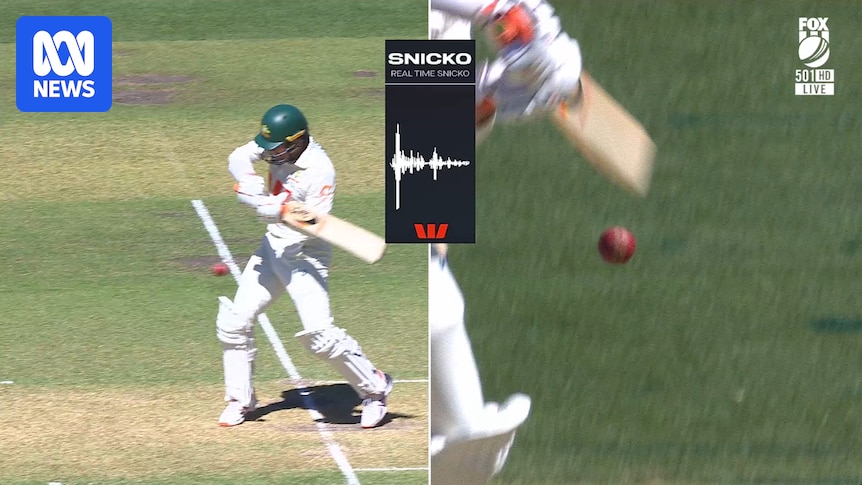
England has been left frustrated after it was revealed that an operator error involving the Snicko umpire aid granted Alex Carey a controversial reprieve on the first day of the third Ashes Test in Adelaide. This revelation has sparked a debate over the reliability of technology in cricket, as England believed they had Carey out on 72 when he swung at a wide delivery from Josh Tongue, only for the decision to be upheld as not out.
At the time of the incident, Australia was positioned at 6-245 and went on to reach 8-326 at stumps, strengthening their bid to secure a 3-0 lead in the series. The incident has raised questions about the accuracy of the Decision Review System (DRS) after the Snicko technology showed a spike, but not aligned with the ball passing the bat.
Technical Glitch and Admission
The discrepancy was attributed to a calibration error, as confirmed by BBG Sports, the company operating Snicko on behalf of Fox Sports. In a statement to the BBC, BBG Sports acknowledged the error, stating,
“Given that Alex Carey admitted he had hit the ball in question, the only conclusion that can be drawn from this is that the Snicko operator at the time must have selected the incorrect stump mic for audio processing.”
The sound used for the review was taken from the wrong stump microphone, leading to the mismatch between the audio and visual evidence.
Carey himself admitted in a press conference that he believed he had edged the ball, saying,
“I thought there was a feather or some sort of noise when it passed the bat. If I was given out, I think I would have reviewed it, probably not confidently.”
His admission aligns with the observations of former umpire Simon Taufel, who suggested that the technology’s calibration was off.
Expert Opinions and Historical Context
Simon Taufel, speaking to Channel Seven, expressed his surprise at the unusual spike, stating,
“The confusing element here was that the spike occurred at least a couple of frames before the bat, which was just amazing. My gut tells me from all of my experience on-field and also as a TV umpire that I think Alex Carey has hit the ball and the technology calibration hasn’t been quite right.”
Taufel’s insights highlight the challenges faced by umpires relying on technology to make crucial decisions.
England’s bowling consultant, David Saker, voiced concerns over the Snicko system’s reliability throughout the series, suggesting that the calibration issues have been persistent. Saker remarked,
“There’s been some things that don’t really measure up. At that stage, I can’t remember the exact score, but it was a pretty important decision. So those things hurt, but we’ll get through it.”
The Snicko error cost England 34 runs, while their own fielding errors, such as Harry Brook dropping Usman Khawaja, proved more costly.
Implications and Future Considerations
The controversy surrounding the Snicko error has prompted England to consider raising the issue with match referee Jeff Crowe. Saker hinted at potential formal complaints, saying,
“I don’t think we’ve done anything about it so far, but after today, maybe that might go a bit further. There have been concerns about it for the whole series.”
The incident underscores the ongoing debate about the role of technology in cricket and its impact on the integrity of the game.
As the series progresses, the focus will remain on ensuring that technological aids like Snicko are accurately calibrated and reliable. The controversy serves as a reminder of the delicate balance between human judgment and technological assistance in sports, and the need for continuous improvement in these systems.