




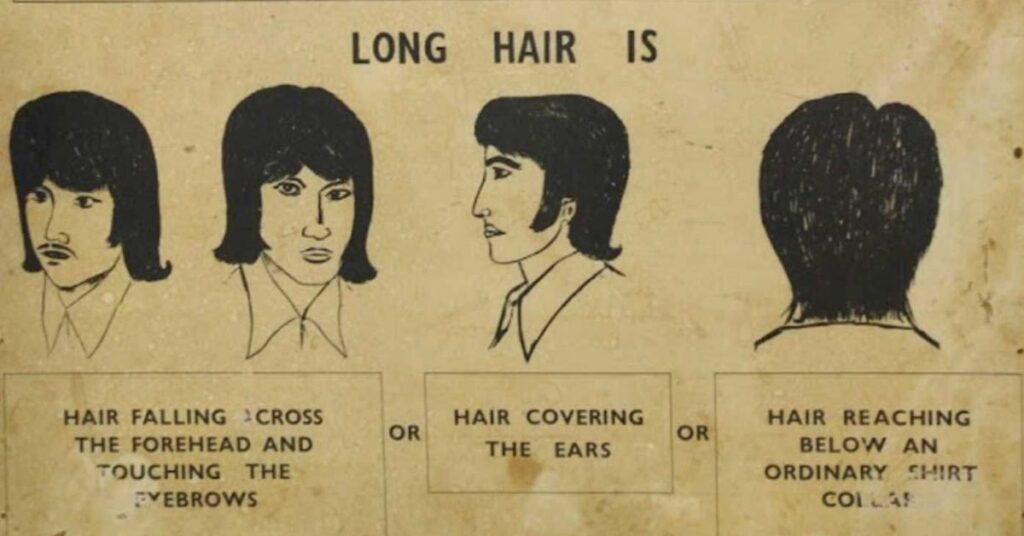
On January 9, 1972, Singapore implemented a controversial policy that would deny entry to men with long hair, marking a significant cultural clash between the island nation and the global rock music scene. Dubbed “Operation Snip Snip,” this policy was part of Singapore’s broader effort to curb the influence of hippie culture, which was perceived as a threat to the country’s social fabric.
Under the new regulations, visitors whose hair extended below their collar were turned away at the border. The Ministry of Home Affairs further decreed that any man with hair covering the ears or touching the eyebrows would be served last in government offices. This move was aimed at discouraging the presence of long-haired individuals, whom the government associated with the counterculture movement.
Impact on the Music Scene
The haircut law quickly made waves in the music industry, prompting several high-profile cancellations. Iconic rock band Led Zeppelin opted to cancel their scheduled concerts in Singapore rather than submit to a haircut. Other notable artists, including Cliff Richard, The Who, Tom Jones, and Cat Stevens, also canceled their tour plans. The Bee Gees, known for their distinctive hairstyles, were sent home immediately after a performance due to their non-compliance with the new regulations.
These cancellations underscored the tension between Singapore’s conservative policies and the liberal values often associated with rock music and its followers. The government’s stance was clear: long hair was not just a fashion statement but a symbol of a lifestyle they sought to keep at bay.
Local Enforcement and Public Reaction
Locals were not exempt from the strict enforcement of the haircut law. Civil servants faced fines or even termination if their hair extended below the collar or over the ears. In government facilities, long-haired individuals were deliberately served last, regardless of their position in line. The government also discouraged private businesses from hiring men with long hair, and it was not uncommon for police to escort hirsute men to barbers for an immediate trim.
Returning Singaporean citizens with long hair had their passports confiscated until they complied with the haircut requirement. Additionally, from mid-1970, long-haired men were banned from appearing on television, further limiting their visibility in public life.
The Government’s Rationale
The haircut policy stemmed from Prime Minister Lee Kuan Yew’s deep-seated suspicion of hippie culture. He articulated his concerns, stating,
“We are a very exposed society, having both an important air and sea junction, and the insidious penetration of songs, TV, skits, films, magazines all tending towards escapism and the taking of drugs, is a very dangerous threat to our young. It is a malady which has afflicted several of the big capitals in the West and would destroy us if it got a grip on Singapore.”
In addition to the haircut law, Singapore also banned a list of popular songs believed to reference drugs, including The Beatles’ “Lucy in the Sky with Diamonds” and the entire soundtrack to “Hair.” Surprisingly, Creedence Clearwater Revival’s “Proud Mary,” a song about a ferryboat ride with no apparent drug references, was also banned. The music ban was lifted in 1993, but the haircut law, though not formally revoked, has not been enforced for several decades.
Legacy and Cultural Reflection
The haircut law of 1972 remains a fascinating chapter in Singapore’s history, reflecting the country’s efforts to maintain its cultural identity amidst global influences. While the policy may seem draconian by today’s standards, it highlights the lengths to which the government was willing to go to preserve societal norms.
As Singapore has evolved, so too have its cultural policies, allowing for a more open and diverse society. The legacy of Operation Snip Snip serves as a reminder of the cultural tensions that can arise when global trends intersect with local values.
Today, Singapore is known for its vibrant arts scene and cultural diversity, a testament to the nation’s ability to adapt and grow while maintaining its unique identity.