



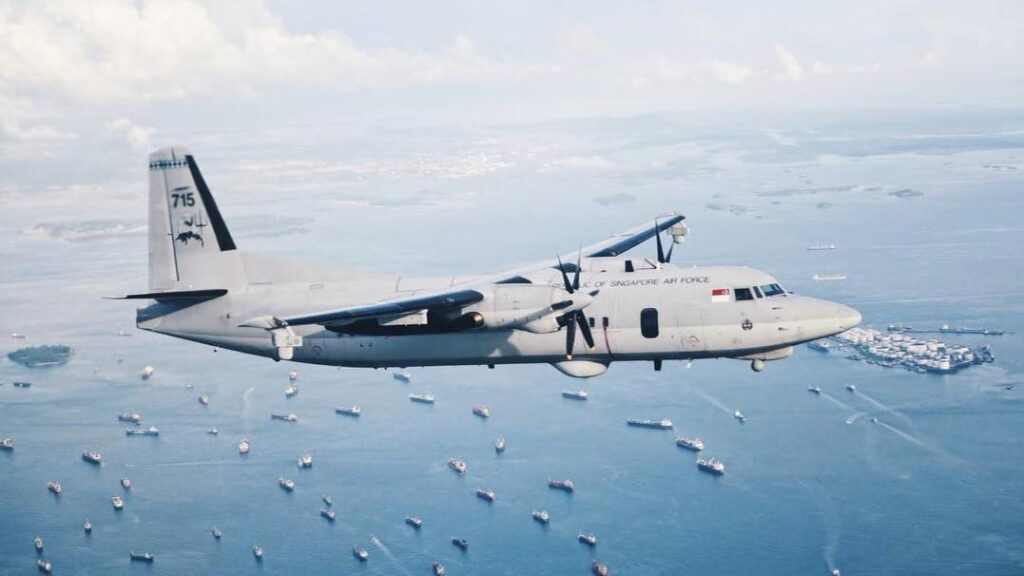
The Royal Singapore Air Force (RSAF) is set to undergo a significant transformation in its maritime patrol capabilities. The island nation is replacing its aging fleet of Fokker 50 Enforcer II aircraft with the state-of-the-art Boeing P-8A Poseidon twinjets. This transition was made possible after the U.S. Department of Defense authorized the purchase of four of these advanced patrol jets, which are based on the Boeing 737 Next Generation airframes.
The new aircraft promise a substantial increase in performance, capability, and fleet longevity, offering a range of new weapons employment options. Equipped with cutting-edge intelligence, surveillance, and reconnaissance technology developed for the U.S. Navy, the P-8A Poseidon is already a key component of the fleets of several U.S. allies.
Modernizing Singapore’s Maritime Security
The introduction of the P-8A Poseidon will significantly enhance the RSAF’s ability to conduct wide-area surveillance along Singapore’s coastline and open ocean. Additionally, these aircraft will support search and rescue operations and aeromedical evacuations. Since 1993, Squadron 121 has operated the Fokker 50 Enforcer II from Changi Airbase—a modified version of the discontinued Dutch regional airliner, the Fokker 50MPA.
The deal, valued at $2.3 billion, includes the aircraft, weapons, related equipment, as well as training and services. The P-8A will extend Squadron 121’s operational reach from 1,000 miles (1,700 km) to 4,660 miles (7,500 km) and introduce aerial refueling capabilities, a feature absent in the Fokker. Furthermore, the Poseidon is nearly twice as fast and almost doubles the service ceiling of the Enforcer II.
“The proposed sale will support Singapore’s goal of improving national and territorial defense as well as increasing interoperability with U.S. and allied forces. Singapore will have no difficulty absorbing this equipment into its armed forces,” stated the Defense Security Cooperation Agency.
Poseidon’s Eye In The Sky
While the Fokker was equipped with a Raytheon AN/APS-134 Search Radar and Forward-Looking Infrared (FLIR) systems, the P-8A Poseidon represents a quantum leap in technology. It boasts far more powerful radar, FLIR, and other optical sensors, alongside a modern electronic warfare suite.
The P-8A’s sensors reflect three decades of technological advancements, enhanced by the larger airframe of the Poseidon, its turbofan powerplants, and greater electrical power supply. These aircraft are designed to operate in tandem with the Republic of Singapore Navy for maritime surveillance and over-the-horizon targeting.
The Raytheon AN/APY-10 multi-mission surface search radar serves as the primary system for reconnaissance and targeting. Complementary systems include the ALQ-213 early warning management systems, AN/AAQ-24(V)N anti-spoofing modules, missile warning sensors, and Guardian laser transmitters. The aircraft also features the AN/ALE-47 countermeasures dispenser for self-defense.
The Business End Of The Trident
Upon delivery of the new Poseidons, the RSAF will also acquire Mark 54 torpedoes from the U.S. Navy, alongside receiving comprehensive training in weapons, avionics, and sensors. While the Fokker had limited ordnance capacity, including the AGM-84 Harpoon anti-ship missile and lightweight torpedoes, the P-8A significantly expands the arsenal available to Squadron 121.
The Poseidon is equipped with both an internal weapons bay and 11 external hardpoints capable of deploying AGM-84 Harpoon missiles, AGM-84 SLAM-ER missiles, AGM-158 LRASM missiles, Mark 54 torpedoes, naval mines, and depth charges. It also features a High Altitude Anti-Submarine Warfare Weapon Capability system, enhancing its operational flexibility.
This transition marks a pivotal moment in Singapore’s defense strategy, aligning its capabilities with those of major allies and ensuring its maritime security for decades to come. As the RSAF embraces this new era of aviation technology, the implications for regional security and international collaboration are profound.