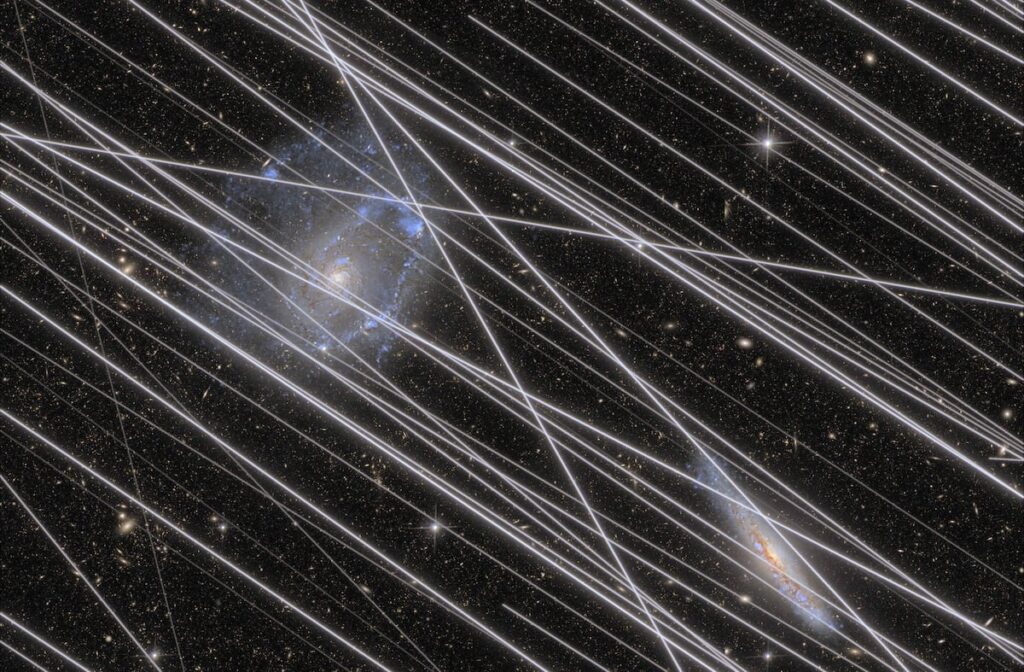
Curious lights in the night sky, initially a spectacle for astronomy enthusiasts, have become a point of contention due to their interference with astronomical observations. These lights, caused by Elon Musk’s Starlink satellite network, have been both a marvel and a menace. While some encouraged the public to witness the luminous trails of these satellites, astronomers soon protested as their telescopic images were marred by intense white streaks.
In response to the outcry, Elon Musk promised to mitigate these effects, suggesting improvements that remain unfulfilled. He also urged scientists to look beyond ground-based observatories and consider space-based alternatives. However, a recent NASA study warns that even space telescopes like Hubble are not immune to the disruptions posed by satellite constellations.
The Impact on Space Telescopes
Research led by Spanish astrophysicist Alejandro Serrano Borlaff indicates that if the planned expansion of satellite constellations, such as Starlink, proceeds, at least one in three Hubble images could be contaminated by satellite light. These plans involve launching over 500,000 satellites, a number that poses a significant threat to astronomical observations.
“This is the first scientific study whose main objective is to investigate the effects of light pollution on space telescopes, taking into account these plans announced by the industry,” says Borlaff from NASA’s Ames Research Center in Mountain View, California.
The implications are dire for the new generation of space telescopes. The European Space Agency’s (ESA) ARRAKIHS mission, scientifically led by Spain, is particularly vulnerable. According to Borlaff’s study, published in the journal Nature, satellite streaks could appear in 96% of images from this future telescope.
Challenges for Current and Future Missions
The Hubble Space Telescope and NASA’s upcoming SPHEREx mission, set for a 2025 launch, are both situated in low Earth orbit, an area already crowded with over 9,000 Starlink satellites. The study predicts that with 560,000 satellites in orbit, nearly 40% of Hubble’s images and up to 99% of SPHEREx’s astrophotographs could be affected.
Borlaff explains that the impact of these artificial streaks depends on the scientific objectives of each mission. While some observations can be corrected by repetition or data combination, others, particularly those requiring precise timing or tracking moving objects like asteroids, could suffer significantly.
“One of the fields that could be most affected is the search for asteroids potentially hazardous to Earth,” Borlaff warns.
ARRAKIHS: A Different Perspective
Despite the concerning predictions, Rafael Guzmán, leader of the ARRAKIHS team, argues that Borlaff’s study is incorrect regarding their mission. He clarifies that the final design of ARRAKIHS will point away from Earth, reducing the number of satellites in its field of view.
Carlos Corral, head of the ARRAKIHS project at ESA, supports Guzmán’s assessment, noting that previous estimates suggest a much smaller impact on ARRAKIHS, affecting only about 1% of its images. Corral emphasizes the mission’s robustness, designed to handle natural interferences like cosmic rays, which are similar in magnitude to the satellite interference predicted by Borlaff’s research.
“Filling the sky with tens of thousands of satellites is not a good idea. It’s a problem especially for ground-based telescopes, but you can’t escape that problem even by going into space,” Corral concludes.
Looking Forward: Balancing Innovation and Preservation
The debate over satellite constellations highlights the tension between technological advancement and the preservation of scientific observation. As companies like SpaceX continue to expand their satellite networks, the astronomical community faces the challenge of adapting to these new realities.
While space agencies and astronomers work to mitigate the impact on current and future missions, the conversation around satellite regulation and space traffic management becomes increasingly urgent. The future of space exploration and observation may well depend on finding a balance that allows for both innovation and the protection of our cosmic vantage points.