



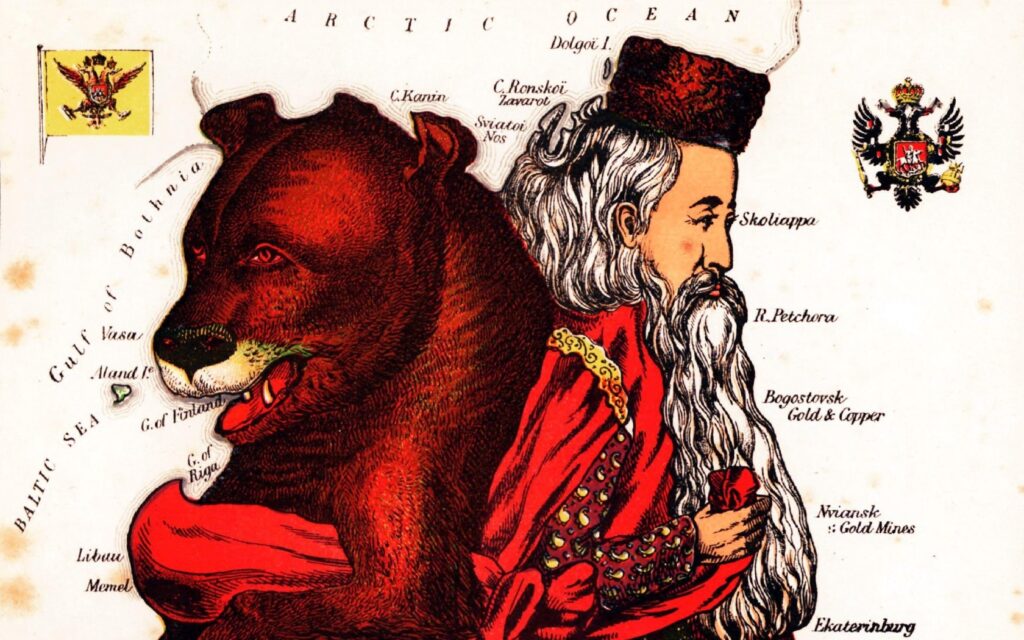
All hegemons eventually fail. Throughout recorded history, no civilization of significance has escaped that fate. This notion is a maxim of global geopolitics. While the Roman Catholic Church is unique in having a traceable institutional lineage for nearly two millennia, its period as a territorial power came and went. China is a complex case, with a discrete, continuous culture and multiple expansion phases, but it recently endured a hundred years at the bottom of the pile – from the middle of the 19th century to the middle of the 20th.
Certainly in the West, the rule holds. The maritime empires of Spain, France, and Great Britain expanded and then retreated to their home territories. The territorial empires of Rome, the Ottomans, the Habsburgs (and dozens of others) arguably fared worse, either disappearing entirely or returning to much diminished, even unrecognizable bases. Paul Kennedy and a handful of academic historians have taken up the whys and wherefores of imperial expansion and contraction. Scores of other historians and journalists have narrated the rise and fall of individual empires. School libraries are full of their works.
Testing the Maxim: Today’s Hegemons
Applying the maxim in real time to today’s leading hegemons – the US, China, and Russia – is an intriguing test of the proposition. For some, however, it may be shocking to even question the Great Power status quo. The presentist bias of many observers and almost all politicians is overwhelming. History was history, of course, but ‘now is different’, they say. It borders on a psychological pathology. Americans will point to their ‘exceptionalism’. The Chinese can respond that the petty rhythms of Western hegemons do not apply to the Middle Kingdom. Whether as the Third Rome or as the bearer of a unique Eurasianist culture, Russia has a healthy sense of its self-importance and its historical role.
Despite those assertions, the US, China, and Russia do not exist outside of history. Check back in a century and all three will be elsewhere on the hegemonic trajectory. Russia peaked somewhere from a century ago (on the eve of the First World War) to the 1970s or so, depending on how one measures Great Power vitality. While many will disagree with that timing, no one can deny that a major diminution occurred around 1990-91, with the end of the Soviet Union.
Russia’s Path Forward
So where does Russia go from here? Does it continue retreating to some historical boundary such as its core territory before it ‘broke out’ in the 15th and 16th centuries? Does it remain the planet’s largest country, but as a weaker, fragmented entity? Something in between? Does it break the mold and rebound, as its leadership has committed to doing?
All are fair questions and, it turns out, none of them original. As the Soviet Union faded in the 1970s and 1980s, and collapsed in the 1990s, scores of scholars, politicians, and journalists in Russia and the West opined on what happened, why, and wherefore. With its recent invasion of Ukraine, Russia is actively testing its hegemonic prerogative. That action makes it a good time to review the prior period of introspection and consider its implications for today’s Russia.
“The accounts of the Soviet Union’s demise are striking in one particular respect. Commentators who would otherwise not associate with one another or even agree on how to spell samovar were nearly unanimous in the view that the Soviet state had become ‘overstretched’.”
The Burden of Overreach
The obvious economic burden of military spending to keep up with the United States was significant. The East European satellite states had to be subsidized. Third World ventures such as Cuba and Afghanistan (to name just two) came out of the general coffers. They did not pay for themselves.
The other form of overreach was within the Soviet Union itself: the high ‘cost’ of Russia expanding beyond the Slavic heartland, starting in the 15th-16th centuries, to what were and still are today far-flung, often non-Russian, and sparsely populated lands. The Russians were very good at the expansion process and ended up with the largest country in the world, by a lot. Paul Werth’s recent account– How Russia Got Big: A Territorial History – tells the tale well and concisely. In Russia’s case, building this empire was partially a matter of military necessity – a form of defense against other powers in the absence of natural barriers – but it was nevertheless a costly strategy. Almost all the commentators note that, in practice, Russia’s imperial legacy to the Soviet Union, and then the latter’s management of its sprawling, ethno-federal empire became an enormous burden.
Soviet Nationalities Policy
In this context, it is helpful to review the unusual nature of Soviet nationalities policy. Like a lot of early Soviet administration, it was remarkably convoluted. Recall that by the time Lenin was done revising Marxism, there was not much left that Marx would have recognized. For instance, according to Marx, advanced industrial workers would know that the important identity was class, not nationality or ethnicity. They would organize themselves accordingly. Well, in mostly rural and multi-ethnic Russia in 1917, it didn’t work out that way. Empires were failing left and right, with nation-states, not a global workers movement, gaining the upper hand. So Lenin and Stalin, his early nationalities commissar, came up with a solution in the years immediately following the Bolshevik takeover to square the circle: they supported newly formed, ethnically based entities that fit within the overarching framework of a socialist state. It was, as the slogan proclaimed, ‘national in form; socialist in content’.
That’s how the Union of Soviet Socialist Republics in 1922 came about, with a constitution in 1924 that voluntarily joined together nominally independent republics. It was a compromise with the nationalistic aspirations of ethnic groups suddenly freed from the ‘prison of nations’, Lenin’s famous characterization of Tsarist Russia. The system featured the promotion of local ethnic languages, culture, cadres, but most importantly ethnic territories had their own administrative structures, educational institutions, and media platforms. Originally, there were four constituent republics. By 1936, further map-making resulted in 11 union republics. Lands taken in the Second World War brought the total to 15 after 1956. The largest, then the Russian Soviet Federative Socialist Republic (RSFSR) and now the Russian Federation, had and still has numerous ethnic sub-divisions and administrative entities.
The Legacy of Soviet Nationalities Policy
And therein lies the rub: the republics that constituted the Soviet Union in 1922 and thereafter had the right to secede. Of course, that was a dead-letter provision at the time, but it came to life 70 years later when inanition had mortally weakened the central state. The Soviet Union fractured precisely along those 15 republic lines. That was not a random outcome. It is instead the great irony of Soviet nationalities policy. Lenin’s solving of a nationalities-vs-empire problem in the early years of the Soviet Union became the source of a renewed nationalities-vs-empire problem at the end of the Soviet Union. In contrast, the lesser ethnic-administrative units within the huge RSFSR did not have the paper right or the practical ability to become independent, and they remained within the post-Soviet Russian Federation. Chechnya was the attempted exception that proved the rule.
Moreover, while all the Soviet republics were nationalities-based, there was one important exception: the RSFSR itself. It was quasi-Russian, quasi-Soviet, leaving Russians as the dominant ethnic group in the Soviet Union, but with a confused identity. Were they Soviet? Were they Russian? Were the two identities supposed to be the same?
“The shortcomings of managing nationalities in this manner became increasingly obvious inside and outside the Soviet Union. In the late 1970s, French historian Hélène Carrère d’Encausse wrote that ‘of all the problems facing Moscow, the most urgent and the most stubborn is the one raised by the national minorities. And like the Empire that it succeeded, the Soviet State seems incapable of extricating itself from the nationality impasse’.”
Russia’s Current Challenges
What is equally striking is that, three decades later, the Russian Federation faces similar challenges. While the extent of ethnic complexity may not be as great as that facing the Tsarist empire circa 1914, or the specific ethno-federalism that bedeviled the Soviet Union circa 1990-91, the Russian state today remains a vast, economically challenged, multi-ethnic enterprise. Yes, there was a clear step-change down in imperial overreach with the end of the Soviet Union. Yes, after the brutal 1990s, Russia started growing again and achieved some degree of political stability.
Still, the Russian Federation is overstretched. Moscow continues to subsidize non-energy-producing regions. Consistent with an over-reliance on hydrocarbon extraction, Russia has had limited success diversifying its economy. Not surprisingly, living standards and development are highly uneven by geography. And the state now faces all-encompassing military expenditures. Does that sound familiar? None of these challenges are secret. They are actively discussed in the Russian media and addressed directly by the political elite.
Most critically, Russia continues to experience a demographic decline. Russia’s current population of around 143 million (sources disagree) is struggling due to a prolonged low fertility rate, net emigration, and most recently, the war. The UN is forecasting further decline to 136 million by mid-century. The extraordinarily low population density outside of European Russia – approximately 25 million people across a territory of 11.3 million square kilometers (the Siberian and Far Eastern Federal Districts), or 2.2 persons per kilometer – highlights the challenge of maintaining such a large territory. Those two eastern territories represent roughly two-thirds of Russia’s landmass, but less than one-fifth of its population. And even those figures are misleading. Essentially, all of the Siberian and Far Eastern population is in a few cities and along the southern tier of the region. The rest of the vast area is, for all intents and purposes, empty. Yes, the entire global north is facing demographic challenges. Yes, Alaska and Canada’s northern territories have even lower population densities, but in Russia’s case, the demographic decline is central to the country’s hegemonic trajectory.
“Russia’s leadership is well aware of the demographic challenge. Among his earliest public pronouncements on the topic, in 2000, Putin declared that ‘year by year, we, the citizens of Russia, are getting fewer and fewer… We face the threat of becoming a senile nation’.”
Conclusion: The Future of Russia’s Geopolitical Strategy
In the meantime, if Putin cannot reverse history, can he at least ‘flatten the curve’ of hegemonic decline? Can he and his successors run it down slowly like the Dutch rather than headlong like the Spanish? He is certainly trying. Policies adopted by the regime over the past decade are explicitly designed to reduce Russia’s reliance on imported goods, and its dependence on foreign economic and technology networks. They include a broad-based effort at import substitution, creation of a ‘sovereign’ internet, native payment systems and a separate financial infrastructure, etc. On the demographic front, there is the maternal capital programme – MatKapital – started in 2007 and designed to encourage family formation. On the cultural front, there is Presidential Decree No. 809, ‘On Approval of the Fundamentals of State Policy for the Preservation and Strengthening of Traditional Russian Spiritual and Moral Values’ signed 9 November 2022. The name says it all.
According to Presidential Decree No. 309 from May of 2024, ‘On the National Development Goals of the Russian Federation’, many of these efforts are supposed to bear fruit by 2030, within a foreseeable measurement period. By that time, the government aims to increase life expectancy to 78 years, raise the total fertility rate to 1.6 (still well below replacement rate), and reduce poverty below seven per cent. Other goals that the Russian government has set include delivering 1,000 domestically produced aircraft, becoming a top-25 leader in industrial robotics, making the Northern Sea Route a major international trade corridor, providing 97 per cent broadband coverage, and facilitating 140 million domestic annual trips through development of new domestic resorts.