



The winners of the Royal Society Publishing Photography Competition 2025 have been announced, showcasing the finest scientific photography from around the globe. This prestigious competition, held in collaboration with the Royal Photographic Society (RPS), celebrates the intersection of captivating art and groundbreaking science.
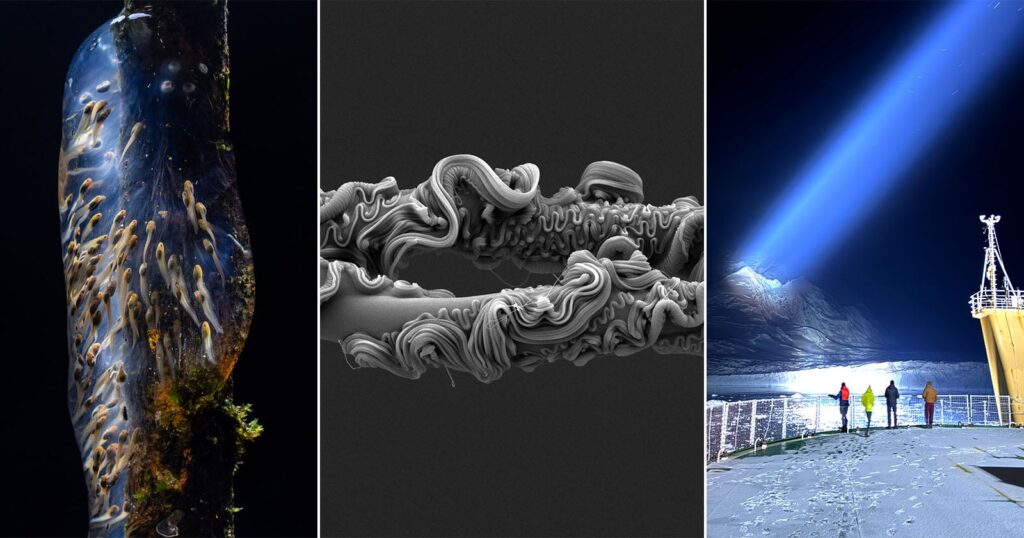
This year’s overall winner, Dr. Martin Ramirez, captured a stunning image using a scanning electron microscope. His photograph, a close-up of silk from the Australian net-casting spider (Asianopis subrufa), reveals intricate details at just 0.05 millimeters in length. The image not only highlights the beauty of nature but also unveils hidden scientific phenomena.
Exploring the Science Behind the Art
The Australian net-casting spider is known for its unique hunting strategy. These ambush predators hold sticky webs between their forelegs and cast them onto unsuspecting insects. The silk’s remarkable properties piqued the interest of Dr. Ramirez and his collaborator, Dr. Jonas Wolff from Greifswald University, leading them to study this fascinating species.
Dr. Ramirez, a research scientist with the National Science and Technical Research Council at the Argentinian Museum of Natural Sciences, expressed his surprise at winning the competition. “I knew my image was nice, but it is very surprising to be competing with these awesome photographers,” he humbly remarked.
“Just from observing the behavior, we knew something spectacular was going to be there,” Dr. Ramirez continued. “The web is incredibly stretchy; no normal silk can extend in that way to then return to its original form.”
The collaboration between Dr. Ramirez and Dr. Wolff involved meticulous dissection of the silk, fiber by fiber, using an electron microscope. The winning image was captured in Argentina, using samples transported from Germany. Unlike traditional microscopes, the electron microscope employs a beam of electrons to create images, offering unparalleled detail.
Judging and Recognition
Hugh Turvey, Science Committee Chair at the Royal Photographic Society and a member of the competition’s judging panel, praised the winning photograph. “The judges were unanimous in their selection of this winning photograph. We evaluate entries on two key criteria: aesthetic appeal and the ability to convey a compelling scientific phenomenon,” he explained.
“This bold, graphic SEM of inconceivable rope-like structures — with their remarkable twists and complex undulations — evokes a sense of wonder, perfectly demonstrating the intersection of artistic form and scientific function,” Turvey added.
Category Winners and Highlights
In addition to Dr. Ramirez’s overall victory, the competition featured five categories: astronomy, behavior, Earth science and climatology, ecology and environmental science, and microimaging. Dr. Ramirez, who also won the microimaging category, received a prize of £1000.
The competition also recognized four other category winners and five runners-up, each earning £500 for their achievements. These categories highlight the diverse ways in which photography can illuminate scientific understanding:
- Astronomy: Capturing the vastness and beauty of the universe.
- Behavior: Documenting the intricate behaviors of living organisms.
- Earth Sciences and Climatology: Revealing the dynamic processes shaping our planet.
- Ecology and Environmental Science: Exploring the relationships between organisms and their environments.
- Microimaging: Delving into the microscopic world to uncover hidden details.
The Broader Impact of Scientific Photography
The Royal Society Publishing Photography Competition continues to emphasize the importance of visual storytelling in science. By bridging the gap between art and science, these images inspire curiosity and foster a deeper appreciation for the natural world.
As scientific photography evolves, competitions like this one play a crucial role in promoting public engagement with science. They highlight the beauty and complexity of the world around us, encouraging both scientists and the public to explore and understand the intricate details of our universe.
Looking ahead, the competition’s organizers hope to inspire future generations of scientists and photographers to continue pushing the boundaries of what is possible, both in the lab and through the lens.