



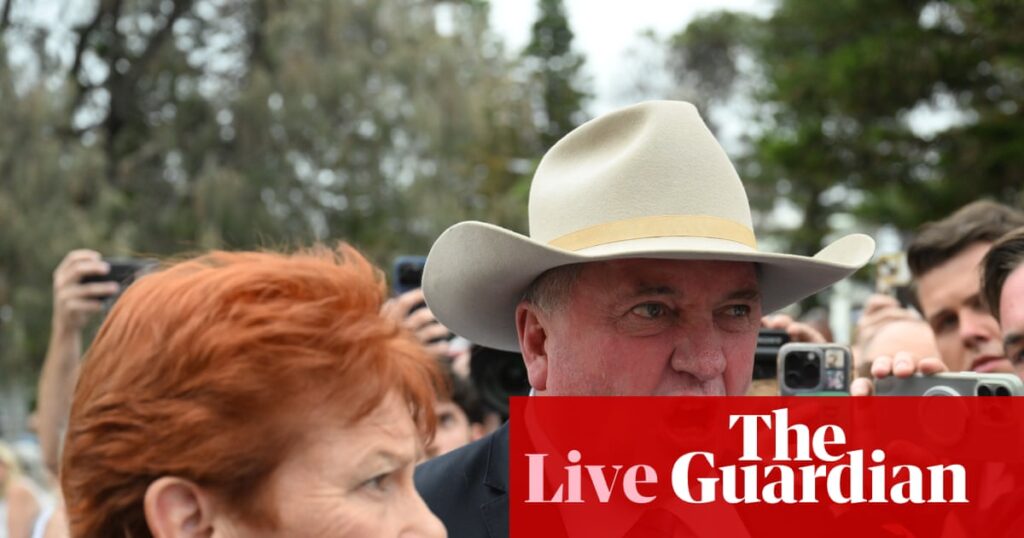
In a significant political development, Barnaby Joyce has expressed his gratitude towards Australians for their growing support of One Nation, following a Newspoll published by the Australian newspaper. The poll revealed that support for the minor conservative party has surged to 22%, surpassing the Coalition’s primary vote of 21%. Meanwhile, Labor’s primary vote has decreased to 32%, marking a four-point drop since last year.
Speaking on the morning show Sunrise, Joyce, who joined One Nation late last year, stated that he was “humbled” by the increased backing. He emphasized that this shift is not a critique of Sussan Ley’s leadership within the Coalition, but rather a reflection of public desire for alternatives. “It’s never been an attack on Sussan’s leadership. I think that what One Nation has done has given people licence for an alternative,” Joyce remarked. “And when you’ve got to make a choice between political correctness or looking after Australians, we’ll look after Australians first.”
Political Implications and Reactions
The rise in One Nation’s support highlights a broader political trend and has prompted reactions from various political figures. Cabinet Minister Murray Watt commented on the poll results, suggesting they illustrate the increasing division within the Coalition. “It’s what’s drifting them further and further to the right,” Watt noted.
This development follows a broader context of political realignment in Australia, where minor parties are gaining traction amid dissatisfaction with traditional political entities. The shift in voter sentiment underscores a growing appetite for alternative political voices that promise to prioritize national interests over global or politically correct agendas.
International Dynamics: Trump’s ‘Board of Peace’
Amid these domestic political shifts, the Australian government is also navigating international diplomatic waters. Prime Minister Anthony Albanese confirmed receiving an invitation to join Donald Trump’s ‘Board of Peace,’ a proposed initiative aimed at furthering the Gaza ceasefire agreement. The invitation, extended to leaders from countries including Canada and Turkey, arrived recently, but Albanese has refrained from making an immediate decision.
“I haven’t looked in detail yet,” Albanese stated, indicating that the matter requires further consideration. This cautious approach highlights the complexities of international diplomacy and Australia’s strategic positioning on global peace efforts.
Legislative Challenges: Hate Group Listings and Gun Control
Domestically, the Australian government is grappling with legislative challenges, particularly concerning hate group listings and gun control. The proposed bill to create a new “hate group listing” remains contentious, with the government urging opposition support to outlaw extremist groups like the National Socialist Network and Hizb ut-Tahrir.
Prime Minister Albanese has called on the opposition to back these measures, emphasizing the importance of addressing dangerous ideological positions. “This organisation [Hizb ut-Tahrir] that essentially has a very dangerous ideological position, promotes extremism at the moment has been allowed to continue to exist for a number of years. We want to have the power to be able to list it and to outlaw it. And I think that is a common-sense position,” Albanese asserted.
Meanwhile, the government is also focusing on gun control reforms in the wake of the Bondi Beach shootings. New figures reveal that Australians own over 4.1 million firearms, with Queensland and NSW leading in gun registrations. The government, supported by the Greens, is pushing for a national buyback scheme to reduce gun violence, echoing the Howard government’s post-Port Arthur reforms.
“The deadly antisemitic terrorist attack at Bondi Beach is a national tragedy which can never be allowed to happen again. Our number one priority is keeping all Australians safe. That’s why we’re finishing the work of the Howard government and getting dangerous guns off our streets,” stated Home Affairs Minister Tony Burke.
Forward-Looking Analysis
As Australia navigates these political and legislative challenges, the implications for the country’s future remain significant. The rising support for One Nation suggests a potential shift in the political landscape, where minor parties could play a more influential role in shaping national policies. This trend also raises questions about the future of major parties and their ability to address the evolving concerns of the electorate.
Internationally, Australia’s response to initiatives like Trump’s ‘Board of Peace’ will reflect its broader foreign policy strategy and commitment to global peace efforts. Domestically, the outcomes of legislative debates on hate group listings and gun control will have lasting impacts on national security and public safety.
As these developments unfold, the political and social fabric of Australia is poised for transformation, driven by a complex interplay of domestic priorities and international responsibilities.