



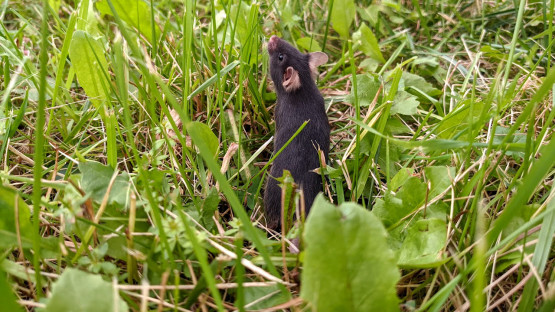
When postdoctoral researcher Matthew Zipple releases lab mice into a large, enclosed field just off Cornell University’s campus, a remarkable transformation occurs. These mice, previously confined to cages only slightly larger than a shoebox, begin to explore their new surroundings with an unfamiliar sense of freedom. This transition from captivity to a natural setting has been shown to reverse anxiety in these animals, according to a new study published on December 15 in Current Biology.
The study, conducted by Cornell researchers over two years, involved rewilding multiple cohorts of lab mice. The findings revealed that the mice’s fear response, measured through a classic anxiety assessment, was significantly reduced after just a week in the field. This groundbreaking research suggests that exposure to a natural environment can alter established anxiety behaviors in lab mice.
The Science Behind Rewilding
Senior author Michael Sheehan, an associate professor of neurobiology and behavior at Cornell, explains the significance of this study. “We release the mice into these very large, enclosed fields where they can run around and touch grass and dirt for the first time in their lives,” Sheehan said. “It’s a new approach to understanding how experiences shape responses to the world, with hopes that our findings will generalize to other animals and even humans.”
The researchers employed the elevated plus maze, a widely used and humane method for studying anxiety in mice. This maze consists of two arms: one enclosed, where mice feel secure, and another open and elevated, where they feel exposed. Traditionally, lab mice develop a fear response to the open arms, spending less time there after initial exposure.
However, the Cornell team observed a striking difference in rewilded mice. “The rewilded mice show either no fear response or a much weaker response,” said Zipple, the study’s first author and a Klarman Fellow. This suggests that the natural environment not only prevents the formation of fear responses but can also reverse established anxiety behaviors.
Implications for Behavioral Research
The findings of this study have significant implications for behavioral research involving mice. The results challenge the traditional use of lab mice as models for human health studies, raising questions about the generalizability of such research. “What we show is that yes, this is an example where the lab animal doesn’t generalize more broadly, but we also provide a solution that’s different, which is to study a real organism that’s living in a real environment,” Zipple noted.
Sheehan emphasized the potential for future research using the field setup to explore how different experiences shape responses to novel situations. “This opens a lot of possibilities for asking interesting questions about how our library of experiences shapes our response to novel experiences, because I think that’s essentially what anxiety is – when you have an inappropriate response to something that isn’t actually scary,” Sheehan said.
Broader Implications and Future Research
While the study does not directly address human behavior, it resonates with broader conversations about modern life and anxiety. Sheehan speculates that the rise in anxiety among young people could be linked to more sheltered lifestyles. “There are conversations around modernity and our own lives that are echoed in this research that make it really interesting,” he said.
The research team plans to further investigate the effects of rewilding on anxiety. Questions remain about how much time in the field is necessary to reverse a fear response and whether the age of the mice affects the outcome. These inquiries could provide deeper insights into the mechanisms of anxiety and the potential for environmental interventions.
Co-author Daniel Chang Kuo ’23, along with external funding from the National Science Foundation and the National Institutes of Health, contributed to this groundbreaking study. The work not only advances our understanding of anxiety in animals but also offers a new perspective on the impact of natural environments on mental health.