
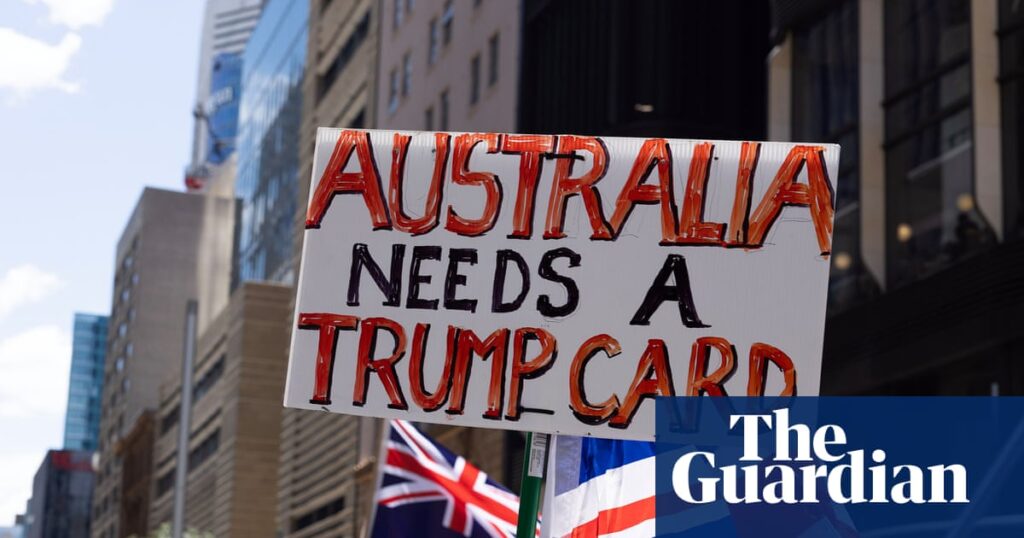
At an anti-immigration rally in Sydney on Saturday, a man in a wide-brimmed hat distributed teal pamphlets for a new political venture, Reform Australia, aiming to capitalize on the crowd’s concerns. The flyer boldly stated, “The major parties have failed us and the minor parties are too fragmented. Join us to be election ready.”
Reform Australia was among several political hopefuls at the Put Australia First event, which saw a significant presence of One Nation and Libertarian supporters. However, Reform Australia stands out as the newest and perhaps most enigmatic entity. Despite its striking resemblance in name and color scheme to Reform UK, led by anti-immigration populist Nigel Farage, the latter has denied any association with the Australian group. Furthermore, the pamphlet lacked official authorization and the group is not yet registered with the Australian Electoral Commission.
Unmasking the Faces Behind Reform Australia
The digital footprint of Reform Australia provides some insights into its potential backers. The website is registered to Walter Villatora, a former Liberal party branch president in Warringah and a known supporter of former Prime Minister Tony Abbott. The Australian Financial Review first reported this connection in September. Although Villatora is no longer the president of the party’s branch in Condamine, he remains listed internally as a Liberal member, though he claims to have left the party.
When contacted, Villatora declined to comment, stating he would speak “when we’re ready to do media.” A recruitment email from late November describes Reform Australia as a “big tent,” suggesting that the current conservative party has lost its way by abandoning values of hard work, family, and freedom.
Connections and Controversies
Villatora’s business interests are varied. He is the co-owner of the company behind Turning Point Australia, a franchise of Charlie Kirk’s conservative organization, run by Joel Jammal. In 2022, prior to Villatora’s involvement, Turning Point promoted an event featuring Nigel Farage as part of his Australian tour.
Jammal, listed as tech support on one of Reform Australia’s website registrations, told Guardian Australia he is not involved with the group and is amicably ending business ties with Villatora due to the Reform project.
“Turning Point Australia is a third-party campaigner, not a political party, and therefore we maintain our own strict standards of separation with political parties,”
Jammal stated, wishing Villatora well with Reform Australia.
Political Landscape and Challenges
On social media, Reform Australia has begun running ads featuring Ben Britton, a former Liberal candidate for the 2025 federal election. Britton, who was removed from the Liberal campaign following controversial remarks about women in defense roles, has not responded to inquiries.
Adding to the complexity, a separate website named Reform Au is linked to Queensland man Luke Ashwood, yet redirects to Villatora’s site. Ashwood has not commented on the matter.
Yaron Finkelstein, former chief political strategist for Scott Morrison, believes an Australian Reform party faces significant challenges compared to its UK counterpart.
“Not only did Brexit provide a springboard for Farage’s political ambitions, his political brand was 20 years in the making. Who is the Australian version of that?”
Finkelstein questioned, noting the difficulty new parties face in building grassroots support.
Implications for Australia’s Political Future
Support for Pauline Hanson’s One Nation, the most prominent right-wing minor party in Australia, has surged to nearly 20% since the May federal election. Although its chances of wielding real power in parliament are slim, One Nation’s growing popularity has already influenced the Coalition’s stance on energy and immigration policies. Numerous minor parties are eager to capitalize on this momentum.
Election analyst Ben Raue points to a “structural incentive” for right-wing fringe groups to consolidate votes.
“I’m sure the people forming this party are trying to say, ‘Oh, we need a party like Reform in Australia,'” he said. “The answer is: we may not have a party with that name, but we have lots of parties like that.”
As Reform Australia seeks to establish itself, the political landscape may witness further shifts, with potential implications for Australia’s major parties and policy directions. The group’s success will depend on its ability to resonate with voters and distinguish itself amid a crowded field of right-wing contenders.