



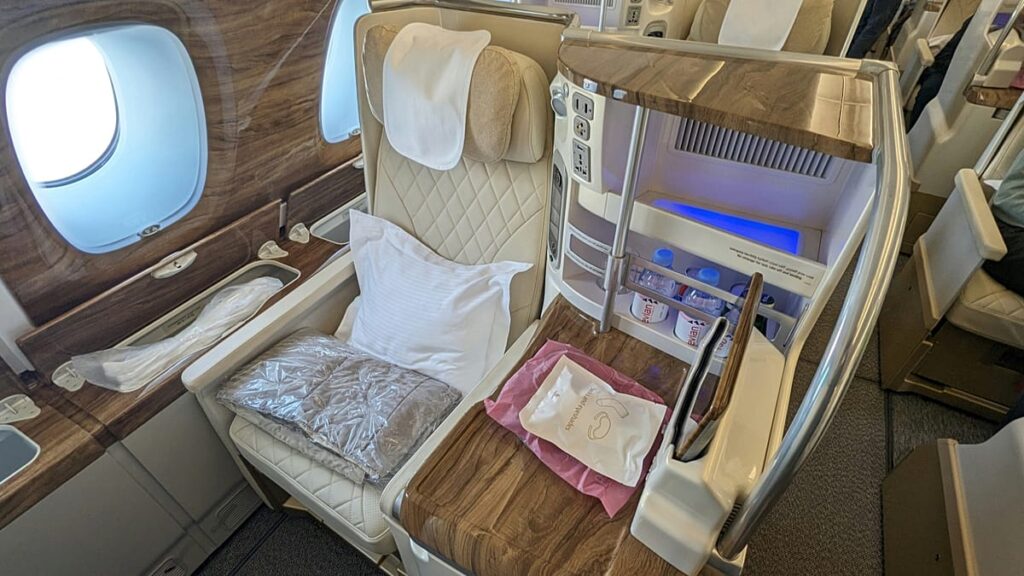
Few activities in modern life have a larger carbon footprint than air travel, and within this sector, business and first-class passengers contribute disproportionately to emissions. According to the International Air Transport Association (IATA), business and first-class seats are up to five times more carbon-intensive than economy seats. A recent study suggests that eliminating premium seating could significantly reduce global aviation emissions.
The study, published in Nature Communications Earth & Environment, posits that scrapping business and first-class seats, operating only the most fuel-efficient aircraft, and increasing passenger occupancy could cut emissions by 50 to 75 percent. These measures could be implemented without waiting for sustainable aviation fuel (SAF) to become widely available and affordable.
Understanding Aviation’s Carbon Footprint
Flying accounts for approximately four percent of global human-driven emissions. However, emissions vary greatly depending on the aircraft’s efficiency and configuration. The study analyzed over 27 million commercial flights in 2023, covering 26,000 city pairs and nearly 3.5 billion passengers. It found that global aviation emissions averaged 84.4 grams of CO2 per kilometer per passenger in 2023, with some routes emitting as little as 30 grams and others nearly 900 grams.
In 2023, the USA was the highest global emitter with 144.6 million tonnes of CO2, accounting for 25 percent of total emissions. China followed with 49.7 million tonnes, and the UK with 24.1 million tonnes.
Within Europe, the UK led, followed by Spain, Germany, France, and Italy. Norway was noted for operating particularly inefficient flights, often linked to smaller airports and less busy routes, which in some cases are government-funded to maintain connectivity to remote areas.
Challenges and Opportunities in Reducing Emissions
Despite significant efficiency improvements since 1980, when average CO2 emissions per passenger kilometer were 280 grams, the demand for air travel has outpaced these gains. Recent geopolitical conflicts, such as Russia’s invasion of Ukraine, have led to airspace closures, increasing flight distances and fuel consumption. Additionally, efforts to reduce contrails by avoiding certain flight zones could further increase fuel use.
Looking ahead, the potential return of supersonic travel as early as 2029 could exacerbate the situation by reducing fuel efficiency and increasing aviation’s warming impact on the atmosphere.
Reconfiguring Aircraft for Efficiency
The study suggests that reconfiguring aircraft to economy-only seating could increase passenger capacity and reduce emissions by 22 to 57 percent. Ensuring higher passenger occupancy is also crucial. In 2023, average aircraft occupancy was 79 percent, with some flights operating at just 20 percent capacity. Raising this average to 95 percent could cut emissions by an additional 16 percent.
Adopting More Efficient Aircraft
Replacing older aircraft with newer, more efficient models could decrease fuel use by 25 to 28 percent. The study highlights the Boeing 787-9 and Airbus A321neo as the most efficient for long-haul and short- to medium-haul flights, respectively, producing 60 grams of CO2 per kilometer per passenger. In contrast, the least efficient aircraft emitted up to 360 grams per passenger.
“Realistically, this would be a long-term transition – one that could be promoted by policies that reward efficiency,” says Dr. Milan Klöwer from the University of Oxford.
Policy Measures and Future Prospects
To incentivize the transition to more efficient aircraft, the study suggests several policy tools, including SAF fuel quotas, carbon intensity caps, emissions trading schemes, and emissions ratings for airlines. Adjusting air passenger duties and landing fees based on aircraft performance could also play a role.
Airlines could achieve an immediate 11 percent reduction in emissions by prioritizing their most efficient aircraft on existing routes. While these changes would need to be implemented gradually, the potential for significant emissions reductions is clear.
The conversation around decarbonizing air travel is gaining momentum, and the findings of this study could influence future industry practices and policies. As the world grapples with the urgency of climate change, the aviation sector’s role in reducing emissions is more critical than ever.