



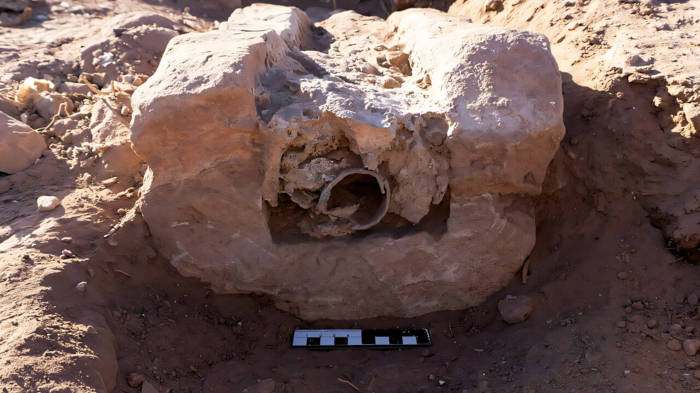
A recent study of Petra’s ‘Ain Braq aqueduct has unveiled a remarkably advanced water-delivery system, featuring a rare lead pipeline that indicates engineers were adept at transporting water under pressure across challenging terrains. The discovery of a previously undocumented 116-meter-long lead conduit is particularly noteworthy, as such materials are uncommon outside buildings in the eastern Mediterranean, suggesting both affluence and technical prowess in the Nabataean capital’s infrastructure.
Petra, located in present-day southern Jordan, is renowned for its rock-cut monuments, yet its ability to thrive hinged on meticulous water management. At its zenith, Petra sustained baths, pools, gardens, and temple water features, necessitating a consistent water supply in its semi-arid environment, as reported by Phys.org.
The Intricacies of Petra’s Water Network
Rather than relying solely on broad reconstructions of Petra’s hydraulic system, researcher Niklas Jungmann from Humboldt-Universität zu Berlin concentrated on a specific area: a 2,500 m² section of the Jabal al-Madhbah massif. This detailed survey revealed a more intricate and dense network of installations than previously acknowledged in that region.
During fieldwork for the Urban Development of Ancient Petra Project (UrDAP) in September 2023, the team documented nine conduits, a large reservoir obstructed toward the city by a high dam, and two cisterns alongside seven basins of varying sizes. The lead conduit appears to belong to a period when pressurized transport was deemed worth the investment. The findings have been published in the journal, Levant.
Why Lead Pipelines Stand Out
In Nabataean systems, terracotta pipes are far more typical, especially for gravity-fed flow. In contrast, lead is smooth, welded, and better suited for high-pressure situations, particularly where an “inverted siphon” principle might be beneficial in steep, uneven landscapes. This is a significant reason why a lead line in Petra’s aqueduct is so striking, as noted by Phys.org.
Jungmann highlights that lead pipelines outside building complexes are extremely rare in the broader region, arguing that the choice of lead signifies substantial investment not just in raw material, but also in fuel and specialist skills. He posits that the objective may have been to transport water up to az-Zantur hill and then onward to Petra’s city center, serving high-demand areas.
Technological Shifts and Economic Decisions
Alongside the pipeline, the survey also documented an unusual retention dam: irregular in outline, tiered in appearance, and lacking a clearly visible pressure outlet on the preserved face. Jungmann suggests the peculiar profile might be partially explained by how builders closed a gap in the sandstone, and notes that Petra’s dams may have been plastered to visually blend into the surrounding rock.
The narrative also includes a “technology pivot.” At some stage, the lead line was sealed and replaced (or bypassed) in favor of a terracotta conduit, likely due to economic and maintenance considerations, given the cost and expertise required to maintain lead systems. This transition serves as a reminder that ancient water engineering was dynamic, evolving with budgets, skills, and the city’s changing needs.
Implications and Future Research
The discovery of the lead pipeline offers fresh insights into the sophistication of Petra’s water management and the broader technological capabilities of the Nabataeans. It underscores the importance of detailed archaeological surveys in uncovering the complexities of ancient infrastructures.
Future research may focus on further exploring the extent of Petra’s hydraulic networks and the technological innovations employed by the Nabataeans. Understanding these ancient systems not only enriches our knowledge of historical engineering but also provides valuable lessons for modern water management in arid regions.
As researchers continue to unravel Petra’s secrets, each new finding adds depth to our understanding of this ancient wonder and its ingenious inhabitants.