



A groundbreaking approach to searching for dark matter candidate particles, known as axions, has yielded the most stringent constraints yet on their interaction with normal matter. Utilizing a network of quantum sensors spread across two cities in China, physicists have refined the possible values of a parameter called axion-nucleon coupling, surpassing limits previously established by astrophysical observations. This advancement not only enhances our understanding of dark matter but also holds potential for probing other phenomena that extend beyond the Standard Model of particle physics, such as axion stars, axion strings, and Q-balls.
Dark matter is believed to constitute over 25% of the universe’s mass, yet it remains undetected directly. Its presence is inferred through gravitational interactions with visible matter and its influence on the universe’s large-scale structure. Despite the Standard Model of particle physics not accounting for dark matter, numerous physicists have proposed methods to integrate it. One promising theory involves axions, hypothetical particles first suggested in the 1970s to address unresolved issues concerning charge-parity violation. Axions are characterized by their lack of charge and significantly lower mass compared to electrons, resulting in weak interactions with matter and electromagnetic radiation.
Unveiling Axion Interactions
Theoretical calculations suggest that the Big Bang should have generated axions in abundance. During early universe phase transitions, these axions would have formed topological defects, which, according to study leader Xinhua Peng of the University of Science and Technology of China (USTC), should be detectable in principle. “These defects are expected to interact with nuclear spins and induce signals as the Earth crosses them,” Peng explains.
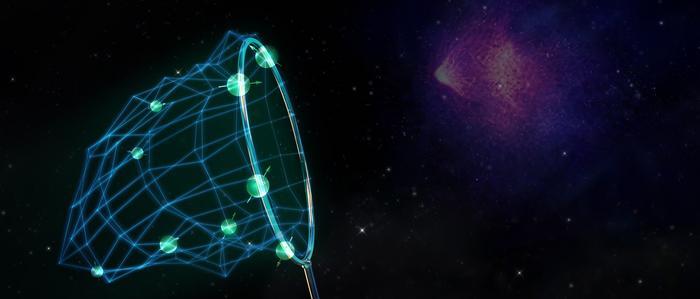
The challenge, Peng continues, lies in the anticipated weak and transient nature of such signals. To address this, Peng and her colleagues devised an alternative axion search method that leverages a different predicted behavior. When fermions, particles with half-integer spin, interact with axions, they should generate a pseudo-magnetic field. Peng’s team sought evidence of this interaction using a network of five quantum sensors, four located in Hefei and one in Hangzhou. These sensors combined a large ensemble of polarized rubidium-87 (87Rb) atoms with polarized xenon-129 (129Xe) nuclear spins.
Advantages of Nuclear Spins
“Using nuclear spins has many advantages,” Peng explains. “These include a higher energy resolution detection for topological dark matter (TDM) axions due to a much smaller gyromagnetic ratio of nuclear spins; substantial spin amplification owing to the high ensemble density of noble-gas spins; and efficient optimal filtering enabled by the long nuclear-spin coherence time.”
The USTC researchers’ setup also boasts other advantages over previous laboratory-based TDM searches, including the Global Network of Optical Magnetometers for Exotic physics searches (GNOME). While GNOME operates in a steady-state detection mode, the USTC researchers employ a detection scheme that probes transient “free-decay oscillating” signals generated on spins after a TDM crossing. The USTC team also implemented a dual-phase optimal filtering algorithm to extract TDM signals with a signal-to-noise ratio at the theoretical maximum.
Setting New Constraints
Peng tells Physics World that these advantages enabled the team to explore regions of TDM parameter space well beyond limits set by astrophysical searches. The transient-state detection scheme also facilitates sensitive searches for TDM in the region where the axion mass exceeds 100 peV—a region that GNOME cannot access.
Although the researchers have not yet recorded a statistically significant topological crossing event using their setup, the dark matter search is far from over. They have, however, established more stringent constraints on axion-nucleon coupling across a range of axion masses from 10 peV to 0.2 μeV. Notably, they calculated that the coupling strength must be greater than 4.1 x 10¹⁰ GeV at an axion mass of 84 peV. This limit is stricter than those obtained from astrophysical observations, though Peng notes that these rely on different assumptions.
“These defects are expected to interact with nuclear spins and induce signals as the Earth crosses them.” – Xinhua Peng, USTC
Implications for Future Research
Peng emphasizes that the technique developed in this study, which is published in Nature, could pave the way for the development of even larger, more sensitive networks for detecting transient spin signals like those from TDM. It also opens new avenues for investigating other physical phenomena beyond the Standard Model that have been theoretically proposed but have so far lacked a pathway for experimental exploration.
As the search for dark matter continues, the advancements made by Peng and her team represent a significant leap forward in our quest to understand the universe’s hidden components. The ongoing refinement of these techniques and the expansion of sensor networks could eventually lead to a breakthrough in detecting dark matter and unraveling the mysteries of the cosmos.