
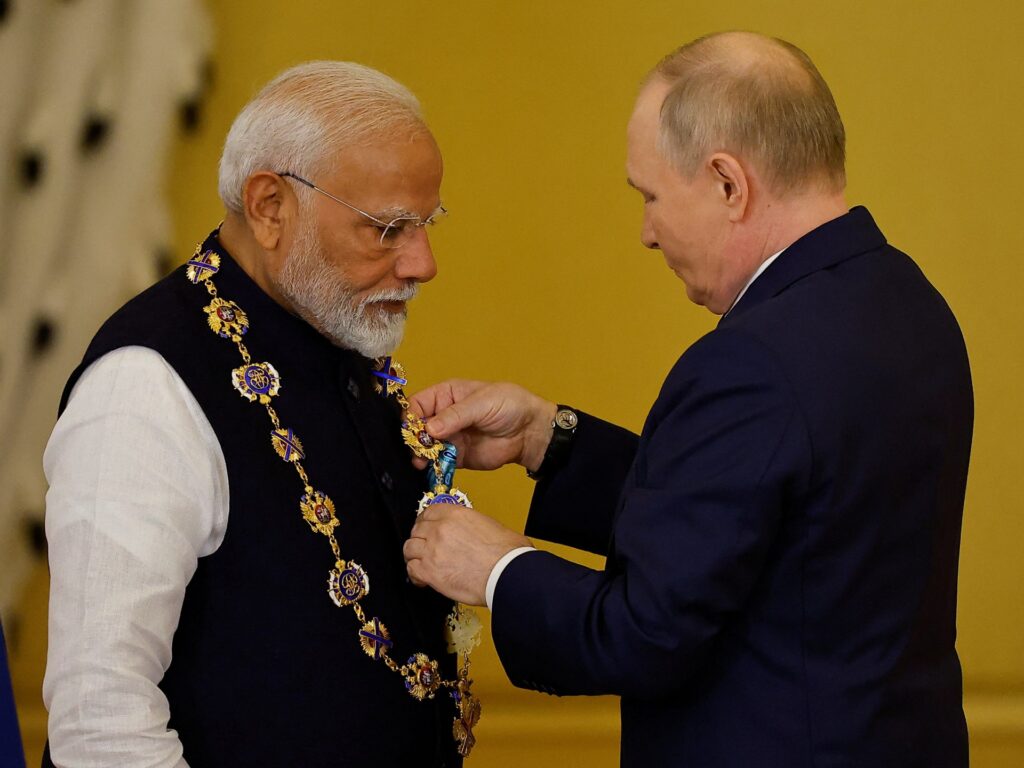
New Delhi, India – Russian President Vladimir Putin is set to visit India on Thursday, marking his first trip to the country since Russia’s full-scale invasion of Ukraine nearly four years ago. This visit comes at a time when efforts by the United States to broker peace in the Ukraine conflict have hit a stalemate, and relations between Washington and New Delhi are experiencing heightened tensions.
Putin’s 30-hour visit coincides with a period of strained ties between the US and India, exacerbated by American tariffs and threats of sanctions. These actions are largely in response to India’s historical ties with Russia and its increased purchase of Russian crude oil during the ongoing Ukraine war. This geopolitical tension underscores India’s delicate balancing act between its traditional ally, Russia, and its growing partnership with the West.
Historical Context and Strategic Balancing
Since gaining independence in 1947, India has maintained a policy of non-alignment, avoiding formal alliances with any superpower. During the Cold War, however, India leaned closer to the Soviet Union. In recent decades, India has strengthened its strategic and military ties with the United States while striving to preserve its friendship with Russia.
Russia’s ongoing conflict with Ukraine has tested this balance, and Putin’s visit may provide insights into how Indian Prime Minister Narendra Modi intends to manage these competing relationships without compromising any of them.
Putin’s Itinerary in India
Putin is expected to arrive on Thursday evening, starting his visit with a private dinner with Modi at the Prime Minister’s residence. On Friday, he will attend a guard of honor at Rashtrapati Bhavan, meet with India’s ceremonial head of state, Droupadi Murmu, and pay respects at Raj Ghat, the memorial to Mahatma Gandhi.
The main event will be the annual India-Russia summit at Hyderabad House, where Putin and Modi will engage in discussions, followed by meetings with business leaders and a banquet hosted by President Murmu. The Kremlin has emphasized the visit’s importance, highlighting the opportunity to discuss the extensive agenda of Russian-Indian relations.
Significance of the Visit
The visit marks 25 years of strategic partnership between India and Russia, a relationship that began during Putin’s first year in office. Despite being portrayed as a steady friendship, the ties have faced pressures from other nations, particularly the United States.
Annual summits between the two countries were disrupted in 2022 due to the Ukraine invasion, with Modi’s planned visit to Russia being postponed. In 2023, Putin skipped the G20 summit in New Delhi, largely due to an International Criminal Court warrant against him. Now, in 2024, the tradition resumes with Putin’s visit to India.
Key Agenda Items
Trade analysts and political experts anticipate that Putin will advocate for India to purchase more Russian missile systems and fighter jets, aiming to bolster defense ties and explore trade expansion in sectors like pharmaceuticals, machinery, and agriculture.
“The summit offers an opportunity for both sides to reaffirm their special relationship amidst intense pressure on India from US President Trump with punitive tariffs,” said Praveen Donthi, a senior analyst at Crisis Group.
For Putin, the summit presents a chance to demonstrate that Russia is not isolated internationally, despite the ongoing war in Ukraine. Rajan Kumar, a professor at Jawaharlal Nehru University, noted that “Russia is being welcomed by a democracy when Putin faces pressure for the war in Ukraine.”
Challenges and Opportunities in Energy Trade
India became the second-largest buyer of Russian crude after the 2022 invasion, with imports increasing by 2,250 percent. Initially encouraged by the US to stabilize global oil prices, India’s continued purchase of Russian oil has now drawn criticism from President Trump, who has imposed tariffs and threatened sanctions.
Reliance, India’s largest private oil refiner, has announced it will cease exporting products using Russian crude, leading to a projected decline in Indian imports of Russian oil. Meanwhile, India has signed a deal to increase its gas imports from the US.
Defense Relations and Future Prospects
Despite challenges in energy trade, defense ties between India and Russia remain robust. Russia is India’s largest defense supplier, accounting for 36 percent of arms imports. While India seeks to diversify its suppliers, Russia’s role as a key defense partner is expected to continue.
“The S-400 was a game changer for India,” said India’s Air Force Chief, Marshal AP Singh, highlighting the importance of Russian defense systems.
India is considering additional purchases of the S-400 system and exploring the acquisition of Russia’s Su-57 fighter jets, described by Dmitry Peskov, Putin’s press secretary, as “the best plane in the world.”
Future Trade and Labor Migration
India-Russia trade has surged from $10 billion to nearly $69 billion, driven by oil imports. However, with a trade deficit of $64 billion, experts caution that the goal of reaching $100 billion by 2030 is challenging. Instead, labor migration is emerging as a potential area of cooperation, with Russia seeking Indian workers to fill a projected shortfall of 3.1 million by 2030.
As India negotiates trade deals with the US, the EU, and the Eurasian Economic Union, it must carefully navigate its relationships to avoid antagonizing key partners. Analysts suggest that a peace deal between Russia and Ukraine could alleviate some of these tensions.