



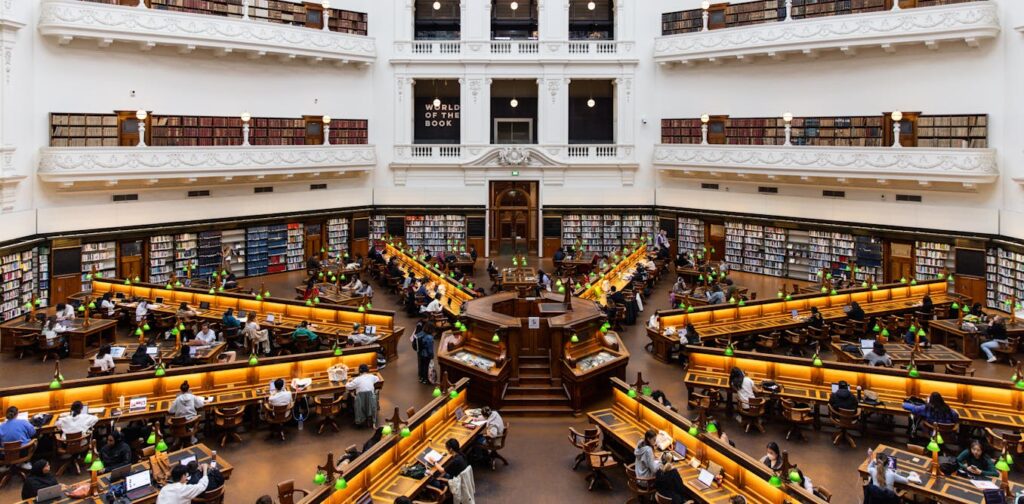
The State Library of Victoria, recently recognized as the third most popular library in the world, is facing significant reductions in staff and services. The proposed cuts include reducing the number of reference librarians from 25 to just ten, eliminating children’s and family engagement officers, and axing digital access officers. Additionally, the number of free computers available to the public will be “dramatically” reduced. These changes could severely impact some of the most vulnerable members of the community who rely on the library for digital access to basic services.
According to staff who spoke anonymously to The Age, there is disagreement with senior management’s arguments that removing these computers will “address safety issues.” The decisions have been made by a predominantly acting executive team and board, many of whom have limited experience or qualifications in library administration. Concerns are further compounded by a lack of transparency, as the changes are based on recommendations from the “SLV Strategic Reorganisation Change Proposal,” whose authors remain unidentified.
Impact on Community Services
The proposed changes contradict a recent report indicating that Australia’s public and state libraries are thriving and providing vital community services, partly due to cost-of-living pressures. Founded in 1854, the State Library of Victoria attracts 2.8 million in-person visitors annually, with an additional 4.5 million online user sessions. Despite its vast reach, the library’s reputation is recovering from recent ideological conflicts over programming, which led to boycotts by prominent Australian writers such as Michelle de Kretser and Tony Birch.
The library’s founding values emphasize inclusion, access, and knowledge transfer. Its mission to “enrich the cultural, educational, social, and economic lives of all Victorians” appears under threat. Staff reductions follow a previous round of cuts in 2019, which reduced the number of librarians from 40 to 25. Now, only ten will remain to serve the public’s information and research needs.
“It shows shocking incompetence and misunderstanding of what we do,” said one staffer. “They want to turn it into a tourism destination,” remarked another.
Libraries as Community Anchors
Libraries are more than just repositories for books; they offer a wide range of services that combat ignorance and isolation. They provide cultural experiences, social connections, and essential community services. During a cost-of-living crisis, these services are needed more than ever.
The reduction in public computers will have serious ramifications. Libraries often provide digital access to individuals who may not have other means to access government entitlements or information related to their basic needs. Interviews with members of South Australia’s unhoused community reveal that they rely on library computers to apply for jobs, maintain social networks, and access health records. For many, the library is the closest thing to a home, a place to feel secure and sheltered from the elements.
“Taking away free computers and cutting digital access officers goes against the library’s mission to enrich the cultural, educational, social, and economic lives of all Victorians,” staff told The Age.
Administrative Challenges and Policy Implications
The library has been under the administration of the Victorian government’s Creative Industries policy portfolio since 2015, when Creative Victoria replaced Arts Victoria. The idea was to position cultural institutions within tech-focused, revenue-generating sectors like film and fashion to share economic benefits. However, researchers in Australia and the UK have found that such measures often fail to deliver on their promises, leading to “unintended consequences” that can be “destructive.”
On the same weekend the cuts were announced, the Allan Labor government pledged A$21 million to support the A$45 million redevelopment of the Bendigo Art Gallery. This juxtaposition raises questions about priorities and the allocation of resources.
The Need for Transparency and Accountability
Responding to concerns raised by library staff, a Victorian government spokesperson stated, “The Library board and leadership are responsible for organizational and staffing matters.” However, Creative Victoria’s website claims “overarching responsibility for this incredible portfolio of state-owned cultural institutions, on behalf of the people of Victoria.” This raises the question of whether there is an opportunity for Creative Victoria to advocate for the library’s mission.
Libraries historian Stuart Kells wrote in 2024: “As public institutions, libraries have a responsibility to be transparent about their decision-making.”
The public, especially those who can least afford to lose access to vital facilities, stands to bear the long-term costs of these cuts. Depriving Victorians of a fully functioning state library risks not only the state’s cultural heritage but also the community’s sense of inclusion, cohesion, and international reputation.