



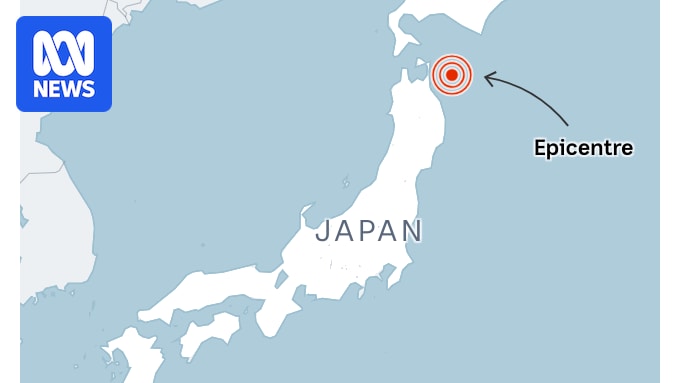
A powerful magnitude-7.6 earthquake struck near Japan’s northeastern coast late Monday night, prompting a tsunami warning that affected a significant portion of the country’s coastline. The Japan Meteorological Agency (JMA) reported that the quake’s epicenter was located in the Pacific Ocean, approximately 80 kilometers off the coast of Aomori Prefecture, at 11:15 PM local time.
The earthquake, which occurred at a depth of around 50 kilometers, raised concerns of a tsunami with waves potentially reaching up to 3 meters in height. The Pacific Tsunami Warning Center extended the alert, indicating that waves could impact areas within 1,000 kilometers of the epicenter, including coastal regions in Russia, Guam, and the Philippines.
Immediate Impact and Government Response
Before midnight, a tsunami of 40 centimeters was recorded at Aomori’s Mutsu Ogawara and Hokkaido’s Urakawa ports, according to the JMA. Smaller tsunamis, ranging between 20cm and 50cm, were observed at several other ports. In response, Japan’s Prime Minister Sanae Takaichi announced the establishment of an emergency task force to swiftly assess and address the damage.
“We are putting people’s lives first and doing everything we can,” Prime Minister Takaichi stated.
Government spokesman Minoru Kihara urged residents to remain in safe locations until the warning was lifted, cautioning that subsequent waves could be more severe. “Even after an initial wave, a second or third wave of an even greater height can arrive,” he warned.
Damage and Safety Measures
Several injuries were reported at a hotel in the Aomori town of Hachinohe, as per public broadcaster NHK. Power outages affected thousands in the region, although Tohoku Electric, which operates a nuclear power plant nearby, confirmed no irregularities at its facility. Similarly, Hokkaido Electric reported that its nuclear power plant remained unaffected.
The tsunami warning specifically targeted the central Pacific Coast of Hokkaido, the Pacific Coast of Aomori Prefecture, and Iwate Prefecture. Meanwhile, a tsunami advisory was issued for the eastern and western parts of the Pacific Coast of Hokkaido, the Japan Sea Coast of Aomori Prefecture, Miyagi Prefecture, and Fukushima Prefecture.
Japan’s Seismic Vulnerability
Japan, situated on the Pacific “Ring of Fire,” is one of the world’s most earthquake-prone countries. The nation experiences a tremor approximately every five minutes, accounting for about 20 percent of the world’s earthquakes with a magnitude of 6.0 or greater. This seismic activity is a constant reminder of the country’s vulnerability and the importance of preparedness.
Historically, Japan has faced devastating earthquakes and tsunamis, such as the 2011 Tōhoku earthquake and tsunami, which resulted in significant loss of life and property. The country’s infrastructure, emergency response systems, and public awareness campaigns have been developed and refined over the years to mitigate the impact of such natural disasters.
Looking Ahead
As the situation unfolds, authorities continue to monitor the affected regions closely. The JMA and local governments are working together to ensure the safety of residents and to provide timely updates. The international community watches with concern, hoping for minimal impact and a swift recovery.
Japan’s resilience and preparedness are once again put to the test as the nation responds to this latest seismic event. The coming hours and days will be critical in assessing the full extent of the damage and the effectiveness of the emergency measures in place.