

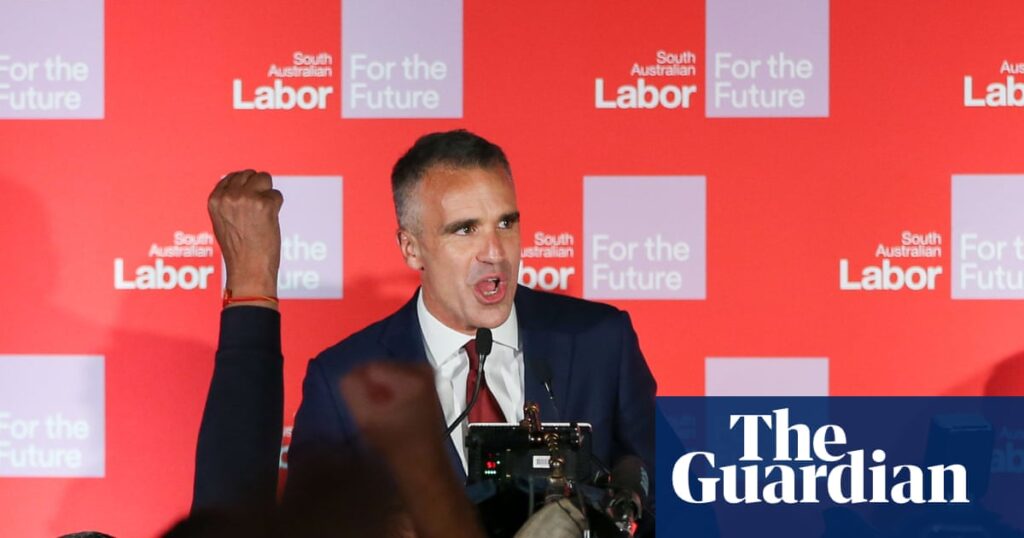
South Australia’s Premier, Peter Malinauskas, has leveraged Labor’s resounding victory in the state election to advocate for a more inclusive and compassionate political climate. In a stirring address, he extended an olive branch to disillusioned One Nation voters and pledged to collaborate across party lines during his second term in office.
The Labor leader managed to expand his majority in Saturday’s election, even as One Nation’s influence surged, leaving the Liberal opposition with only a handful of seats. As the vote count progressed late into the night, Labor was poised to secure at least 32 of the 47 seats in the parliament. The Liberals appeared likely to win at least four seats, while independents were expected to claim at least four more. One Nation was on track to capture the seat of Hammond in Murray Bridge, with several other seats still undecided.
Malinauskas’ Vision for South Australia
Quoting the iconic Australian poet Henry Lawson, Malinauskas called on South Australians to embrace patriotism and mutual care. “When we all combine, we can achieve anything,” he declared. “When we work together, diversity has always been our greatest strength. If we focus on what unites us – a shared love of living in a peaceful, prosperous place, a state full of hard-working people that value care and compassion – then we can harness this moment with our newfound confidence.”
Labor’s victory was underscored by securing nearly 38% of the primary vote, outpacing One Nation’s 21% and the Liberals’ 19%. The election outcome has prompted Pauline Hanson, One Nation’s federal leader, to assert that her party’s MPs would pose significant challenges for Labor in parliament. “I think the rest of Australia is going to be watching what’s happening here tonight,” Hanson remarked, highlighting the potential implications for upcoming elections.
Challenges and Reflections for the Opposition
The election results delivered a severe blow to the Liberal Party, with opposition leader Ashton Hurn conceding defeat to Malinauskas before 9:30 PM. The loss was particularly stinging for former leader Vincent Tarzia, who lost his seat of Hartley. “It’s a tough night for the Liberals,” Hurn admitted. “There’s absolutely no doubt about it, that things are tough. And lessons must be learnt. There are a lot of things that we need to reflect on.”
Political scientist Luke Mansillo from the University of Sydney noted the significance of the election results, suggesting they could indicate a major shift in Australian politics. “It’s unquestionably a potential realignment of Australian politics. We don’t know about its longevity,” he said. Mansillo pointed out that One Nation’s success mirrored its performance in the 1998 Queensland election, where the party won 11 seats.
Historical Context and Future Implications
The Labor Party entered the campaign as the favorite, buoyed by Malinauskas’ personal popularity and the Liberal Party’s internal turmoil. Labor held 29 of the 47 state seats before the election, with five seats controlled by independents. A record 35% of voters cast their ballots before election day, a significant increase from the 17% in the 2022 poll.
The Liberals had turned to Hurn late last year after internal polling suggested an electoral disaster was imminent, making him the party’s fourth leader in four years. Malinauskas now has a mandate to pursue a second-term agenda focused on building more homes, offering free public education, and reducing children’s screen time.
Despite the Liberals’ strategy of directing preferences to One Nation over Labor, Hanson chose to run open tickets on their how-to-vote cards. The election was also the first under new state electoral laws banning donations to political parties.
Federal Labor will be closely monitoring the results, but the federal Coalition, including opposition leader Angus Taylor and new Nationals leader Matt Canavan, will be particularly attentive to One Nation’s performance.
Counting was expected to continue until 1 AM on Sunday morning, with the final results likely to shape the political landscape in South Australia and beyond.