

Upon entering the Art Gallery of Western Australia (AGWA), visitors are immediately greeted by a striking large-scale photograph that fills an entire wall. It depicts a donkey standing serenely in a dinghy, setting the tone for Italian artist Paola Pivi’s vibrant new exhibition, I don’t like it, I love it.
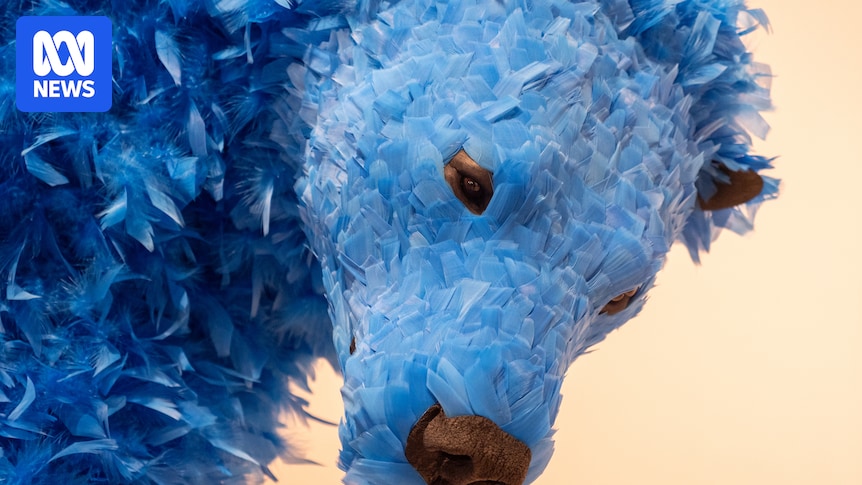
As attendees proceed into the gallery’s central atrium, they encounter a towering 14-meter comic-strip cell, an homage to Lincoln Peirce’s Big Nate, emblazoned with the phrase, “One Picture is Worth a Thousand of Those Suckers”. Nearby, fluorescent feathered polar bears leap and dangle from the ceiling, while adjacent walls display colorful murals with messages like “Free Humans” and “God let me hunt”.
The Creative Vision Behind the Exhibition
The exhibition’s title, I don’t like it, I love it, was conceived by Pivi’s husband, a Tibetan songwriter. “Words come out of his mouth in a very beautiful way, and so I always ask him to give me titles,” Pivi explains.
Curator Robert Cook, who collaborated with Pivi for over 18 months to create the show, emphasizes the accessibility and interpretive nature of her work. “She makes work that just, like, stops you in your tracks, and really holds you, and it allows you to have a relationship with it,” Cook says. “You don’t feel like she is setting up a bunch of shrouds that you need to push through to get what it’s about.”
The Donkey in the Boat: A Story of Curiosity
The photograph of the donkey in a boat, taken by Pivi in 2003 on the island of Alicudi, north of Sicily, is a testament to her ability to capture the unexpected. “It’s a real donkey in a real boat, no Photoshop used,” Cook notes. “Occasionally, when the donkeys need to be transported themselves from one area of the island to the opposite area, then they are put on these small boats and brought around by going close to the coast.”
Such imagery invites viewers to ponder the donkey’s journey, sparking questions about its purpose and destination.
Exploring Themes of Art and Environment
Further into the gallery, the giant comic strip, crafted from inflatable tubes of fabric, soars through the atrium. This homage to comic-strip art reflects Pivi’s belief in the power of visual storytelling. “I truly believe that the messages and stories that are inside artworks cannot really be translated into language made by words and sentences,” she asserts.
Bears as Environmental Ambassadors
In the surrounding galleries, Pivi’s feathered polar bears, inspired by her move to Alaska in 2006, convey a message about climate change. “Originally I wanted to do a sculpture of a polar bear and a grizzly bear dancing together,” Pivi shares. “Later on, when the polar bears became ambassadors of the dramatic changes, then my art started to represent this message from the planet.”
The bears, newly created for AGWA, were assembled on-site, with Pivi’s team meticulously applying feathers to each sculpture. “I really think that global warming is a catastrophic change that we should be concerned about and focus on more,” Pivi emphasizes.
From Science to Art: Pivi’s Journey
Pivi’s path to becoming an artist was unconventional. Initially studying chemical engineering, she eventually realized her true passion lay elsewhere. “I was enrolled. I was talented in it. I was very slow in studying that subject. And I was very sad,” she recalls. “But finally, after five years of that, I decided that I had to let it go.”
Her transition to art was fueled by curiosity and a desire to explore new creative avenues. “I just started to sniff around art and feeling curiosity and attraction and fascination,” she says.
AGWA: A Platform for Experimentation
For Cook, Pivi’s exhibition exemplifies AGWA’s mission to showcase uncompromising contemporary art that engages a diverse audience. “To be given this opportunity to have so much of my art brought forward … and to try new things — and to experiment also with the danger that it might be wrong — to be given these chances and to try for real, that’s great,” Pivi reflects.
The exhibition also highlights the architectural beauty of AGWA’s 70s brutalist building, particularly through the installation Love Addict, where 999 clear trays filled with colored liquid are suspended from the ceiling. “The screens will be open, letting the sunlight in, and … it’s like walking through a Mondrian or something,” Cook describes.
As visitors navigate Pivi’s imaginative world, they are invited to engage with art in a way that is both thought-provoking and visually stunning, leaving a lasting impression long after they exit the gallery.