




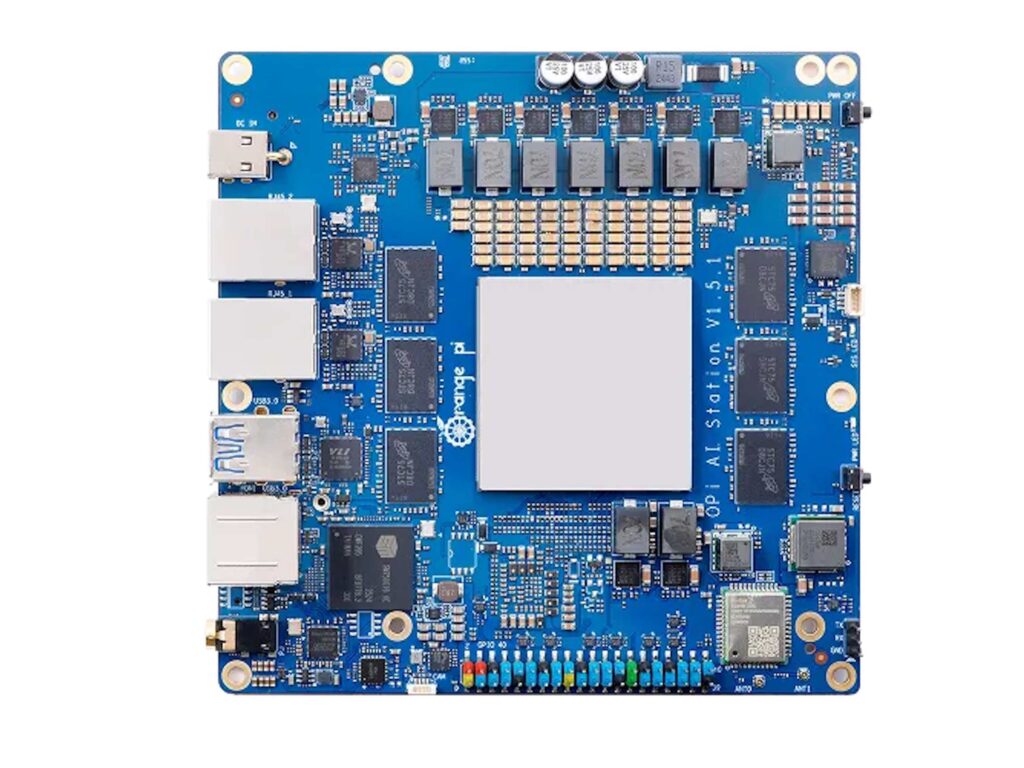
The Orange Pi AI Station has arrived, marking a significant advancement in the realm of single-board computers (SBCs). Officially classified as a mini PC by its manufacturer, this innovative device offers a versatile platform for custom projects, particularly appealing to the do-it-yourself (DIY) community. The system operates on openEuler 22.03, with video output capabilities through HDMI at Full HD resolution and 60 frames per second.
At the heart of the Orange Pi AI Station is the Huawei Ascend 310 System on Chip (SoC), which features a Neural Processing Unit (NPU) with 10 AI cores, 16 CPU cores clocked at 1.9 GHz, and 8 vector cores. The device boasts an impressive AI performance of 176 TOPS, positioning it as an ideal solution for AI-intensive applications that require local execution. Potential use cases include real-time image analysis for crowd monitoring and the rapid identification of hazardous areas.
Technical Specifications and Capabilities
The Orange Pi AI Station offers two configurations of LPDDR4X RAM, with capacities of either 48 GB or 96 GB. Storage options include support for up to 256 GB of eMMC, SD cards, and PCIe SSDs. Networking capabilities are robust, featuring dual Gigabit Ethernet ports and WiFi connectivity. Additionally, an active fan can be installed to manage thermal performance. The device also includes a 40-pin GPIO header, enabling users to control peripherals such as motors or alarms.
By the Numbers: The Orange Pi AI Station’s AI performance reaches 176 TOPS, significantly outpacing many of its competitors in the SBC market.
Comparisons and Market Position
This release comes as the Raspberry Pi 5 continues to dominate the SBC market, known for its affordability and versatility. However, the Orange Pi AI Station’s advanced specifications, particularly its AI capabilities and memory options, set it apart as a powerful alternative for more demanding applications. While the Raspberry Pi series has historically been favored for educational and hobbyist projects, the Orange Pi AI Station targets a niche that requires higher computational power and AI processing.
According to industry experts, the Orange Pi AI Station could redefine the landscape for single-board computers, especially in sectors requiring advanced AI processing. “The Orange Pi AI Station is a game-changer for developers working on AI projects,” said Dr. Emily Chen, a computer science professor specializing in AI technologies. “Its ability to handle complex tasks locally without the need for cloud computing resources is a significant advantage.”
Future Implications and Availability
The introduction of the Orange Pi AI Station suggests a shift towards more specialized SBCs that cater to specific technological needs, particularly in AI and machine learning. This development could inspire further innovation in the field, encouraging other manufacturers to enhance their offerings.
Despite the excitement surrounding its capabilities, Orange Pi has yet to announce the pricing and availability details for the AI Station. As the market eagerly awaits this information, potential users are already considering the possibilities that this powerful device could unlock in various domains, from industrial automation to advanced robotics.
In conclusion, the Orange Pi AI Station represents a significant leap forward in single-board computing, offering unprecedented power and flexibility for AI applications. As we anticipate further announcements from Orange Pi, the industry watches closely to see how this new player will influence the future of computing technology.