



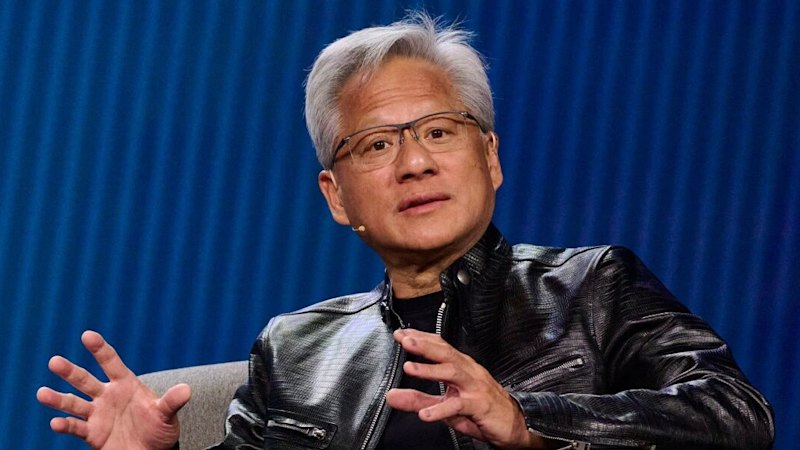
Las Vegas, Nevada: Nvidia chief executive Jensen Huang, the Taiwanese-American billionaire and the world’s ninth-richest person with an estimated net worth of $US170 billion, has no plans to step down from leading the world’s most valuable company. Speaking after his keynote address at the Consumer Electronics Show in Las Vegas, Huang attributed his 32-year tenure to a simple mantra: “don’t get fired, and don’t get bored.”
During the event, Huang, 62, announced that Nvidia’s next-generation Vera Rubin AI chip platform is now in “full production,” months ahead of Wall Street expectations. This announcement underscores Nvidia’s pivotal role in the tech industry, particularly as it alone comprises roughly 8 percent of the S&P 500 index, with a market capitalization equivalent to Germany’s GDP.
Jensen Huang’s Remarkable Journey
Huang’s rise to becoming one of the world’s wealthiest individuals is a quintessential American success story. Born in Taipei in 1963, he moved to the United States at age nine. A mix-up led him to Oneida Baptist Institute in rural Kentucky, a reform school where he faced challenging circumstances. Despite these early adversities, Huang excelled academically, graduating from high school at 16, and later studying electrical engineering at Oregon State University.
While working the graveyard shift at a Denny’s diner, Huang and two university friends founded Nvidia in 1993. Today, the company is a cornerstone of the artificial intelligence revolution, with its graphics processing chips powering technologies from ChatGPT to autonomous vehicles.
Nvidia’s Strategic Position in the Tech Landscape
The announcement of the Vera Rubin platform, named after the astronomer who revolutionized galaxy motion understanding, promises significant advancements in AI training efficiency. Huang claimed that a 10 trillion-parameter model can now be trained in one month using one-quarter of the chips compared to its predecessor, Blackwell.
“Demand for Nvidia GPUs is skyrocketing,” Huang stated. “Models are increasing by a factor of 10, an order of magnitude, every single year.”
However, Nvidia faces mounting competition. Advanced Micro Devices is gaining traction with major clients like OpenAI and Oracle, while tech giants such as Google, Amazon, and Microsoft are developing their own chips through collaborations with Broadcom, whose market value has surged past $US1.6 trillion.
Investor Concerns and Market Dynamics
Despite Nvidia’s impressive market position, the company has no publicly disclosed succession plan, raising concerns among investors about potential market volatility should Huang depart. Governance experts warn that his exit, planned or otherwise, could trigger unprecedented shifts in financial markets.
Meanwhile, Nvidia’s stock has dipped 8 percent from its October peak, losing approximately $US460 billion in market value. Nonetheless, Wall Street analysts remain optimistic, with 76 out of 82 rating it a ‘buy’.
Huang appears unfazed by these challenges. He emphasized Nvidia’s unique position as “the smallest large company in the world,” employing just 40,000 people with notably low turnover rates.
“We have supply chain partners and collaboration partners all over the world who are counting on us to do our part,” Huang said. “There’s a great responsibility that comes with our company.”
Looking Ahead
As Nvidia continues to navigate the complex landscape of the tech industry, Huang’s leadership remains a critical factor in its ongoing success. His ability to adapt and innovate will be essential as the company faces both opportunities and challenges in the rapidly evolving world of artificial intelligence and semiconductor technology.
The future of Nvidia, much like its CEO’s journey, is a testament to resilience, vision, and the relentless pursuit of excellence. As the company forges ahead, the tech world watches closely, anticipating the next chapter in this remarkable story.