



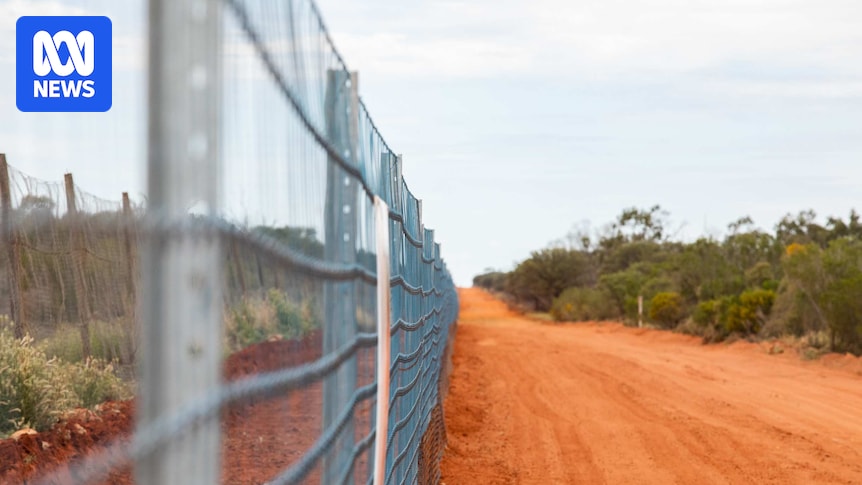
In a move that has left local graziers frustrated and concerned, the New South Wales government has halted the ambitious 400-kilometer Wild Dog Border Fence project, initially proposed to curb the movement of wild dogs across the NSW-Queensland border. The decision, announced informally to local officials, comes after only 23 kilometers of the planned extension were completed, despite the project being in the works for seven years.
Sheep grazier Kylie Baty, whose property near Hungerford is frequently threatened by wild dogs, expressed her disappointment. “Some weeks it can be the equivalent of two to three days’ labor,” she explained, highlighting the ongoing struggle to protect her livestock. “It’s not just the case of going out into a paddock and setting a trap.”
Community Discontent and Government Response
The project, valued at $37.5 million, was a beacon of hope for local communities when it was proposed by residents in 2018. However, Bourke Shire Mayor Lachlan Ford disclosed that he was informed of the project’s cancellation in early 2025, not by the state government, but through third-party correspondence.
“We’re very disappointed and angry,” Mayor Ford stated. “This is a project the residents out here have wanted for a long time.” The council has been actively seeking clarity on the decision for nearly a year, and intends to lobby for the project’s revival, maintaining direct communication with NSW Agriculture Minister Tara Moriarty.
Meanwhile, graziers like Ms. Baty are left to reconsider their options. She is contemplating the installation of a pest control fence, albeit with reservations about the financial viability. “It’s a huge cost and we’re still working out whether the long-term benefits will offset the up-front costs,” she noted.
A Project with a Troubled History
Wanaaring grazier Neill Leigo recalled the initial excitement when both NSW Labor and the Coalition pledged funding for the fencing project ahead of the 2019 state election. “That money was given to the NSW Soil Conservation Service, and they were tasked with designing and erecting the fence,” he said.
However, progress has been slow, with only 32 kilometers of new fencing erected along the South Australian border and 23 kilometers on the Queensland border. In August of the previous year, a 32-kilometer section was completed to close a gap between the Queensland and South Australian fences, creating a continuous 2,700-kilometer barrier from the Great Australian Bight to Hungerford.
Mr. Leigo, a long-term member of the NSW Border Fence Maintenance Board, emphasized the fence’s potential benefits, including restricting feral pig and goat movements, enhancing community safety, and protecting livestock industries further east. However, he acknowledged that delays might have inflated the project’s costs beyond the initial budget.
Government’s Justification and Future Implications
In a statement, a spokesperson for the NSW Department of Primary Industries and Regional Development (DPIRD) explained the decision to halt the project. “This best practice approach has led to the decision to not spend taxpayer funds on any new dog fence along the Queensland border because of the project’s high costs and low benefits in return,” the spokesperson said.
Instead, the remaining funds have been allocated to contract the South Australian government to construct up to 290 kilometers of new fencing, an extension included in the 2019 proposal. The spokesperson also noted that NSW is investing $1.05 billion in biosecurity this year, with more than $40 million spent on feral and pest animal control over the past three years.
Despite these efforts, graziers argue that the absence of a comprehensive fence leaves properties east of Hungerford increasingly vulnerable. “Quite often, the ramifications of a dog attack aren’t just immediate death of the animal, it’s severe injury which causes prolonged, likely agonizing death,” Ms. Baty lamented. “It’s heartbreaking to see a wild dog attack on your animals, especially as we care for them so much.”
The decision to halt the fence project not only impacts local graziers but also raises questions about the future of pest control and livestock protection in the region. As the Bourke Shire Council continues to advocate for the project’s revival, the affected communities remain hopeful for a solution that balances economic feasibility with effective pest management.