


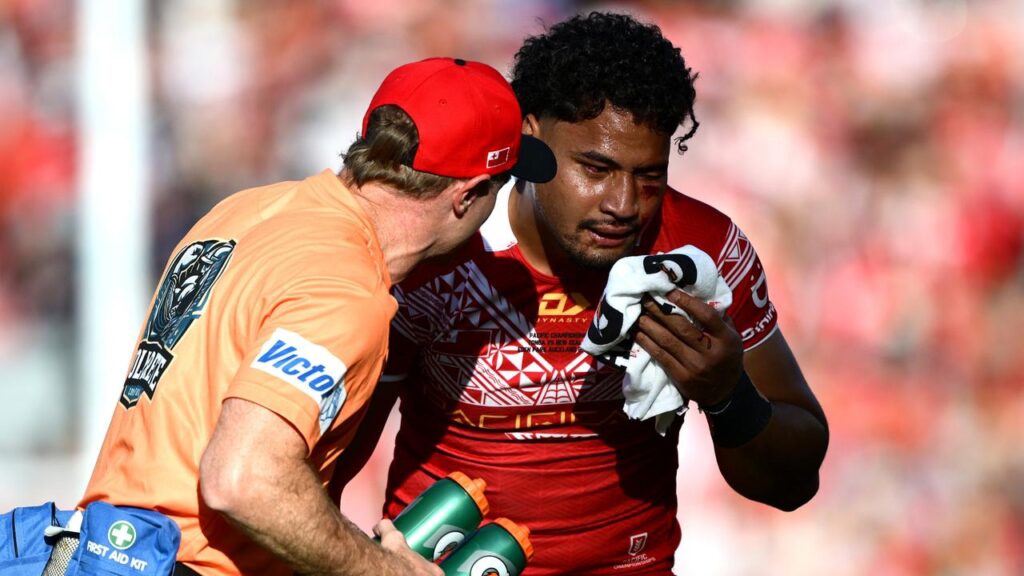
The National Rugby League (NRL) has announced the findings of its investigation into the events leading to Eliesa Katoa’s hospitalization, issuing four breach notices to officials of the Tongan XIII team. Katoa, a star player for the Melbourne Storm, suffered three head knocks during Tonga’s Pacific Championships match against New Zealand on November 2, which resulted in emergency brain surgery following a seizure on the sideline.
Upon his return from Auckland to Melbourne, the Storm declared Katoa out for the 2026 season. The NRL released a statement on Monday addressing the situation, emphasizing their continued support for Katoa and his family during his recovery. The statement highlighted several serious concerns regarding potential breaches of NRL rules and protocols by individuals involved in Katoa’s treatment.
“The investigation has identified a number of serious concerns regarding possible breaches of the NRL Rules and protocols by a number of individuals in the way that Mr. Katoa was treated,” the NRL statement read.
Investigation Findings and Breach Notices
The NRL’s investigation pointed to a potential breakdown in communication among medical and health professionals responsible for Katoa’s safety. The report criticized the failure to share and disclose critical information vital to the player’s health. The NRL stressed that its rules and protocols are designed to protect player safety and wellbeing and must be adhered to strictly.
As a result, breach notices were issued to Tonga XIII’s head doctor, assistant doctor, and the orange shirt trainer, who serves as the head trainer. Each faces proposed penalties of a 24-month ban from any involvement with Australian Rugby League Commission (ARLC) or NRL-related competitions. Meanwhile, the yellow shirt trainer, acting as a medical assistant, received a formal warning.
“All individuals will also be required to undergo further training on their responsibilities under the NRL Rules and the NRL’s policy for the management of possible head injuries and concussion,” the statement added.
Context and Background
The incident involving Katoa has brought renewed focus on the handling of head injuries in rugby league, a sport that has faced increasing scrutiny over player safety in recent years. The NRL has implemented stringent protocols to manage concussions and head injuries, reflecting a broader trend in contact sports worldwide to prioritize athlete health.
Historically, rugby league, like many contact sports, has grappled with the long-term effects of repeated head trauma on players. The NRL’s current policies are part of a global movement to address these concerns, informed by medical research linking concussions to chronic traumatic encephalopathy (CTE) and other serious health issues.
Expert Opinions and Future Implications
Experts in sports medicine have lauded the NRL’s proactive stance in enforcing its safety protocols. Dr. Sarah Thompson, a leading sports injury specialist, commented on the importance of strict adherence to concussion management guidelines.
“The health and safety of players must always be the top priority. The NRL’s actions send a strong message about the seriousness of these protocols,” Dr. Thompson stated.
Looking ahead, the breach notices and subsequent penalties could serve as a precedent for how similar cases are handled in the future. The NRL’s firm response may encourage other sporting bodies to review and strengthen their own policies regarding player safety.
Next Steps
The four members of Tonga’s medical staff have the opportunity to respond to the breach notices. Their responses could influence the final outcome of the penalties imposed. Meanwhile, the NRL’s commitment to player welfare continues to shape the landscape of rugby league, with ongoing discussions about improving safety measures and ensuring compliance with established protocols.
As the rugby league community awaits further developments, the case of Eliesa Katoa underscores the critical need for vigilance and accountability in the management of player health, particularly concerning head injuries.