



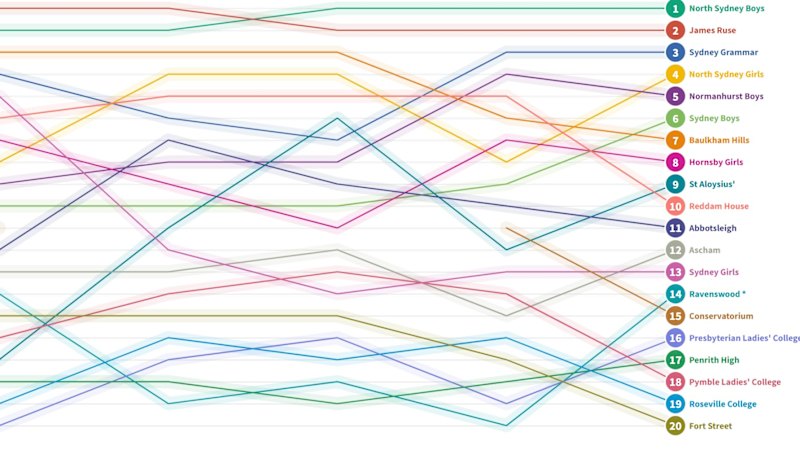
North Sydney Boys High School has once again claimed the top spot in the New South Wales Higher School Certificate (HSC) rankings, marking its third consecutive year of academic dominance. This achievement solidifies the school’s reputation for excellence and sets a new benchmark in educational success.
Close on its heels, James Ruse Agricultural High School secured the second position, maintaining a fierce rivalry with North Sydney Boys. Both schools have consistently outperformed others, creating a league of their own in the top 10 rankings. Sydney Grammar emerged as the leading private institution, achieving third place for the second year in a row, while North Sydney Girls matched their best performance in a decade, securing fourth place.
Public vs. Private School Performance
Public selective schools dominated the top 10, occupying seven spots, while private institutions such as St Aloysius’ College and Reddam House completed the list. Notably, girls’ schools like Abbotsleigh, Ascham, and Sydney Girls also made significant strides.
This year saw a notable increase in the proportion of students from both public and private girls’ schools achieving marks of 90 percent or higher. Single-sex female schools claimed nearly half of the top 50 positions, highlighting a trend towards academic excellence in these environments.
The Herald ranks schools by calculating their HSC success rate, which is the number of top band results—student subject marks of at least 90—as a proportion of the total number of subject attempts at that school.
Success Rates and School Highlights
North Sydney Boys achieved a success rate of 71.6 percent, a significant increase of over six percentage points from the previous year. James Ruse followed closely with a 70.4 percent success rate, a performance that would have surpassed North Sydney Boys’ achievements last year.
Brian Ferguson, the principal of North Sydney Boys, expressed his joy and surprise at the results. “Every page I turned, when I saw how well they did, I was almost in tears of joy,” he said. “We just didn’t know what to expect. I was just grateful they’re going to have these opportunities, and I know that they’re going to be happy because they’re going to see that hard work, collaboration pays off.”
Elsewhere, Caringbah High in the city’s south recorded the most significant improvement, with a 14 percentage point rise in students scoring marks of 90 or more. This was largely due to the exceptional performance of its legal studies students.
Trends and Future Implications
Private boys’ school Newington College, set to admit girls next year, achieved its best result in a decade, jumping 75 places to rank 52nd. Comprehensive public school Crestwood High in Baulkham Hills also made significant gains, moving up 71 places to 165th with a success rate of 11.4 percent.
Girls’ school Ravenswood climbed 26 places to 14th in the state, with students excelling particularly in English extension 1 and textiles. Year 12 student Kaitlyn Wee credited her success to her teachers’ feedback, while her classmate Zara West noted a significant improvement in her creative writing skills after taking her teachers’ advice.
Jennifer Richardson, Ravenswood’s deputy principal for teaching and learning, emphasized the importance of a positive education framework. “I think the cohort itself is a very collaborative and cohesive group, we talked to them about how flourishing is not a solo endeavour,” she said.
This year’s strong results for single-sex schools come as several high-fee private schools consider transitioning to co-education. The trend raises questions about the future landscape of education and the potential shifts in school rankings.
Historical Context and Analysis
The HSC, now in its 58th year, has seen a decline in the number of public comprehensive schools ranking in the top 100. Of the top 300 schools in the Herald’s league table, only 64 were public comprehensives, a decrease from last year. Meanwhile, independent schools accounted for 136 places, and Catholic schools took up 64 positions, indicating a shift in educational dynamics.
As schools continue to adapt to changing educational demands and societal expectations, the competition for top HSC rankings remains fierce. The ongoing debate between the merits of public versus private education is likely to intensify, with stakeholders closely monitoring future developments and their implications on student outcomes.
The results not only reflect the academic prowess of these institutions but also highlight the evolving strategies and frameworks that schools are adopting to foster student success. As the educational landscape continues to evolve, the focus remains on providing students with the necessary tools and opportunities to excel.