



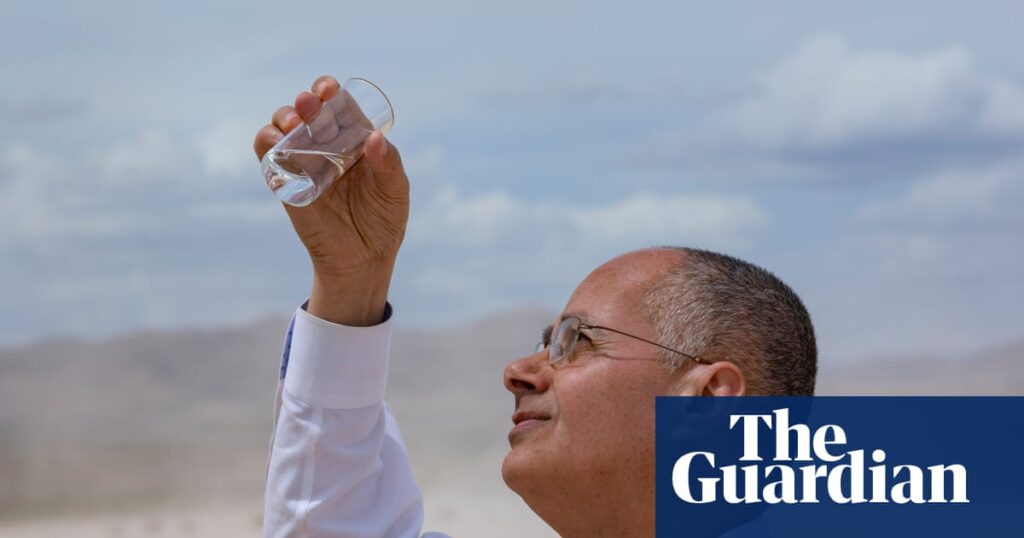
A groundbreaking invention by Nobel laureate Prof Omar Yaghi promises to revolutionize water accessibility in disaster-prone regions. Utilizing a scientific approach known as reticular chemistry, Yaghi has developed a machine capable of extracting moisture from the air, even in the most arid conditions. This innovation could prove vital for islands vulnerable to hurricanes and droughts, providing a sustainable solution when traditional water supplies are compromised.
Yaghi’s invention, developed through his company Atoco, is designed to function independently of centralized electricity and water sources. Comparable in size to a 20-foot shipping container, these units are powered by ultra-low-grade thermal energy and can produce up to 1,000 liters of clean water daily. This capability is particularly significant for regions like the Caribbean, where hurricanes such as Beryl and Melissa have left thousands without water.
Revolutionizing Water Supply in Vulnerable Regions
Prof Yaghi, awarded the Nobel Prize in Chemistry in 2025, believes his invention could transform water supply systems, especially for island nations frequently hit by extreme weather events. “Hurricanes such as Melissa or Beryl unleashed heavy flooding, destroying homes and crops and impacting thousands of lives in the Caribbean,” Yaghi stated. “This devastation is a stark reminder of the urgent need for enhanced water supply resilience in vulnerable areas.”
The technology offers a climate-friendly alternative to traditional methods like desalination, which can harm marine ecosystems due to the discharge of concentrated salty brine. Yaghi’s machine, by contrast, provides a sustainable and decentralized solution, crucial for areas where centralized infrastructure is often damaged by storms.
Global Water Scarcity and the Need for Innovation
Yaghi’s invention emerges at a critical time, as a recent UN report highlights the severity of global water scarcity. According to the report, nearly three-quarters of the world’s population lives in water-insecure regions, with around 2.2 billion people lacking safely managed drinking water. The report underscores the need for innovative solutions to address these challenges.
“Around 2.2 billion people still lack safely managed drinking water, 3.5 billion lack safely managed sanitation, and about 4 billion experience severe water scarcity for at least one month a year,” the UN report stated.
In the Caribbean nation of Grenada, Yaghi’s technology offers hope, particularly for the islands of Carriacou and Petite Martinique, which were severely affected by Hurricane Beryl in 2024. These islands face a triple threat of storms, drought, and coastal erosion, making the invention’s off-grid capabilities especially valuable.
Local Impact and Future Prospects
Davon Baker, a government official and environmentalist from Carriacou, emphasized the importance of Yaghi’s invention for his community. “The technology’s ability to function off-grid using only ambient energy is particularly compelling for our context,” Baker said. The islands currently rely on importing water from Grenada, a process that is costly and carbon-intensive.
Baker further explained that the atmospheric water-harvesting technology addresses several critical challenges, including the vulnerability of centralized systems to hurricane damage and the need for decentralized solutions that can operate independently of traditional infrastructure.
Yaghi’s personal history adds a poignant layer to his scientific achievements. Growing up in a refugee community in Jordan, he experienced firsthand the challenges of living without running water or electricity. In his Nobel prize banquet speech, he recalled the urgency of collecting water when it was sporadically delivered to his desert community.
“I remember the whisper through our neighbourhood, ‘the water is coming’, and the urgency as I rushed to fill every container I could find before the flow stopped,” Yaghi shared.
Describing his invention as “a science capable of reimagining matter,” Yaghi urged global leaders to support scientific innovation and collaboration. “On climate, the hour for collective action has already arrived. The science is here. What we need now is courage – courage scaled to the enormity of the task – so we may gift the next generation not only carbon capture, but a planet worthy of their hopes,” he concluded.
As the world grapples with increasing water scarcity and climate change, Yaghi’s invention represents a beacon of hope, offering a practical and sustainable solution for communities most at risk. The potential impact of this technology extends beyond immediate relief, paving the way for a more resilient and equitable future in water accessibility.